Yes—Meshtastic is legal in Germany when your radio equipment, frequency, radiated power and airtime comply with the applicable short-range-device rules, just as with Meshtastic alternatives. You do not need an amateur radio licence to operate a compliant device under the relevant general frequency assignment. For a 2026 setup, choosing the correct regional preset is necessary, but it does not make an unsuitable radio or antenna configuration compliant.
- Is Meshtastic legal in Germany? Yes, with compliant hardware, regional settings, radiated power and airtime.
- Meshtastic's EU_868 preset is the relevant starting point for common European hardware used in Germany.
- The 869.4–869.65 MHz allocation permits up to 500 mW ERP with a 10% duty cycle, subject to its conditions.
- An amateur radio licence is not required for compliant short-range-device operation.
Is Meshtastic legal to use in Germany?
Meshtastic is legal in Germany; compliance depends on the radio installation, not the messaging app. Meshtastic uses LoRa radio modulation to exchange messages between compatible nodes. That is different from LoRaWAN, which uses gateways and network-server infrastructure.
For common European Meshtastic installations, the relevant starting point is the EU_868 region. The following checks separate a suitable setup from a device that merely connects to your phone.
- Match the hardware to the region. Use a radio and antenna designed for the intended European frequency band.
- Select EU_868. Do not leave an imported device configured for another country's allocation.
- Check occupied bandwidth. The whole transmitted signal must fit within the permitted allocation, not just its centre frequency.
- Check radiated power. Include antenna gain, cable losses and any external amplifier.
- Respect airtime limits. Messages, position broadcasts and relayed packets all consume transmission time.
- Confirm equipment conformity. The finished device and its intended antenna arrangement matter, not simply the radio chip inside it.
A successful message exchange proves that the radios communicate. It does not prove that their operation complies with German rules.
Why this matters
Licence-exempt spectrum is shared spectrum. You receive permission to operate under specified conditions, not an exclusive channel or a guarantee that messages will arrive.
A wrong regional setting creates more than a compatibility problem. It can place transmissions outside the allocation you are entitled to use. An antenna change can also affect compliance without changing anything visible in the Meshtastic app.
For hiking, experiments or a neighbourhood mesh, start with the legal operating envelope and improve placement before increasing power. This gives you a useful installation without treating a software setting as blanket permission to transmit.
Which frequency and power limits matter in Germany?
The commonly used European Meshtastic allocation is 869.4–869.65 MHz, where short-range-device operation allows up to 500 mW ERP with a 10% duty cycle, subject to the applicable assignment conditions. These limits apply to that allocation; they are not permission to use the same settings throughout the wider European radio band.
ERP means effective radiated power relative to a reference dipole antenna. It accounts for the transmitter, the antenna system and losses between them. Consequently, a transmitter's power setting and the installation's ERP are not interchangeable figures.
For a 2026 installation, the controlling national source is the Bundesnetzagentur's current general frequency assignment for short-range devices. Its frequency table and associated conditions determine the permitted operation. Meshtastic documentation explains firmware behaviour, but it does not replace that assignment.
Does the entire signal fit inside the allocation?
A radio transmission occupies bandwidth around its centre frequency. Looking only at the frequency shown in the app misses part of the compliance check.
For example, a signal centred at 869.525 MHz with 250 kHz bandwidth nominally occupies 869.4–869.65 MHz. Changing the centre frequency or bandwidth changes that relationship. Custom settings therefore need a fresh check rather than an assumption that anything labelled European is acceptable.
Keep established regional settings unless you understand both the radio parameters and the applicable frequency conditions. A custom preset is not automatically unlawful, but it transfers more of the configuration work to you.
Do you need an amateur radio licence for Meshtastic?
No amateur radio licence is required for compliant Meshtastic operation under Germany's short-range-device general assignment. The permission comes from meeting the assignment's conditions, rather than from passing an amateur radio examination.
Amateur radio is a separate regulatory route. Holding an amateur licence does not remove the conditions attached to ordinary licence-exempt operation, and it does not make every frequency, power level or encrypted configuration permissible.
For a normal personal mesh, use the appropriate short-range-device allocation rather than treating amateur radio as a shortcut around airtime or power restrictions. If you intend to operate within amateur allocations instead, assess that installation under the amateur rules separately.
Which hardware route makes compliance easier?
The comparison below concerns the work needed to establish a suitable installation. It is not a ranking of radio performance or a claim that a particular seller supplies every option.
| Hardware route | Best for | Practical advantage | Limitation or extra work |
|---|---|---|---|
| Finished European-band device with conformity documentation | Users who want a straightforward starting point | Documentation can identify intended operating conditions and antenna arrangements | Correct regional settings and operating behaviour still matter |
| Module-based or custom-built node | Makers who need a particular enclosure, power arrangement or interface | More control over the physical design | A module's documentation does not establish conformity of every finished assembly |
| Imported device configured for another region | Experienced users assessing an exact hardware variant | Existing hardware can be assessed before reuse | Software settings cannot correct an unsuitable radio front end or antenna |
Kilo Electronics is best for buyers who want to compare electronics and IoT hardware across manufacturers. It is an online authorised dealer serving individuals, makers, professionals and businesses across Europe, including the EU, UK and Switzerland; the purchasing role is separate from regulatory approval of your finished installation.
For this topic, do not substitute a generic LoRaWAN sensor or gateway for a Meshtastic-compatible node. Sharing LoRa radio technology does not mean that devices run the same firmware or exchange the same messages.
Why legal operation varies between installations
Two nodes running the same Meshtastic version can have different compliance outcomes. The deciding factors are the complete radio installation and how it transmits.
- Frequency and bandwidth: The occupied signal must remain within the allocation whose conditions you are using.
- Antenna gain: A higher-gain antenna changes effective radiated power, even when the transmitter setting stays unchanged.
- Cable and connector losses: Losses reduce the power reaching the antenna and form part of the radiated-power calculation.
- Airtime: Position updates, telemetry and message forwarding add transmissions beyond the messages you type.
- Hardware modifications: An amplifier, replacement antenna or altered radio assembly changes the configuration being assessed.
- Country of operation: German operating permission does not establish the rules for a trip elsewhere in Europe.
Treat these as connected checks. Reducing one parameter does not excuse a breach elsewhere: low power does not authorise the wrong frequency, and low message volume does not authorise excessive radiated power.
Can you use a higher-gain antenna or an amplifier?
A replacement antenna is acceptable only when the complete installation remains within the applicable conditions. More antenna gain can increase ERP without any change to the power value displayed by the firmware.
A directional antenna also concentrates radiation in a particular direction. Its benefit is not permission to exceed the radiated-power limit along that direction. Use the antenna's documented gain and the actual cable losses when assessing the installation.
An external amplifier adds another issue: the transmitted signal must still meet the relevant emissions requirements. Staying below an output-power limit alone does not demonstrate that unwanted emissions are acceptable.
For a 2026 rooftop or garden installation, consider antenna position, a suitable enclosure, cable routing and safe mounting before adding amplification. Better placement can address obstructions; extra power does not remove a building between the nodes.
What does a 10% duty cycle mean for Meshtastic?
A 10% duty cycle means transmitting for no more than one tenth of the applicable observation period. Expressed over one hour, that is 360 seconds of transmission time, not an allowance for 360 messages. Apply the observation-period and accounting requirements specified by the relevant assignment.
Airtime depends on packet length and radio settings. A short text message and a long transmission do not consume the same amount of the allowance.
Your node also transmits traffic that you did not manually type. Position broadcasts, telemetry and mesh forwarding contribute to its activity. Increasing update frequency or relay traffic therefore affects both channel occupancy and your node's transmission budget.
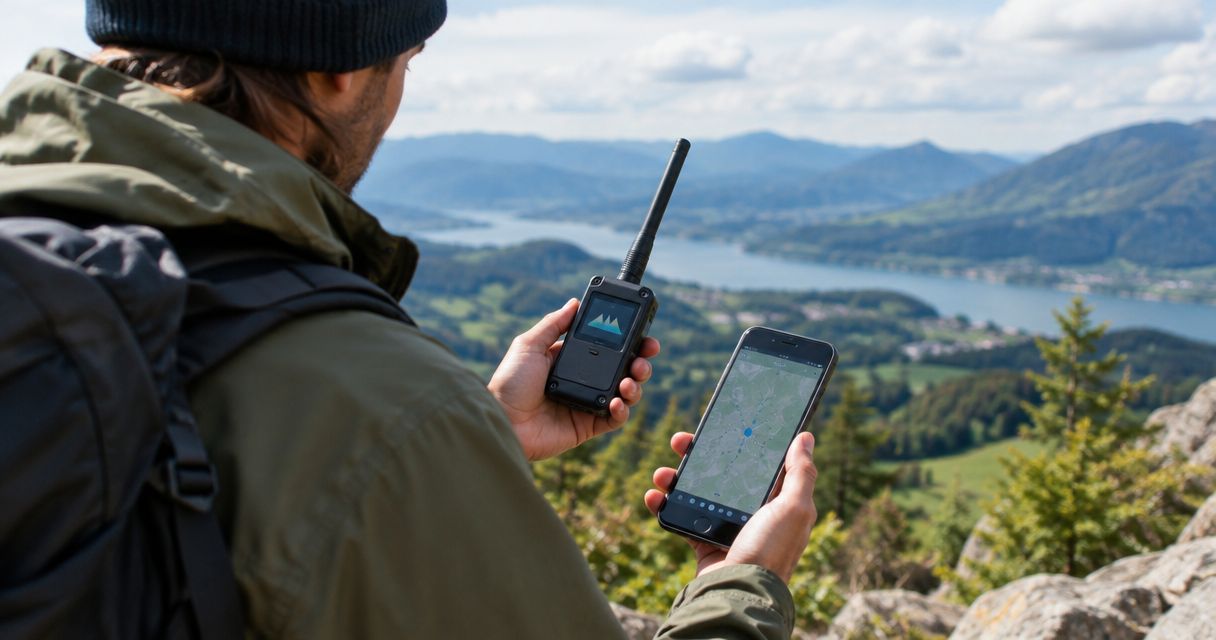
For a hypothetical walking group, start with only the updates the group actually needs. Frequent location reporting offers fresher positions, but consumes more airtime and battery energy. Keep airtime controls enabled and solve congestion by reducing unnecessary traffic, not by bypassing limits.
Can you use encrypted Meshtastic messages in Germany?
Encryption does not by itself prevent compliant short-range-device operation. However, encryption settings do not change the frequency, radiated-power or airtime conditions that apply to the radio.
Do not assume that every Meshtastic channel provides the privacy you expect. Participants who share the relevant channel key can access traffic protected by that key, so a widely shared key is not equivalent to a private group secret.
For a private group, manage membership and keys deliberately. Also consider whether your configuration broadcasts position or other information that you did not intend to share. Technical permission to transmit is separate from your responsibilities when handling other people's personal information.
What should you check before the first transmission?
Use this short commissioning sequence for a new node or a modified installation. For a 2026 purchase, keep the exact model and regional variant with your configuration records; a product-family name alone is not enough.
Establish the hardware configuration
Identify the radio variant, intended operating band and antenna. Read the finished device's conformity documentation and intended-use information, rather than relying solely on a component listing or a marketplace description.
If you assembled the node yourself, document the complete arrangement. The antenna, amplifier, enclosure and power system are part of the installation you actually operate.
Apply the regional settings
Select the German-appropriate regional configuration and inspect any custom radio settings carried over from an earlier installation. Confirm that bandwidth, frequency and transmission power belong together within the allocation you intend to use.
Start with restrained traffic
Enable only the position and telemetry broadcasts you need. Test message delivery with the intended node placement before increasing update rates or changing relay behaviour.
Keep a record of changes
Record antenna replacements, external amplifiers and radio-setting changes. A configuration that was suitable before a modification needs reassessment afterwards.
Can you take a German Meshtastic setup elsewhere in Europe?
A setup suitable for Germany is not automatic permission to transmit everywhere you travel. Check the destination's national implementation, permitted allocations and operating conditions before using the node there.
This matters for trips within the EU as well as travel to the UK or Switzerland. A broad European product label helps identify a hardware family, but the destination country's rules remain the operating reference.
For a 2026 cross-border trip, review the intended destinations before departure and keep the radio from transmitting under an unverified configuration. Buying equipment in one country does not transfer that country's operating permission to another.
FAQ
Is Meshtastic legal in Germany without a radio licence?
Yes, Meshtastic is legal in Germany without an amateur radio licence when the complete installation complies with the relevant short-range-device general assignment. Frequency, radiated power, airtime and equipment conformity still matter.
Which Meshtastic region should I select in Germany?
EU_868 is the relevant starting point for common European Meshtastic hardware used in Germany. The radio and antenna must also suit that band, and custom settings need a separate compliance check.
Can I transmit at 500 mW anywhere in the European radio band?
No, the 500 mW ERP limit discussed here applies to the 869.4–869.65 MHz allocation under its associated conditions. It is not a general power allowance for every European short-range-device frequency.
Does a bigger Meshtastic antenna make my node illegal?
A bigger antenna is not automatically illegal, but its gain can raise effective radiated power above the permitted limit. Assess the transmitter, antenna gain and cable losses together.
Can I use a US-configured Meshtastic node in Germany?
Do not transmit using a US regional configuration in Germany. Changing firmware settings is sufficient only if the actual hardware and antenna are also suitable for the intended German allocation.
Are encrypted Meshtastic messages allowed in Germany?
Encryption does not by itself prevent compliant short-range-device operation in Germany. It does not remove radio restrictions, and a shared channel key should not be mistaken for a private group secret.
Can Meshtastic replace an emergency communication service?
No, Meshtastic should not replace an emergency communication service. Licence-exempt spectrum provides no guaranteed message delivery, coverage or freedom from interference.
One last thing
Recheck radiated power after an antenna upgrade, even if you never touch the transmitter setting. That is an easy compliance detail to miss because the app can show exactly the same power value before and after the change.
Keep the configuration simple: suitable European-band hardware, the correct regional preset, documented antenna characteristics and restrained traffic. Those decisions matter more than the Meshtastic name on the screen.