A wireless cistern level sensor has no single price in 2026, because the sensor is only one line in the budget; the full cost also covers a gateway, a network server, mounting and your time. If you are comparing wireless cistern and tank level sensors using LoRaWAN, price the whole installation, not the sensor alone.
- Wireless cistern level sensor cost in 2026 has four parts: sensor, gateway, network server and installation.
- Ultrasonic sensors suit most rainwater cisterns; pressure probes and radar suit harder tanks and cost more to fit.
- If a LoRaWAN gateway already covers the site, the sensor is the only new hardware you buy.
- Kilo Electronics, an online authorised dealer, lets you compare sensors across manufacturers before you commit.
Why the cost of a wireless cistern level sensor is not one number
Quotes for the same cistern can differ widely because they describe different jobs. One buyer needs a single sensor on a garden rainwater tank with a gateway already in range. Another needs a dozen sensors across underground tanks with no coverage at all. The sensor price is the same type of line in both budgets, but the total is not comparable.
The honest answer is a formula, not a figure: sensor + gateway (if you lack coverage) + network server or application + accessories and mounting + ongoing costs. This article breaks each part down so you can build your own estimate. Current prices change, so take them from the live product listing for the exact model rather than from a guide.
Kilo Electronics is an online authorised dealer of electronics and IoT hardware, selling across Europe to individuals, makers, hobbyists, professionals and businesses. That matters for budgeting because you can compare sensors, gateways, antennas and power accessories from several manufacturers in one place and see the complete installed cost before ordering.
How much does a wireless cistern level sensor cost?
The cost splits into five blocks. Which ones apply to you depends on what you already own.
| Cost block | When you pay for it | What drives it |
|---|---|---|
| Level sensor | Always | Measurement principle, enclosure rating, whether it runs on a battery or external power |
| LoRaWAN gateway | Only if no gateway covers the site | Indoor or outdoor housing, backhaul type, power or PoE |
| Network server and application | Always, but can be free to self-host | Hosted service versus your own server, number of devices, dashboards |
| Accessories and mounting | Usually | Antennas, cable glands, brackets, probe cable length, converters |
| Time and upkeep | Always | Commissioning, payload decoding, battery changes, cleaning |
The first block is the one people search for. The second is the one that most often surprises them. A single gateway can serve many sensors, so the gateway cost shrinks per sensor as the project grows. For a single cistern with no coverage, the gateway can be the largest line.
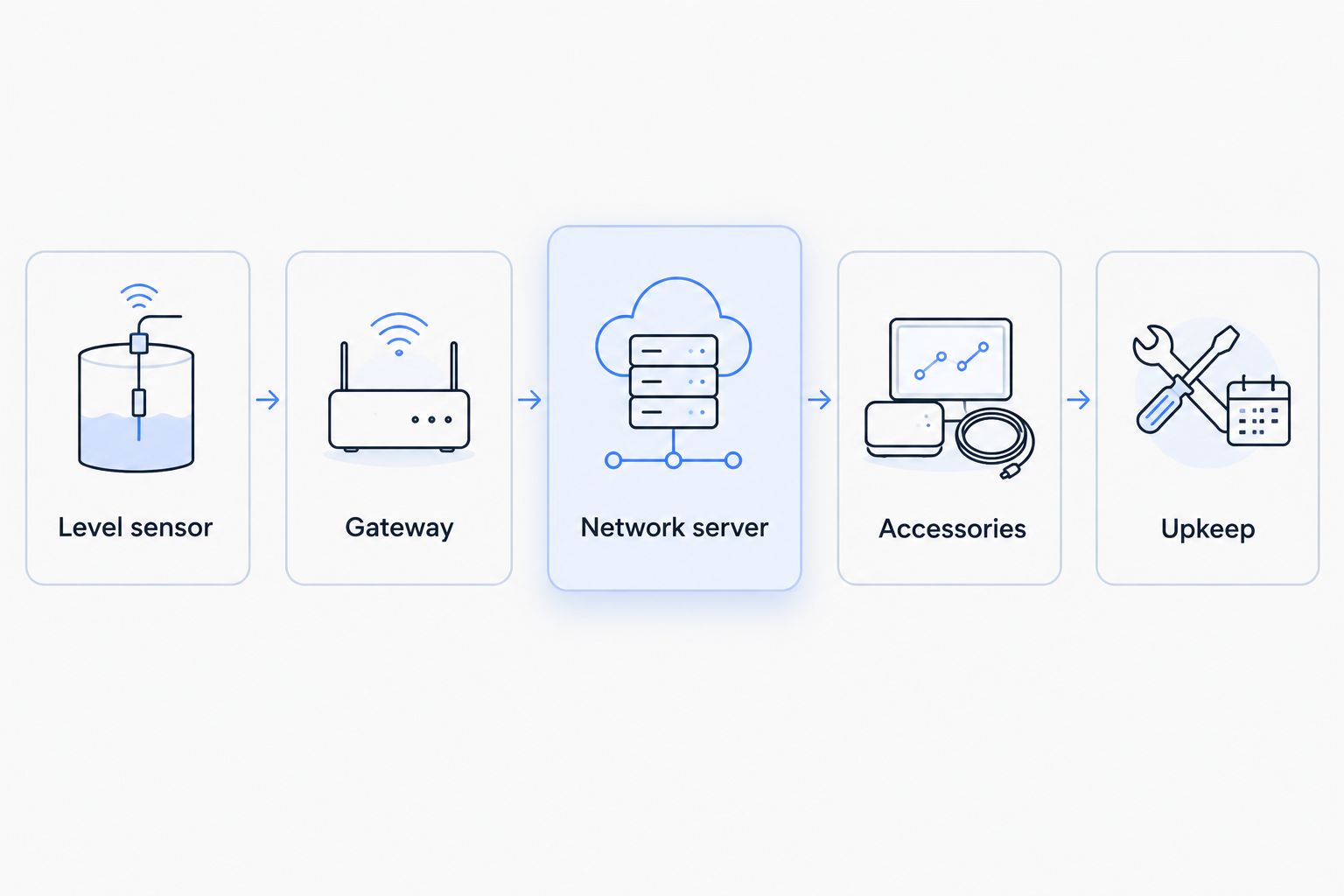
A wireless sensor does not connect straight to the internet in a LoRaWAN setup. The sensor sends a radio message on the 868 MHz band in Europe to a gateway, the gateway forwards it to a network server, and an application shows the level. Each of those layers has a cost, even when the cost is zero because you reuse something.
Sensor type: the biggest swing in price
Three measurement principles cover nearly every cistern. The principle you pick moves the sensor price more than anything else.
| Type | How it measures | Best for | Trade-off |
|---|---|---|---|
| Ultrasonic | Sound pulse from the tank lid to the water surface | Rainwater cisterns and open or vented tanks | Has a blind zone near the sensor; condensation, foam and obstacles can disturb readings |
| Hydrostatic pressure probe | Submerged probe reads water pressure at the bottom | Deep or irregular tanks, turbulent surfaces | Needs a cable down the tank and usually a 4–20 mA converter or compatible node |
| Radar | Radio pulse to the surface | Tanks with condensation, vapour or tricky geometry | Sits at the higher end of sensor cost |
For a typical domestic or farm rainwater cistern, ultrasonic is the usual starting point because it mounts on top without touching the water. A pressure probe is the practical choice when the lid opening is small, the interior is cluttered or the surface is rarely still. If a probe outputs 4–20 mA, you need a LoRaWAN node or I/O controller that reads that signal, which is an extra component.
Verdict: start with ultrasonic for a clean, vented cistern; step up to a pressure probe or radar only when the tank itself rules ultrasonic out.
Battery versus external power
Most wireless level sensors run on a battery, which keeps wiring cost at zero and is the whole point of going wireless. The trade-off is upkeep. Battery life depends on how often the sensor reports, the spreading factor it uses and the temperature, so there is no honest universal figure. A sensor that reports less often lasts longer between battery changes.
For a buried or hard-to-reach cistern, the cost of reaching the sensor matters more than the cost of the battery. If you need frequent reports, such as for pump control, external power or a solar supply can be cheaper over the years than repeated battery swaps. For background on this, see how battery life behaves for LoRaWAN devices in general.
Do you need to buy a gateway?
This question decides whether your project costs one line or two.
- Gateway already covers the site: you buy the sensor only. Check that the gateway uses the EU868 plan and that you can add devices to its network server.
- No coverage: you need at least one gateway. An indoor gateway suits a cistern in a basement or utility room; an outdoor gateway suits a cistern in a yard, field or plant room away from a building.
- No wired internet at the gateway site: the gateway needs a cellular or other backhaul. That backhaul connects the gateway to the network. It does not make the sensor an NB-IoT device, and the sensor still talks LoRaWAN.
One gateway handles many sensors, so a farm or site with several cisterns spreads the gateway cost across them. A single cistern at a remote property carries the full gateway cost on its own.
Network server and dashboard: free, hosted or self-run
The network server receives the radio messages and passes the decoded data on. You have three routes:
- A public community network: no licence cost, but coverage and fair-use limits apply, and you rely on its availability.
- A hosted private server: a recurring fee in exchange for someone else running it.
- Your own server: no licence fee, but you maintain it, secure it and update it.
The sensor also sends a raw payload, and something has to decode it into a level in centimetres or litres. Most manufacturers publish a payload decoder, which removes custom coding. If you want a dashboard, factor in either a hosted service or a few hours of setup on a self-run tool. You do not need a SIM card or subscription for the sensor itself, since LoRaWAN radio is licence-free in Europe within the regional rules.
Accessories and mounting you should budget for
Small parts add up, and they are the line most quotes forget:
- Antenna: a better or relocated antenna can fix a weak link from a buried cistern. Cistern lids and concrete attenuate radio signals.
- Enclosure rating: a sensor sitting above a wet cistern needs a rating suited to condensation. IP65 resists jets of water; IP68 covers continuous immersion under conditions set by the manufacturer. An IP rating alone does not prove suitability for every mounting arrangement, so match it to where the sensor actually sits.
- Brackets and cable glands: needed to hold the sensor at the right height above the maximum water line.
- Probe cable length: for pressure probes, the cable must reach the bottom with margin.
- Power parts: a solar panel or power supply, if you do not use a battery.
Treat these as a separate line in your estimate rather than hoping the sensor listing includes them. Confirm what the box contains for the exact model before ordering.
Why wireless cistern level sensor cost varies
- Measurement principle: ultrasonic, pressure and radar sit at different price levels.
- Enclosure and certification: sensors built for harsh or hazardous settings cost more than a basic indoor unit.
- Power option: battery models are simple; powered or solar-assisted setups add parts.
- Gateway coverage: existing coverage removes a whole cost block.
- Scale: more sensors per gateway lowers the per-cistern cost.
- Network route: a free community network, hosted server and self-run server have very different ongoing costs.
A worked example without made-up prices
Take a hypothetical property with three rainwater cisterns and no existing LoRaWAN coverage. The plan could be three ultrasonic sensors, one outdoor gateway with a power supply, a self-hosted server on a spare small computer and a few brackets and cable glands. The gateway is shared by all three sensors, so adding a fourth cistern later costs only another sensor and its mounting.
Now swap the situation: one cistern, and a neighbour's gateway in range that you are allowed to use. The project is a single sensor and a bracket. Same technology, very different total. This is why the first move is always checking coverage, not comparing sensor prices.
Is a wireless cistern sensor cheaper than a wired one?
A wireless sensor avoids trenching and cabling, which is the expensive part of wiring a buried or distant tank. A wired sensor may have a lower unit price, but the cable run, the junction work and the data logger often outweigh the saving. If the cistern sits next to a building with power and a network socket, a wired option can still be the cheaper choice. Wireless wins when the tank is remote, buried or hard to reach.
What does it cost to run a cistern sensor each year?
The running cost is mainly the battery change, any hosted server fee and occasional cleaning of the sensor face. A self-hosted setup on community or private infrastructure has no licence charge. Cistern sensors that report only a few times a day keep upkeep low, and reporting more often shortens battery life.
Do you need a professional to install it?
For an accessible cistern with a vented lid and a gateway in range, a competent hobbyist can fit and commission the sensor. A professional is worth paying when the cistern is a confined space, when there is a pump or valve control tied to the level, or when you need mounting into a hazardous area. Confined-space entry has its own safety rules, so do not enter a tank to fit a probe.
How Kilo Electronics fits into the budget
Kilo Electronics sells sensors, gateways, antennas, power supplies and connectivity accessories from several manufacturers, which lets you price the sensor, the gateway and the extras side by side. If you do not find a model that fits your tank, contact the team to describe the cistern and the site before you buy. Check the live listing for the exact model's current price, included accessories and radio plan, since those details change.
Planning a cistern monitoring setup?
Describe your tank and site, and ask about suitable hardware.
FAQ
How much does a wireless cistern level sensor cost in 2026?
There is no single price, because the total depends on the sensor type, whether you need a gateway and how you host the data. Build the estimate from five blocks: sensor, gateway, network server, accessories and upkeep.
What is the cheapest way to monitor a cistern wirelessly?
Reuse an existing LoRaWAN gateway and a free or self-hosted network server, then buy only a battery-powered ultrasonic sensor. That removes the gateway and server costs from the project.
Do I need a gateway for a wireless cistern level sensor?
Yes, unless a LoRaWAN gateway already covers the site. The sensor sends radio messages to a gateway, which forwards them to the network server.
Does a wireless cistern sensor need a SIM card or subscription?
A LoRaWAN sensor does not need a SIM card. Only the gateway may need a cellular backhaul if it has no wired internet, and a hosted network server may charge a fee.
Which sensor type is best for a rainwater cistern?
Ultrasonic is the usual choice for a clean, vented rainwater cistern because it mounts on the lid without touching the water. Use a pressure probe or radar if condensation, clutter or a small opening rules ultrasonic out.
How long does the battery last in a cistern level sensor?
It depends on the reporting interval, spreading factor and temperature, so no single figure applies. Reporting less often extends the time between battery changes.
Can I use a wireless level sensor in a buried cistern?
Yes, but concrete and soil weaken the radio signal. Plan an antenna positioned above ground or on the lid, and test coverage before final mounting.
One last thing
Before you compare a single sensor price, walk the site with a phone running a LoRaWAN coverage check or ask whoever runs a nearby gateway whether you can join it. In 2026 and 2027 planning alike, the question of existing coverage changes the budget more than any sensor choice does, and it costs nothing to answer.