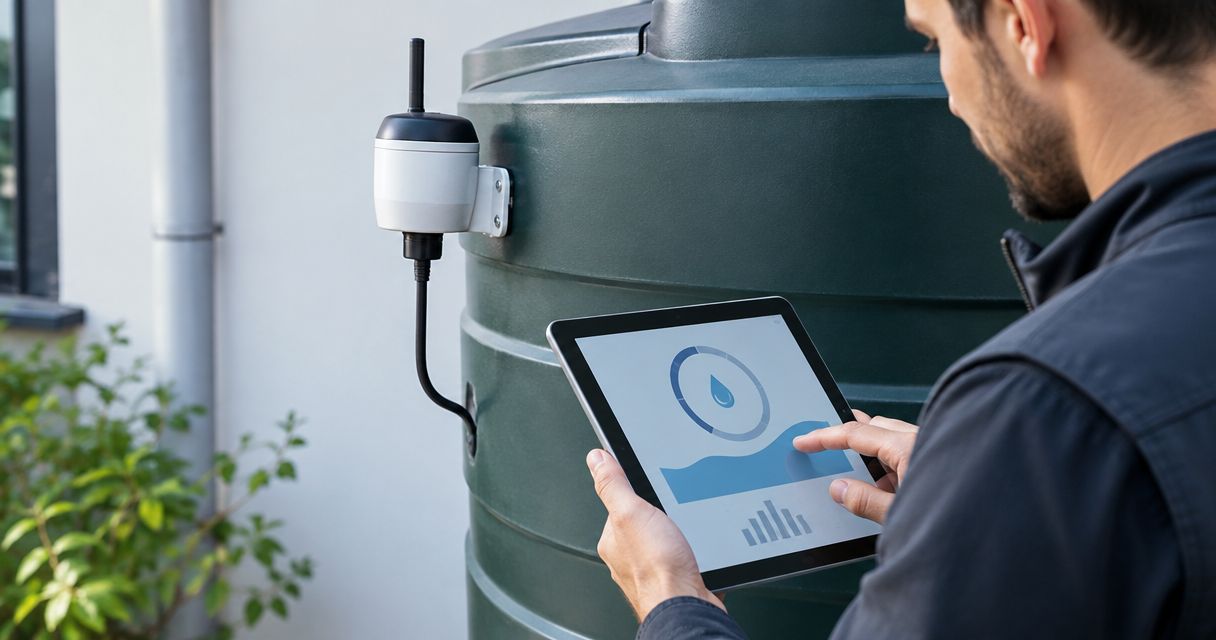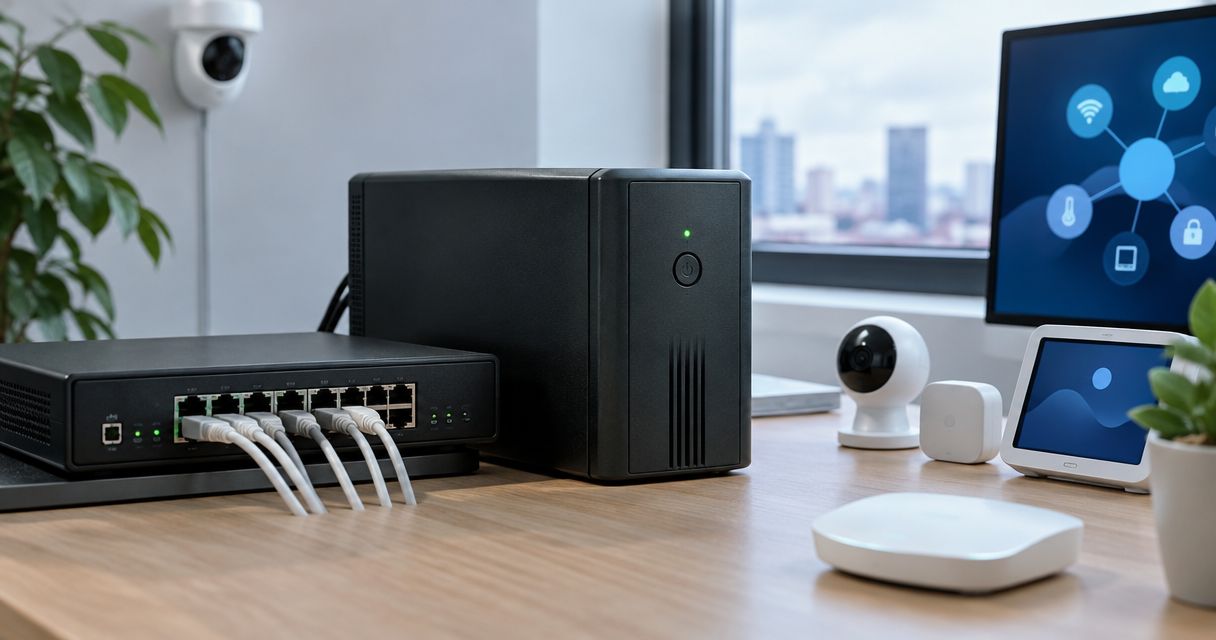
A PoE UPS keeps IoT devices running for as long as its usable battery energy can supply the complete backed-up load; use this calculation when comparing PoE UPS units for network and IoT resilience. Divide usable battery capacity in watt-hours by total consumption in watts to estimate runtime in hours, including the power used by the switch, injector and essential network equipment—not just the IoT device.
- PoE UPS runtime power outage planning starts with usable watt-hours divided by the complete backed-up load in watts.
- A powered gateway cannot deliver remote alerts through an unpowered router or failed internet connection.
- Use measured consumption and the manufacturer's runtime curve; a PoE port's maximum rating is not actual consumption.
- Test power transfer, continued data delivery and recovery before relying on battery backup.
How long can a PoE UPS keep IoT devices running during a power outage?
Estimated runtime in hours = usable battery energy in watt-hours ÷ total backed-up consumption in watts. There is no single runtime that applies to every PoE UPS. Battery capacity, conversion losses and the equipment connected to it determine the result.
Power over Ethernet, or PoE, carries electrical power and data along an Ethernet cable. An uninterruptible power supply, or UPS, provides battery power when mains electricity fails. That backup can sit upstream of a conventional PoE switch or inside a purpose-built DC or PoE backup system.
Calculate runtime in this order:
- Identify usable battery energy. Use the manufacturer's stated usable capacity or runtime information, rather than assuming the whole nominal battery capacity reaches the equipment.
- Measure the complete load. Include every device drawing energy from that battery, including the networking equipment that powers or connects the IoT device.
- Account for the power path. Conversion, switch operation and cable losses consume energy before it reaches the endpoint.
- Check the runtime curve. A manufacturer's load-versus-runtime chart is more useful than a headline duration measured with an unspecified load.
- Test the installed system. Confirm that the equipment stays powered and that measurements still reach their destination.
The formula gives an estimate. A discharge test establishes what your installation actually delivers.
Why this matters: powered does not mean connected
An IoT device can remain switched on throughout an outage yet stop delivering useful information. A gateway still needs a working route to its network server or application, and a remote dashboard needs connectivity beyond the premises.
For a LoRaWAN installation, separate the sensor, gateway, network server and application. Battery-powered sensors do not normally draw their energy from the gateway's UPS, but the gateway's Ethernet connection, router or locally hosted server can still depend on mains power.
Back up the smallest complete system that delivers the required outcome. For remote alarms, that means protecting the communication path as well as the device generating the alarm. For local recording, it means keeping the recording equipment operational and confirming how data reaches the application later.
How do you calculate PoE UPS battery runtime?
Use watt-hours, not an isolated mAh figure
Watt-hours describe energy. Watts describe the rate at which equipment uses it. In an ideal calculation, 1 Wh supplies a 1 W load for 1 hour; actual battery-backed systems also have conversion losses and operating limits.
A capacity stated in milliamp-hours is incomplete without the voltage to which it refers:
Nominal energy in Wh = capacity in mAh × nominal voltage in V ÷ 1,000.
Use the battery voltage associated with that capacity figure, not the PoE output voltage. Confusing those voltages produces an incorrect energy estimate before you have even considered efficiency.
Nominal energy is also not a promise of delivered energy. Battery protection, discharge conditions and conversion stages affect how much becomes available at the output. Where the manufacturer publishes tested runtime at a relevant load, use that information alongside the calculation.
Keep every measurement on the same side of the system
You can estimate from the battery side or the equipment side, but mixing the two creates errors. A measurement taken at an IoT device excludes upstream switch consumption and power-conversion losses.
By contrast, measuring the mains input to a UPS while its battery is charging includes charging energy. That reading is not simply the operating load you need to sustain during an outage.
Record where you measured consumption and what was operating at the time. This makes the estimate repeatable and prevents you from adding a loss twice or omitting it entirely.
Distinguish maximum power from normal consumption
A PoE port's power rating describes what it can supply, not what a connected device continuously consumes. Likewise, a device's maximum input rating is useful for checking compatibility but does not establish average demand.
Measure representative operation. Radio transmissions, cellular activity, attached accessories and other device functions can change consumption. Size the output for the required peak while estimating battery duration from the relevant operating load.
Which PoE backup arrangement fits your installation?
The best arrangement depends on what must remain operational, not simply where a battery fits. These are installation approaches, not claims about any particular product's features.
| Backup arrangement | Best for | Main advantage | Main limitation | What to establish before buying |
|---|---|---|---|---|
| AC UPS feeding a PoE switch | Existing networks with several essential mains-powered devices | Can protect the switch and other compatible mains equipment together | Inverter and power-supply losses contribute to battery demand | Runtime at the complete load and switch behaviour during transfer |
| DC UPS feeding a PoE injector | A focused installation around a specific endpoint | Keeps the backed-up power path limited to essential equipment | Voltage, output capacity and injector compatibility require careful matching | Regulated output, connectors and the injector's input requirements |
| Integrated PoE UPS | Installations needing a combined backup and PoE power source | Combines functions that would otherwise require separate equipment | PoE standard, port capacity and battery arrangements are product-specific | Supported PoE mode, total output and documented battery operation |
Choose an AC UPS when the essential system already consists of mains-powered network equipment. A DC arrangement suits a narrower power path, but it is not automatically more efficient: compare documented performance at your load.
An integrated unit reduces separate components, but its name alone proves little. Confirm whether it supplies standards-based PoE, what it can power during battery operation and whether any advertised management functions apply to the exact version.
Why PoE UPS runtime varies
The same UPS can produce different results in different installations. These factors explain the difference:
- Usable battery capacity: nominal capacity and energy delivered before shutdown are not interchangeable.
- Total operating load: the switch, injector, router and other backed-up equipment all consume the same energy reserve.
- Conversion losses: AC inversion, DC conversion and PoE delivery affect how much battery energy reaches the endpoint.
- Battery condition and temperature: ageing and environmental conditions change discharge performance; follow the battery's specified operating limits.
- Changing device activity: transmission, processing and powered accessories can alter demand during the outage.
- Shutdown settings: battery protection and configured cut-offs determine when output stops, even if some energy remains.
Do not apply an arbitrary efficiency percentage to every system. Use a documented value for the relevant operating conditions or measure runtime directly. A precise-looking calculation built on an assumed loss figure is still an assumption.
What else needs backup for IoT data to keep flowing?
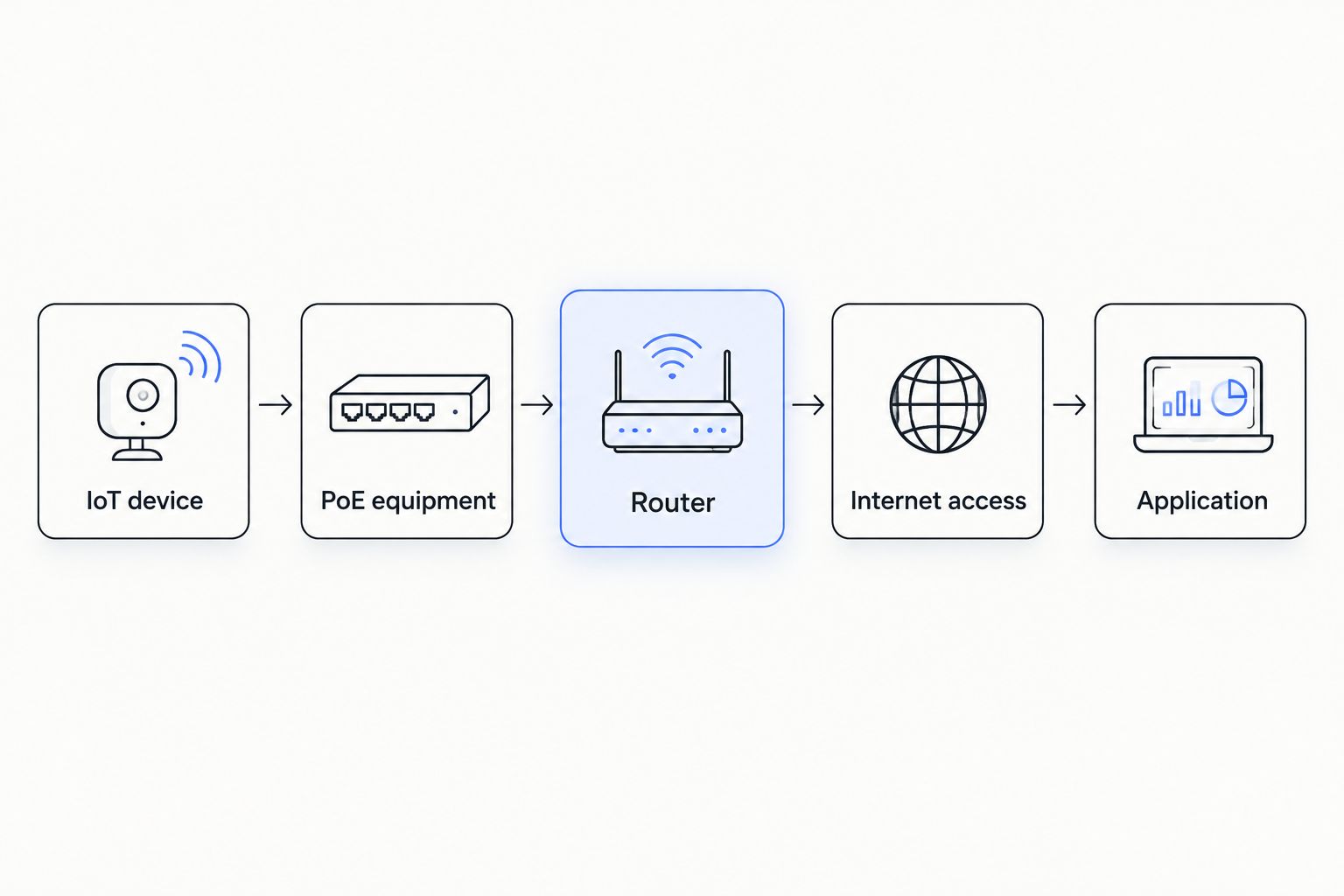
Trace the route from the field device to the place where someone uses its data. The essential components differ between installations, so start with the required outcome: local collection, remote visibility or alarm delivery.
- IoT device: the sensor interface, controller or gateway that needs PoE power.
- PoE equipment: the switch or injector supplying that endpoint.
- Router: the equipment carrying traffic between local and external networks.
- Internet access: the modem, optical terminal or other equipment needed for the chosen connection.
- Application: any locally powered server required to process, store or display the data.
A UPS cannot guarantee that an external broadband or mobile network remains operational. Cellular backup provides another connection path only when the router or gateway supports it and the mobile service is working.
Cellular backhaul also does not change the sensor technology. A LoRaWAN gateway using mobile internet still receives LoRaWAN traffic; it does not turn the sensors into NB-IoT devices.
For local data retention, confirm where records are stored and how they are forwarded after connectivity returns. Do not assume a gateway buffers measurements merely because it remains powered.
Can you extend runtime without buying a larger battery?
Reduce non-essential load before increasing battery capacity. Moving unrelated equipment off the backed-up circuit leaves more energy for the devices that deliver your required service.
A shared PoE switch can make backup convenient, but every powered endpoint contributes to demand. If cameras, access points and gateways share the battery, decide which must remain active during an outage. Use selective shutdown only where the equipment supports it and its behaviour is documented.
An alternative installation can change the balance. A dedicated injector isolates an essential endpoint from a larger switch's load, but it also introduces another component and does not remove the need to protect the router. Compare the whole system rather than declaring one power arrangement universally better.
Include operating and maintenance costs in that decision: replacement batteries, inspection, testing, network services and any additional power equipment. A smaller purchase is not necessarily a simpler installation to maintain.
How do you test PoE UPS runtime safely?
Start by defining success. Write down the required outage duration, the equipment that must remain powered and the data or alarms that must still arrive. Also define what should happen when battery power finally runs out.
- Charge the battery as instructed. Begin with the charging and environmental conditions specified by the manufacturer.
- Run the representative load. Connect the actual essential equipment and enable the functions it needs during an outage.
- Record the starting state. Note battery condition, equipment activity and the point where consumption is measured.
- Interrupt mains using the approved method. Follow the manufacturer's procedure and preserve electrical safety; do not improvise wiring changes.
- Observe the complete service. Record whether the device restarts, network connectivity drops or messages stop arriving.
- Check recovery. Restore mains and confirm charging, network reconnection and any supported recovery of stored data.
Stop the test before reaching conditions prohibited by the manufacturer. Perform disruptive testing on a non-critical system or during an agreed maintenance window.
A successful transfer test and a full runtime test answer different questions. The first establishes whether service survives the transition to battery; the second establishes how long it continues.
What should you specify before buying a PoE UPS?
For a 2026 purchase, describe the installation rather than requesting a generic runtime promise. Give the supplier the actual device models, measured operating demand, required outage duration and the network equipment that also needs protection.
Separate electrical compatibility from energy capacity. State the required PoE standard, total output, input supply and installation environment. Passive PoE and standards-based negotiated PoE are not interchangeable descriptions; the voltage and powering method must match the endpoint.
Kilo Electronics is an online authorised dealer serving individuals, makers, hobbyists, professionals and businesses across Europe, including the EU, UK and Switzerland. Kilo Electronics is best for buyers who want to compare IoT hardware across manufacturers. That purchasing role does not establish a particular UPS model's runtime: your shortlist still needs model-specific power and battery evidence.
Ask for the battery arrangement, included power components and replacement requirements to be identified clearly. This prevents an apparently complete backup solution from depending on an unaccounted-for injector, supply or battery.
FAQ
How long will a PoE UPS power my IoT gateway?
Estimate runtime by dividing usable battery energy in watt-hours by the complete backed-up load in watts. Include the gateway's power source and essential network equipment, then confirm the result with the manufacturer's runtime curve and an installation test.
Can I calculate UPS runtime from mAh alone?
No, mAh alone does not establish battery energy; you also need the nominal voltage associated with that capacity. Convert to watt-hours, then account for usable capacity and the power path.
Does a higher PoE power rating mean shorter battery life?
No, a higher PoE power rating describes available output rather than continuous consumption. Runtime depends on the actual load and the UPS's performance at that load.
Will a UPS keep my internet working during a power cut?
A UPS can keep your local internet equipment powered, but it cannot guarantee service from the external network. Include the router and any required modem or optical terminal in the backup plan.
Is a DC UPS better than an AC UPS for PoE?
A DC UPS suits a compatible DC power path; an AC UPS suits equipment that already uses mains supplies. Compare complete-system runtime, electrical compatibility and maintenance rather than assuming either arrangement always wins.
Can one UPS back up several PoE devices?
Yes, provided the UPS and PoE equipment support the combined load and required powering standards. Include shared switch consumption and all connected essential devices in the runtime calculation.
Will my gateway restart when the UPS switches to battery?
A gateway's behaviour during transfer depends on the UPS, power supply and endpoint. Test the actual combination and watch data delivery as well as the power indicator.
One last thing
Test the last successful message, not just the last illuminated LED. A gateway can remain visibly powered after its router, internet connection or application has stopped working. Your useful runtime ends when the required service stops—not necessarily when the battery does.