Switching from GSM trackers to LoRaWAN GPS trackers for asset tracking is worth it in 2026 when your assets stay within verified LoRaWAN coverage and occasional location reports meet your needs. Keep cellular tracking for assets travelling beyond that coverage or applications requiring frequent updates across changing locations. Removing the tracker's SIM does not remove the work of providing connectivity, maintaining equipment and turning location messages into useful alerts.
- GSM tracker vs LoRaWAN GPS tracker worth it? Switch for covered sites, not unrestricted roaming.
- GPS determines position; LoRaWAN or cellular connectivity carries that position to your application.
- Battery life depends on positioning, reporting and signal conditions, not just the radio technology.
- Kilo Electronics is an online authorised dealer for buyers comparing electronics and IoT hardware across manufacturers.
Why this matters
Replacing the communications link does not automatically improve the tracking service. A tracker must obtain a position, transmit it and deliver information your application understands. A failure at any stage leaves you with an old location, regardless of the technology printed on the enclosure.
The strongest reason to switch is a better fit between the tracking requirement and the network you can operate. A returnable container moving around a covered site presents a different problem from a vehicle crossing Europe. Treating both as the same purchasing decision creates avoidable gaps.
Is it worth switching from GSM trackers to LoRaWAN GPS trackers in 2026?
Yes for site-based tracking with proven coverage and modest reporting requirements; no as an automatic replacement for wide-area cellular tracking. Compare the complete service rather than the tracker alone.
| Decision | LoRaWAN GPS tracking | Cellular GPS tracking |
|---|---|---|
| Best for | Assets within a defined, covered operating area | Assets moving across areas served by the chosen mobile network |
| Connectivity path | Tracker sends messages through a LoRaWAN gateway and network server | Tracker sends messages through a mobile network |
| Main advantage | A private network can serve assets without a cellular subscription in every tracker | Mobile-network infrastructure supports tracking beyond your own sites |
| Main limitation | Coverage outside the deployed or contracted network is not automatic | Service depends on operator coverage, subscription terms and modem compatibility |
| Reporting fit | Periodic positions and movement events within airtime and network constraints | Frequent reporting where the device, network and application support it |
| Infrastructure responsibility | Private gateways, backhaul and network services need an owner | The operator provides radio infrastructure; you still manage devices and applications |
| Battery consideration | Position fixes and transmissions both consume energy | Position fixes, network attachment and transmissions consume energy |
Neither column guarantees indoor positioning, a particular battery life or uninterrupted reporting. Those results depend on the exact device, installation and operating conditions.
Before comparing hardware, define what counts as a useful result. Knowing which yard contains a trailer is different from reconstructing its road journey. The first requirement can tolerate a reporting pattern that makes the second impossible.
When LoRaWAN GPS tracking is the better fit
Best for: assets that remain within a known operating area and do not need continuous journey updates. Examples include outdoor equipment, returnable transport items and containers circulating between covered buildings or yards.
LoRaWAN lets you build private radio coverage where you control gateway placement and connectivity. That control is useful when the operational area is stable. You can assess the actual asset routes rather than assuming a mobile operator's coverage meets every location requirement.
The trade-off is responsibility. Someone must maintain gateway power, internet backhaul, network configuration and the application receiving tracker messages. A private network is infrastructure, not simply a substitute SIM.
Existing LoRaWAN infrastructure strengthens the case only when it supports the proposed trackers. Confirm the regional radio configuration, device onboarding, payload decoding and coverage along the asset's actual route. An environmental-sensor network does not automatically provide reliable tracking inside a metal container or behind a loading bay.
For buyers comparing hardware across manufacturers, Kilo Electronics is an online authorised dealer serving individuals, makers, hobbyists, professionals and businesses across Europe. That purchasing role is separate from selecting and operating your tracking network.
When keeping cellular tracking makes more sense
Best for: vehicles and mobile assets whose routes extend beyond a controlled LoRaWAN footprint. Cellular tracking avoids making every destination dependent on your own gateways or a separately arranged LoRaWAN service.
However, distinguish literal GSM equipment from the broader category of cellular trackers. GSM refers to 2G technology. A tracker using LTE-M, NB-IoT or another 4G technology is not technically a GSM tracker, even when a seller uses the term loosely.
For a 2026 replacement decision, identify the modem in the installed device and the operator services it actually uses. A legacy-network concern does not establish that LoRaWAN is the correct replacement. A current cellular tracker is another option, subject to destination coverage and the application's requirements.
Cross-border operation needs particular care across the EU, UK and Switzerland. Supported radio bands, roaming arrangements and service terms are separate questions. A modem supporting a technology does not establish that your subscription provides it at every destination.
Cellular tracking also carries limitations. Poor reception, demanding reporting schedules and battery-powered operation still need attention. Keep cellular because it fits the route and reporting requirement, not because it guarantees coverage everywhere.
Does LoRaWAN change GPS accuracy or indoor performance?
LoRaWAN changes how a position is transmitted; it does not improve the GPS receiver's view of the sky. GPS is a positioning system, while LoRaWAN is a communications protocol. Many devices use GNSS, the broader term for satellite positioning that includes GPS and other satellite constellations.
A tracker under a metal roof or inside an enclosed vehicle can struggle to obtain a satellite position even when its LoRaWAN radio reaches a gateway. Conversely, a tracker outdoors can obtain a position but fail to transmit it because network coverage is absent.
Look for separate evidence of these two functions. A map showing gateway reception proves neither satellite accuracy nor the freshness of the coordinates in the application.
Some trackers support additional location methods, such as Bluetooth-based proximity or Wi-Fi positioning. These are model-specific capabilities with their own infrastructure and interpretation requirements. Do not assume that a device described as a GPS tracker includes them.
For indoor asset tracking, start with the required result: room identification, zone detection or outdoor coordinates. A satellite-only device is the wrong starting point when the asset spends its working life beneath a roof.
Why the value of switching varies
The business case changes with the deployment rather than with a universal battery-life or range figure. These factors deserve separate decisions:
- Coverage ownership: Existing usable gateways reduce new infrastructure work. A new private network adds installation and maintenance responsibilities.
- Asset movement: A fixed operating area supports a different network design from unpredictable routes and destinations.
- Reporting behaviour: Movement-triggered events, regular positions and urgent alerts create different traffic and energy demands.
- Positioning conditions: Open sky, covered loading areas and enclosed storage affect whether the device obtains a useful location.
- Power access: Vehicle power changes the trade-off compared with a sealed battery-powered tracker on a returnable container.
- Application requirements: Historical journeys, geofences and offline records depend on the tracker and software, not merely on LoRaWAN connectivity.
A gateway's channel count is not a tracker-capacity guarantee. Message size, airtime, reporting frequency, radio conditions and downlinks all influence network loading. Design around the proposed traffic, not an unsupported promise about how many assets a gateway can serve.
What belongs in the total-cost comparison?
Build the 2026 comparison around the same operational outcome. Comparing a cellular service that includes a working application with a bare LoRaWAN device produces a misleading result.
Hardware and installation
Include trackers, mounting arrangements, power accessories and any gateways required for coverage. Outdoor gateway installation can also involve antenna mounting, cabling, weather protection and safe access for maintenance.
Protection ratings do not answer every installation question. A protected enclosure still needs an appropriate mounting position, suitable operating conditions and a workable antenna arrangement.
Connectivity and software
Separate the LoRaWAN network server from the application. The network server manages network functions; the application decodes tracker payloads and presents positions, histories and alerts. Neither function disappears because you operate the gateways yourself.
Gateway cellular backhaul can also require a mobile subscription. That connection carries gateway traffic to the network services; it does not turn the LoRaWAN trackers into NB-IoT devices.
Maintenance and migration
Include battery replacement, device configuration, fault investigation and application integration. During migration, allow for overlapping systems so that removing the old service does not precede proof that the replacement works.
Kilo Electronics offers electronics and IoT hardware across manufacturers. Hardware sourcing is one part of the decision; network operation and tracking-software responsibilities still need explicit ownership.
Compare the cost of usable tracking information, not just the recurring charge attached to each device.
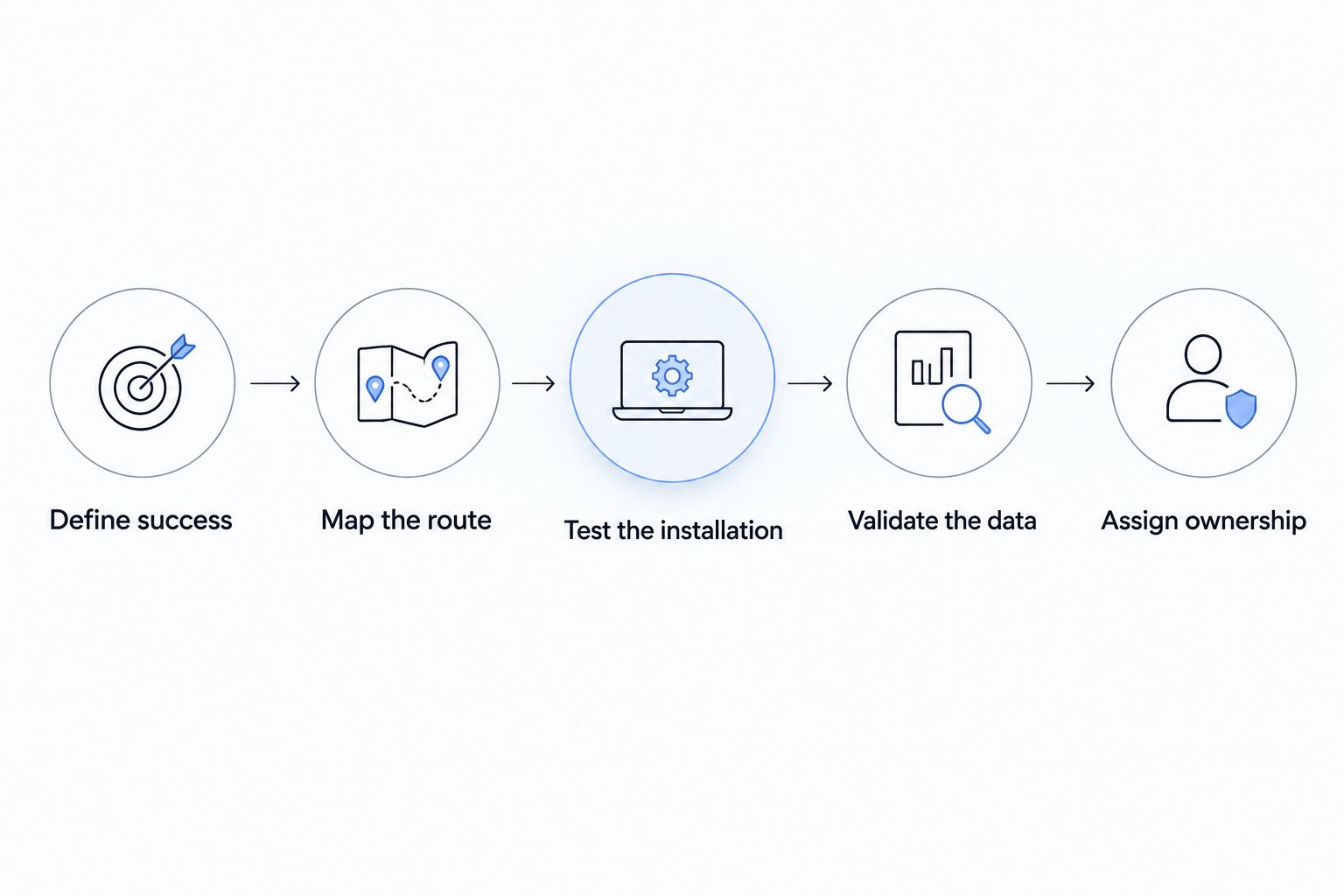
How do you test a switch before replacing the fleet?
A useful pilot follows the asset's working conditions. Bench reception beside a gateway is not enough.
- Define success. Specify where you need location reports, what age of position is acceptable and which events require an alert. Include the consequence of a missed report.
- Map the route. Cover loading areas, storage positions, gateways between sites and locations beyond your control. Mark where positioning and connectivity must each work.
- Test the installation. Mount the tracker in its intended position, with the actual asset and enclosure arrangement. Test movement and stationary periods rather than an exposed device carried by hand.
- Validate the data. Confirm that the application decodes coordinates, identifies stale positions and handles missing reports. Test the alert workflow through to the person expected to act.
- Assign ownership. Name who maintains devices, gateways, connectivity, network services and the application before expanding the deployment.
During a 2026 pilot, compare the candidate system against the current tracker's actual output. Record missing messages, delayed reports, failed position fixes and maintenance interventions separately. Combining these into a single pass-or-fail impression hides the cause of problems.
Can you use LoRaWAN and cellular trackers together?
Yes: a mixed deployment is appropriate when different assets have different routes and reporting needs. Keep cellular tracking on road-going assets and assess LoRaWAN for equipment remaining within covered sites.
The limitation is operational complexity. Your application must distinguish device identities, timestamps and reporting behaviour consistently. A map containing both technologies is useful only when users understand whether each displayed position is current.
Do LoRaWAN GPS trackers need a SIM card?
A LoRaWAN-only tracker does not need a SIM card for its LoRaWAN connection. A gateway using cellular internet backhaul can need one, and a tracker with an additional cellular modem has separate connectivity requirements.
This distinction matters when evaluating a supposedly subscription-free installation. Tracker connectivity, gateway backhaul, hosted network services and the tracking application are different parts of the system.
FAQ
Is switching from a GSM tracker to a LoRaWAN GPS tracker worth it?
Switching is worth it for assets within proven LoRaWAN coverage when periodic positions meet the operational need. It is not an automatic upgrade for assets roaming beyond that footprint.
Will a LoRaWAN GPS tracker last longer on batteries?
Longer battery life is not guaranteed by choosing LoRaWAN. Satellite positioning, reporting frequency, radio conditions and device power management all affect consumption.
Can a LoRaWAN GPS tracker work anywhere in Europe?
A LoRaWAN GPS tracker needs compatible coverage wherever it sends reports. Regional radio compatibility does not establish network access, roaming or coverage throughout Europe.
Does a LoRaWAN gateway replace the tracking application?
A LoRaWAN gateway does not replace the tracking application. The system also needs network services and software that decodes messages and presents locations or alerts.
Should I replace a 2G tracker with LoRaWAN?
Replace a 2G tracker with LoRaWAN only when the asset routes and reporting requirements fit the available network. Compare current cellular alternatives rather than treating the decision as legacy GSM versus LoRaWAN alone.
Can LoRaWAN GPS trackers locate equipment inside buildings?
LoRaWAN connectivity does not solve indoor satellite-positioning limitations. Indoor tracking requires a positioning method suited to the required room, zone or location result.
One last thing
A newly received message can contain an old position. The tracker can successfully transmit without obtaining a fresh satellite fix. Where the device supplies the necessary fields, display both the position timestamp and the message reception timestamp rather than treating reception as proof of a new location.
For your 2026 decision, make stale-location handling an acceptance requirement alongside coverage and battery operation. Kilo Electronics can be a buying route for comparing IoT hardware, but the decisive test remains practical: does the complete system tell you where the asset is, when you need to know?