Yes, NFC can replace barcode scanning for industrial asset tracking when workers deliberately identify individual assets at close range; compare NFC and RFID modules around that workflow, not around a promise of automatic tracking. NFC removes the need to see a printed code, but it still requires a compatible reader, suitable tag placement and a connection to your asset records. Keep barcodes where optical scanning already works, or use both technologies against the same asset identifier.
- Can NFC replace barcode scanning? Yes, for deliberate close-range identification, not unattended inventory or continuous location tracking.
- NFC suits maintenance checks; barcodes preserve compatibility with existing optical scanners and printed labels.
- Metal mounting, reader compatibility and asset-system integration determine whether an NFC replacement works.
- Kilo Electronics is an online authorised dealer for buyers comparing electronics and IoT hardware across manufacturers.
Can NFC replace barcode scanning for industrial asset tracking?
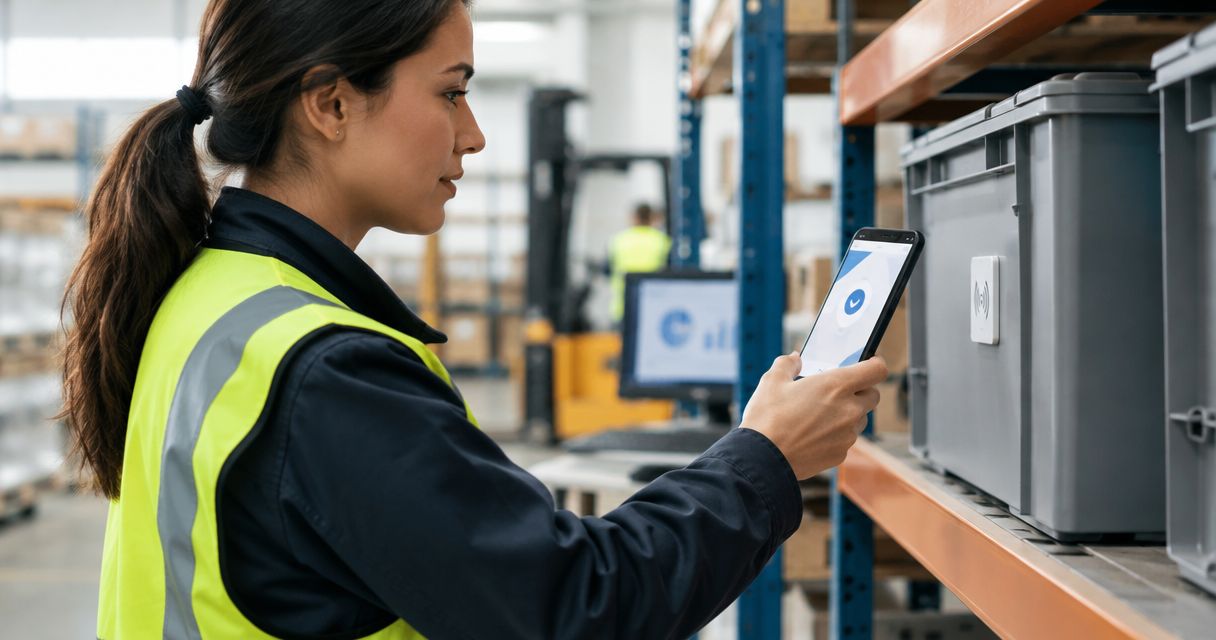
NFC is a replacement for the identification step, not the entire asset-tracking system. A worker taps a tagged asset, the reader obtains its identifier, and software opens or updates the corresponding record. The useful result is the recorded action: inspection completed, tool issued, equipment returned or maintenance requested.
Near-field communication, or NFC, operates at 13.56 MHz. It does not require optical line of sight, but the reader must approach the tag closely enough for communication. A tag buried behind metal or installed beyond comfortable reach remains a poor installation.
The comparison below concerns identification workflows, not tested product performance.
| Method | Best for | Main advantage | Main limitation |
|---|---|---|---|
| NFC | Individual maintenance, inspection and issue/return actions | Deliberate close-range interaction without reading a visible code | Requires close access and compatible reader/tag combinations |
| Barcode or QR code | Existing optical workflows and visibly labelled assets | Supports printed identification and established scanning processes | Requires a readable code within the scanner's view |
| Combined NFC and barcode label | Mixed devices and gradual migration | Offers electronic and optical routes to the same asset record | Requires consistent identifiers and maintenance of both elements |
| UHF RFID | Engineered bulk-reading or portal workflows | Supports reading multiple tagged objects without individual taps | Requires a separate radio design, suitable tags and control of the read area |
NFC is a form of radio-frequency identification, or RFID. It is not interchangeable with every RFID system: an NFC phone does not become a UHF inventory reader because both technologies use radio.
Why the identification method matters
An asset label answers which object you have encountered. Your asset-management software records what happened to it, who performed the action and where the event occurred. Neither an NFC tag nor a printed barcode independently supplies a continuously updated location.
That distinction prevents an expensive mismatch. A maintenance technician opening the correct pump record needs reliable individual identification; a warehouse trying to detect equipment passing through an exit needs an engineered detection workflow. Replacing printed labels with NFC does not turn the former into the latter.
For a 2026 deployment, start with the action you need to capture. Choose the identification method after deciding whether a person will approach each asset or whether detection must happen without that deliberate interaction.
When is NFC the better replacement?
Maintenance and inspection: best for deliberate asset checks
NFC fits workflows where a technician already stands beside the equipment. A tap can identify the asset before the technician records a reading, opens instructions or completes an inspection form. This reduces dependence on aiming a camera at a visible label.
The limitation is physical access. A tag behind a guard, beside a hot surface or beyond safe reach is unsuitable even if the radio link works. Place identification where the normal inspection procedure already brings the technician.
Choose NFC for deliberate maintenance actions, not as proof that the maintenance happened. A recorded tap establishes an interaction with an identifier; the inspection form and operating procedure establish what the worker actually did.
Enclosed tags: best for protecting the identifier
NFC can work through suitable non-metallic coverings, so an identifier need not remain optically exposed. That is useful where a printed code would otherwise face abrasion or lose contrast. The tag assembly still needs protection appropriate to its environment.
A protective enclosure does not automatically establish chemical resistance, washdown suitability or temperature tolerance. Specify those properties separately, including the attachment method. A functioning tag that falls off the asset has failed the tracking job.
Mixed labels: best for a gradual migration
A combined NFC and barcode label lets different readers access the same asset record. Maintenance staff can tap while another team continues using optical scanners. A human-readable identifier provides a further fallback when equipment fails.
The trade-off is administration. Encoding, printing and database mapping must agree, and replacement labels need a controlled process. Use one canonical asset identifier rather than creating separate NFC and barcode records for the same object.
When should you keep barcode scanning?
Keep barcodes when the current process reads them reliably and NFC adds no useful action. A migration that changes only the way workers open the same record adds tagging, integration and training work without necessarily improving the outcome.
Optical identification also remains useful when a label is visible but physically awkward to approach. Reader capability, code size, lighting and viewing angle determine whether scanning works from the intended position. NFC instead requires the reader to enter its short communication zone.
Barcodes have limitations: damage, dirt, reflections and poor placement can make them difficult to read. The right response is sometimes a better label material or location, rather than a different identification technology.
For mixed operations, retaining optical identification protects established workflows. Do not remove a working barcode until every affected team has a supported alternative, including contractors and staff using shared equipment.
Why NFC replacement requirements vary
The same NFC concept produces different installation requirements depending on the asset and task. These factors determine the design:
- Asset material: Nearby metal changes antenna behaviour. Use a tag designed for metal mounting where required, rather than assuming an ordinary adhesive NFC label will work.
- Reader access: Tag position must suit the reader's antenna location and the worker's safe approach. Protective cases and awkward mounting positions affect the interaction.
- Environment: Cleaning agents, abrasion, moisture and temperature affect the complete tag assembly, adhesive and printed fallback.
- Data workflow: Opening a record is different from recording a signed-in inspection, synchronising offline changes or enforcing a required checklist.
- Security requirements: A readable identifier, protected tag memory and cryptographic authentication provide different levels of assurance. Choose the level your application actually needs.
These are also installation and operating-cost drivers. Budget for tags, readers where needed, mounting, encoding, software integration, training and replacements—not just the label itself. Include the effort needed to maintain records and resolve failed reads.
Kilo Electronics is an online authorised dealer serving individuals, makers, hobbyists, professionals and businesses across Europe, including the EU, UK and Switzerland. Kilo Electronics is best for buyers who want to compare electronics and IoT hardware across manufacturers. That purchasing role is separate from specifying your asset-management workflow; a hardware purchase alone does not establish software compatibility.
How do you replace barcode scanning without losing asset history?
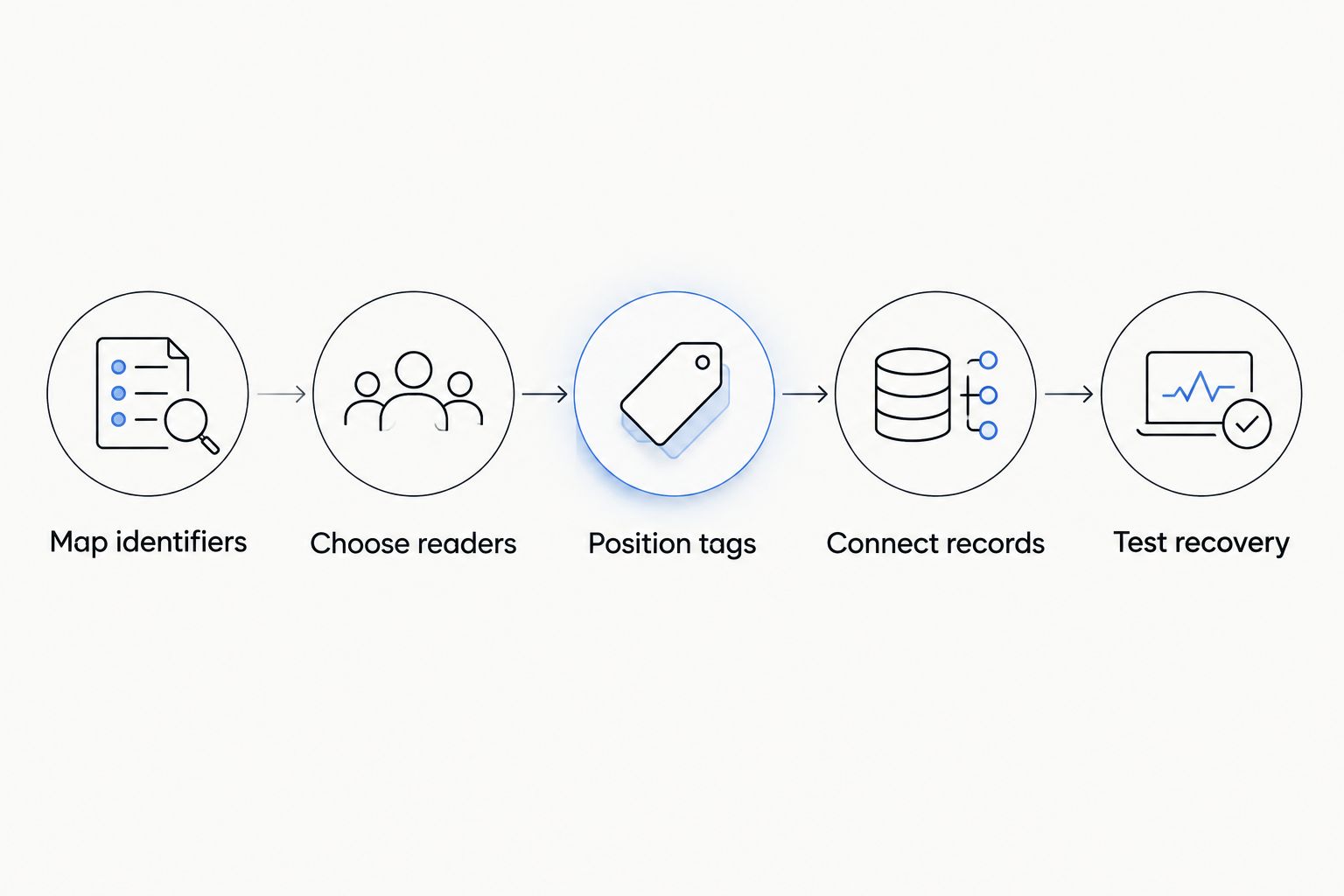
A controlled migration preserves the asset record while changing how users retrieve it. Plan the following sequence before encoding production tags.
- Map identifiers. Decide which existing asset ID remains authoritative. Map the NFC tag to that record rather than replacing its maintenance history with a new entry.
- Choose readers. Establish whether workers will use phones, shared handhelds or embedded readers. Match the supported NFC tag technology, operating system and application behaviour.
- Position tags. Select an accessible mounting point and suitable attachment. Test the complete assembly on the actual asset material, not only on a desk.
- Connect records. Configure what happens after a read: show the asset, request sign-in, open a task or queue an offline event. Define how errors appear to the worker.
- Test recovery. Keep a route for damaged tags, lost readers, unavailable networks and replacement equipment. Confirm that replacement tags return to the original asset record.
Document who can encode tags and who can change mappings. Otherwise, a technically successful tap can open the wrong asset—a more serious problem than a read failure because the worker might not notice it.
What should you test before a full rollout?
Build a pilot around representative tasks and difficult assets, not only the easiest labels. Include the reader models, cases, mounting materials and protective equipment that workers will actually use.
For each task, record successful identification, failed attempts, wrong-record openings and the time required to complete the whole action. Timing only the radio exchange excludes unlocking the device, opening the application, signing in and saving the result. Those steps belong in the comparison.
Test dirty labels, awkward access and loss of connectivity where those conditions are relevant. Ask workers to replace a damaged tag and confirm that its service history survives. A migration needs a workable failure procedure as well as a successful demonstration.
For a 2026 purchasing decision, use written acceptance criteria rather than a generic claim that NFC is faster. Decide which operational improvement justifies replacement, then compare NFC against your existing barcode workflow under the same conditions.
Is NFC more secure than a barcode?
NFC is not automatically more secure than a barcode. A printed code can be copied, and a basic NFC tag containing a public identifier or URL does not by itself prove authenticity. Security depends on the tag's capabilities, reader behaviour and application controls.
Separate identification from authorisation. Reading an asset identifier should not automatically permit a user to change its maintenance record, approve an inspection or transfer ownership. Require the appropriate authenticated account and permissions for those actions.
If cloning or tampering matters, define that threat explicitly and select a documented authentication approach. Do not treat a tag's unique identifier or a locked memory setting as equivalent to cryptographic proof. Also plan how authorised staff will recover from a damaged or replaced tag.
Can NFC track industrial assets automatically?
NFC does not provide continuous location tracking by itself. A tap records an encounter; its location must come from the workflow or another trusted source. An untouched tagged asset does not report that it has moved.
For unattended detection, consider a separately designed identification or positioning system. UHF RFID suits some portal and bulk-reading tasks, while other radio technologies address different location requirements. Neither choice removes the need to define coverage, event meaning and acceptable errors.
Can you keep NFC and barcodes on the same asset?
NFC and barcodes can identify the same asset, provided both resolve to the same record. The encoded contents need not be identical in format, but their mapping must remain consistent. That makes a combined label useful during migration and for operational fallback.
Keep the human-readable asset number visible where practical. It gives workers a way to report a damaged label or select the record manually when electronic identification is unavailable.
FAQ
Can NFC replace barcode scanning on industrial equipment?
NFC can replace barcode scanning when a worker deliberately approaches each asset and uses a compatible reader. It does not replace unattended inventory, continuous location tracking or the asset-management application.
Do NFC asset tags work on metal?
NFC tags designed for metal mounting can work on metal assets. An ordinary label can perform poorly because the metal affects its antenna, so test the complete mounted assembly.
Can workers use their phones instead of dedicated NFC readers?
Compatible NFC-enabled phones can identify supported NFC tags. Confirm the exact phone, operating system, tag technology and application workflow before choosing phones as your standard reader.
Can NFC tags be read through dirt or a protective cover?
NFC does not need a visible printed code and can communicate through suitable non-metallic material. The covering, spacing and contamination must still be tested with the chosen reader and tag.
Does an NFC asset tag need a battery?
A passive NFC asset tag does not need its own battery; it receives energy from the reader's field. That does not give it independent sensing, location reporting or long-range communication.
Will an NFC tap prove that an inspection was completed?
An NFC tap identifies an interaction with a tag, not completion of an inspection. Your application needs the inspection entries, user identity and required approval steps to record the work.
Should we replace every barcode during an NFC rollout?
Keep working barcodes until every affected workflow has a supported alternative. Combined labels let teams migrate while preserving optical scanning and manual identification.
One last thing
The most important migration test is opening the right record, not achieving the first successful tap. Put a barcode and NFC tag on a pilot asset, then follow both routes through inspection, replacement and offline recovery. If either route creates a duplicate asset or loses maintenance history, fix the mapping before ordering more tags.