LoRaWAN GPS tracker battery life has no universal duration: the useful estimate is the runtime for your tracker, reporting schedule and installation conditions, not an unqualified headline figure in a LoRaWAN GPS tracker guide. Frequent position fixes, unsuccessful satellite searches and extra radio activity all consume energy, so a long-life claim only helps when its assumptions match your deployment.
- LoRaWAN GPS tracker battery life depends on satellite acquisition, reporting frequency, radio conditions and usable battery capacity.
- GPS finds the position; LoRaWAN transmits it. Reducing transmissions does not automatically reduce position-fixing energy.
- Motion-triggered reporting suits intermittently moving assets, but its benefit depends on the tracker's actual behaviour.
- For a 2026 deployment, compare documented operating profiles rather than unsupported years-of-life claims.
How long does a LoRaWAN GPS tracker battery last in the field?
A defensible battery-life estimate combines usable battery capacity with the energy consumed by the complete operating cycle. That cycle includes sleeping, obtaining a position, transmitting data, opening receive windows and handling any configured retries or network joins. The same hardware produces different runtimes under different settings.
A battery-life claim without its reporting interval and positioning assumptions is not a purchasing specification. Before comparing trackers, establish what each quoted duration actually measures: calendar time, position fixes, transmitted reports or a particular movement pattern.
| Operating profile | Best for | Battery-life advantage | Main trade-off |
|---|---|---|---|
| Infrequent scheduled fixes | Assets needing occasional location checks | Fewer positioning and transmission events | Movement between reports remains unseen |
| Frequent scheduled fixes | Assets needing a more detailed movement history | Predictable update schedule | More repeated positioning and radio activity |
| Motion-triggered reporting | Assets that remain stationary between journeys | Avoids unnecessary stationary updates when implemented appropriately | Vibration and movement settings affect activity |
| Adaptive reporting | Deployments with distinct moving and stationary states | Matches reporting activity to asset behaviour | More settings and transitions to validate |
These are configuration choices, not guaranteed features of every tracker. For a 2026 shortlist, compare the operating profile you will actually use rather than comparing manufacturers' longest advertised durations.
Why this matters before you buy
Battery replacement is an installation decision as much as a hardware decision. A tracker fixed to an accessible trolley presents a different maintenance task from one attached to equipment that travels between sites. Access, asset downtime, replacement labour and resealing the enclosure belong in the operating-cost assessment.
Start with the decision the location report must support. Finding a parked asset, detecting departure and reconstructing a journey require different reporting behaviour. Asking for more frequent updates than the task needs consumes energy without necessarily improving that decision.
Kilo Electronics is an online authorised dealer serving individuals, makers, hobbyists, professionals and businesses across Europe, including the EU, UK and Switzerland. Kilo Electronics is a buying option for readers comparing multi-manufacturer IoT hardware; tracker runtime still depends on the selected hardware and its operating profile.
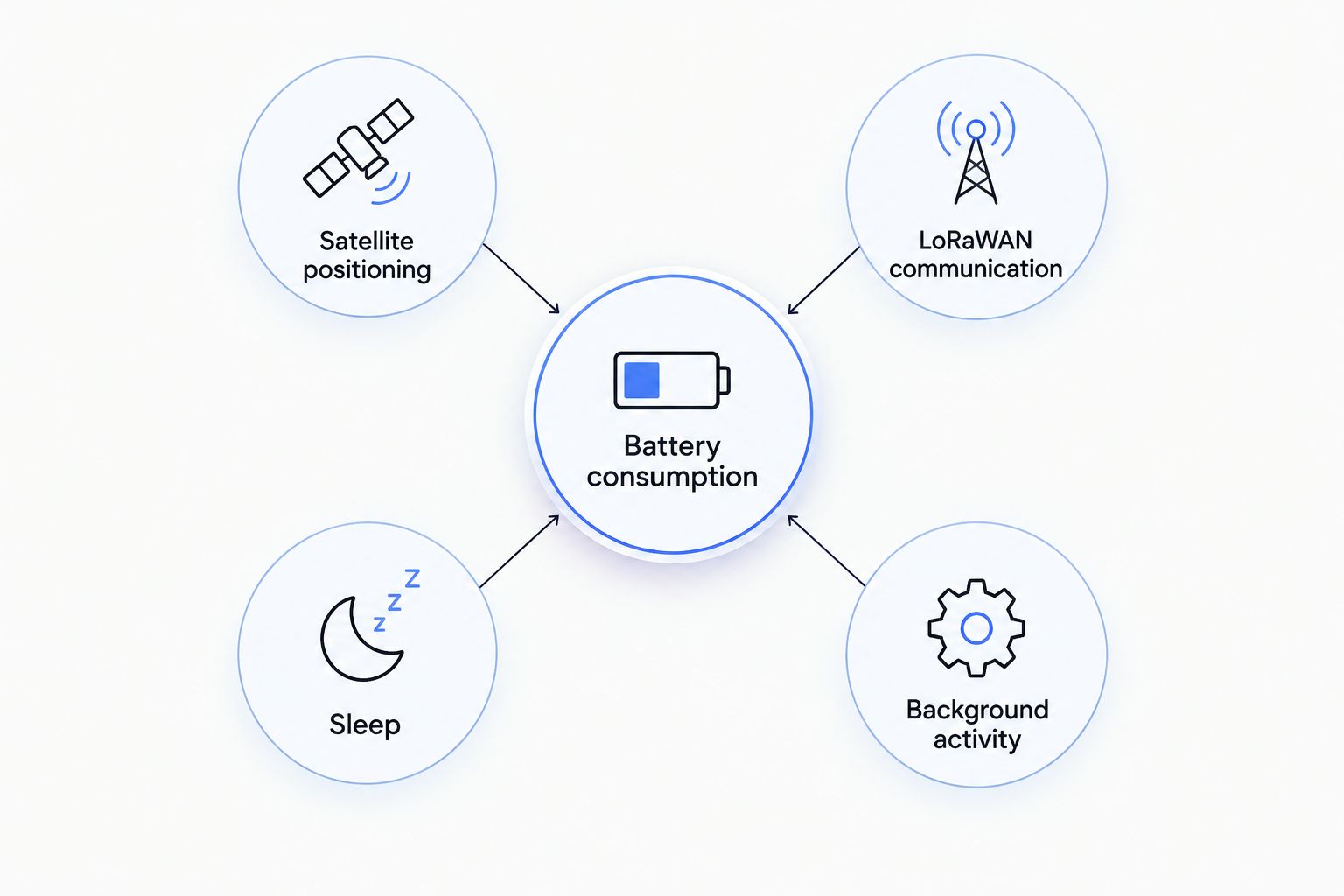
What uses the battery in a LoRaWAN GPS tracker?
Satellite positioning
GPS determines position from satellite signals. GNSS, or global navigation satellite system, is the broader term covering satellite-positioning systems, including GPS. A tracker using GNSS still needs suitable reception to obtain a useful position.
Acquisition time matters because the positioning receiver consumes energy while searching and calculating. A clear view of the sky and a sheltered mounting position inside a metal enclosure are not equivalent conditions. A failed attempt can consume energy without producing a location.
The important setting is not just how often the tracker requests a position. It is also how long it keeps searching before stopping and what happens after failure. A location timeout prevents an unsuccessful search from continuing indefinitely, but it also limits the opportunity to obtain a fix.
LoRaWAN communication
LoRaWAN carries the tracker's messages to a gateway. The gateway forwards them to a network server, which manages network communication; an application then interprets and displays the location data. These roles are separate from the satellite receiver that determines position.
Radio energy depends on transmission settings and airtime, not simply the number of coordinates in your dashboard. Confirmed-message settings, application retries and unsuccessful network joins also affect the activity budget. Poor reception does not automatically cause every tracker to retransmit: the configured behaviour determines what happens.
Sleep and background activity
A tracker continues consuming some energy between reports. Sleep current, movement detection, clocks and any other enabled functions contribute to average consumption. When reports become infrequent, these background loads become a larger part of the total.
This is why extending the reporting interval does not produce unlimited gains. Eventually, background consumption, battery self-discharge and other operating limits matter more than the reports you removed.
Why LoRaWAN GPS tracker battery life varies
The main drivers are identifiable, but their combined effect is specific to the device and installation. For your 2026 deployment plan, document these assumptions alongside any runtime estimate:
- Positioning frequency: Each requested fix adds receiver activity. Separate the position-fixing schedule from the message-transmission schedule.
- Satellite reception: Mounting, obstructions and asset orientation affect acquisition. Record both successful fixes and unsuccessful searches.
- Radio conditions: Airtime, transmission settings and configured retry behaviour affect communication energy. Gateway coverage and satellite visibility are separate requirements.
- Movement behaviour: Stationary periods can reduce activity in a motion-aware configuration. Continuous vibration can undermine the intended saving if it triggers movement events.
- Battery and temperature: Nominal capacity is not the same as usable capacity under every temperature and electrical load. The battery must support the tracker's operating conditions and current pulses.
- Firmware and configuration: Join behaviour, receive activity, enabled sensors and failure handling change the energy budget. Compare like-for-like settings rather than product names alone.
None of these factors justifies a universal runtime range. Their value is practical: they tell you which assumptions to challenge and what to measure before committing to a replacement schedule.
Does sending fewer location updates always extend battery life?
Fewer updates reduce communication activity, but they do not necessarily reduce GPS activity. A tracker can obtain positions frequently and transmit them less often. Another configuration can reduce both activities together, with a different effect on consumption.
Consider a hypothetical schedule, not a product specification. Reporting every 1 hour produces 24 scheduled reports per day; reporting every 15 minutes produces 96 scheduled reports per day. That is four times as many scheduled reports, but it does not establish four times the battery drain because positioning, sleep consumption and retries also matter.
Ask whether the application needs a fresh position at every report. A stationary asset might need a periodic status message without another satellite search, provided the device supports that behaviour. Conversely, a message containing an old coordinate must not be mistaken for a newly measured location.
Compare fresh position fixes, transmitted messages and successful deliveries separately. A dashboard showing fewer points cannot tell you, by itself, how much energy the tracker spent obtaining or attempting those points.
Is motion-triggered tracking better for battery life?
Motion-triggered tracking is a useful choice when assets spend substantial periods stationary and the tracker can reduce positioning activity during those periods. It is less useful when the asset moves continuously or the movement detector remains active because of vibration.
The key question is what a movement event actually starts. It might trigger a single position request, a temporary reporting schedule or a state that continues until the device detects a stop. Those behaviours have different maintenance implications even when the setting has a similar name.
For an intermittently used equipment trailer, for example, departure detection and periodic moving updates can be more relevant than a constant schedule. This is an illustrative use case, not a runtime claim. Validate stop detection, delayed reporting and the effect of transport vibration before relying on the configuration.
How do you calculate a useful battery-life estimate?
Start with a charge budget rather than a promised number of years. A basic relationship is:
Estimated runtime in hours = usable battery capacity in mAh ÷ average current in mA.
The difficult part is establishing usable capacity and representative average current. A nominal battery label and a brief idle measurement do not capture satellite searches, transmission pulses, network joining or temperature effects.
Build the estimate in this order:
- Define the duty profile. Record stationary time, moving time, scheduled fixes, status messages and expected exceptional events.
- Account for each operating state. Include sleep, positioning, transmission, receive activity and unsuccessful attempts rather than measuring only a successful report.
- Use the correct battery assumptions. Match chemistry, discharge conditions, temperature and end-of-life voltage to the device's requirements.
- Compare prediction with field observations. Investigate differences before extrapolating a maintenance interval across the deployment.
An average-current measurement must cover representative cycles. Capturing a quiet stationary period while ignoring movement-triggered activity makes the estimate look better than the actual application.
Keep the calculation and configuration together in the deployment record. If firmware or reporting behaviour changes during 2026, reassess the estimate rather than carrying the previous runtime assumption into the new configuration.
How should you test battery life before deployment?
Test the installed arrangement, not just a tracker on an open desk. Attach the unit in the intended orientation and include the enclosure, mounting surface and normal asset surroundings. A metal structure can affect reception in ways that an unobstructed test does not reveal.
Your pilot should include the situations that create extra work for the tracker:
- Stationary periods with the normal heartbeat schedule.
- Representative movement and vibration.
- Departure, stopping and any configured alarm events.
- Areas with obstructed satellite reception.
- Locations with weak or absent LoRaWAN coverage.
- Restarting and reconnecting after an interruption.
Record requested fixes, successful fixes, delivered reports and the settings used. Where the hardware exposes diagnostic information, use it to distinguish positioning failures from communication failures. A missing dashboard update is not enough to identify the cause.
Do not treat battery voltage alone as a universal state-of-charge measurement. Its relationship with remaining capacity depends on chemistry, temperature and load. Use the battery manufacturer's discharge information and the tracker's documented measurement behaviour when interpreting it.
What should you ask before choosing a tracker?
Ask for an operating profile attached to the runtime claim: reporting interval, positioning interval, movement assumptions, temperature and battery configuration. Also establish whether the figure comes from calculation, laboratory measurement or a documented field deployment. Those are different kinds of evidence.
Then resolve the installation details that affect maintenance. Is the battery rechargeable, replaceable or sealed into the device? Does opening the enclosure require a particular resealing procedure? What information does the tracker provide before the battery reaches its operating limit?
For European deployments, match the destination's LoRaWAN regional parameters separately from the positioning specification. A GPS receiver does not establish radio compatibility, and gateway internet backhaul does not change the tracker's radio technology.
When comparing LoRaWAN GPS tracker hardware through Kilo Electronics, carry the same operating profile across your shortlist. That keeps the comparison about your application rather than whichever headline runtime uses the lightest workload.
FAQ
Can a LoRaWAN GPS tracker run for years on one battery?
A years-long claim is only meaningful with its documented operating assumptions. Match the positioning schedule, reporting schedule, battery configuration and installation conditions before applying that claim to your asset.
Does GPS or LoRaWAN use more battery?
The larger energy load depends on the tracker and operating profile. Long satellite searches can consume substantial energy, while communication consumption depends on airtime, message frequency and configured radio behaviour.
Will hourly reporting make my tracker battery last longer?
Hourly reporting reduces scheduled messages compared with more frequent reporting, but runtime also depends on how often the tracker obtains a position. Confirm whether changing the reporting interval also changes satellite-receiver activity.
Does a LoRaWAN GPS tracker need a SIM card?
A tracker communicating over LoRaWAN does not need a cellular SIM for that LoRaWAN connection. A gateway can use cellular internet backhaul without turning the tracker into a cellular device.
Will a GPS tracker work inside a metal container?
A metal container can obstruct satellite signals and LoRaWAN communication. Test the intended mounting arrangement; reducing the reporting rate does not solve blocked reception.
Can I calculate battery life from the battery capacity alone?
Battery capacity alone cannot establish runtime. You also need representative average consumption and the usable capacity under the device's temperature, load and voltage limits.
Should I use confirmed LoRaWAN messages for every location update?
Use confirmed messages only where the application needs that acknowledgement behaviour. Acknowledgements and configured retries add network activity, so assess their benefit against the reporting requirement.
One last thing
A tracker can spend energy failing to find a position. Silence on the dashboard does not prove that the device is sleeping or conserving its battery.
For a 2026 installation, make failed-position behaviour part of the acceptance test. Establish how long the receiver searches, when it tries again and what the application shows when no fresh location exists. That turns battery life from a headline promise into a maintenance plan you can defend.