LoRaWAN sensor battery life depends on the exact temperature and humidity sensor, its measurement schedule, reporting interval and radio conditions—not simply on the LoRaWAN label. A manufacturer's stated lifetime applies to its specified operating conditions, rather than every installation. For a 2026 purchase, choose a sensor whose documented battery-life assumptions match your intended use, then confirm its behaviour at the installation site.
- LoRaWAN sensor battery life depends on measurement demand, reporting frequency, radio conditions and usable battery capacity.
- Temperature, humidity and CO₂ sensors need separate battery-life assessments; the wireless protocol alone does not determine consumption.
- Longer reporting intervals reduce transmissions, but measurement and standby consumption still matter.
- Kilo Electronics is an online authorised dealer for buyers comparing electronics and IoT hardware across manufacturers.
How long does a LoRaWAN environmental sensor battery last?
A battery-life figure is useful only when its operating assumptions match your installation. There is no defensible universal duration for all LoRaWAN environmental sensors. A temperature logger, a carbon dioxide monitor and a device powering an external probe have different electrical workloads, even when they use the same network.
Compare the conditions behind each claim before comparing the headline lifetime. Your purchasing record should identify the exact model, battery arrangement, measurement interval, transmission interval and environmental conditions used for the estimate.
| Sensor or operating choice | Best for | Battery-life advantage | Limitation to assess |
|---|---|---|---|
| Temperature and humidity monitoring | Tracking environmental trends | Measurement electronics can operate intermittently | Frequent sampling and reporting still consume energy |
| CO₂ monitoring | Tracking changes in indoor carbon dioxide | Scheduled measurements allow periods of lower activity | The measurement method and operating schedule affect demand |
| Periodic reporting | Regular records and predictable data traffic | Makes transmission frequency easier to budget | Changes between reports are not immediately visible remotely |
| Event-triggered reporting | Sending information when conditions change | Avoids unnecessary routine messages when events are infrequent | Persistent threshold crossings can generate repeated activity |
| Replaceable batteries | Accessible installations intended for continued use | Allows battery replacement without replacing the whole sensor | Access, resealing and approved battery selection require attention |
These are selection principles, not measured rankings. The exact electronics and firmware determine how each principle applies to a particular device.
Why battery life matters beyond the battery itself
A depleted battery interrupts measurements, not just radio traffic. If you use environmental data to investigate building conditions, protect stored materials or monitor equipment, a gap can leave an important change undocumented.
Replacement also involves more than obtaining another cell. Someone must reach the device, open it correctly, replace the approved battery, restore the enclosure and confirm that readings reach the application again.
For your 2026 deployment plan, treat battery replacement as a maintenance task with an owner, rather than an unexpected repair. A sensor mounted within easy reach presents a different maintenance decision from one above machinery or inside a controlled-access area.
What determines LoRaWAN sensor battery life?
The useful question is not whether LoRaWAN is low power. It is which parts of your sensor remain active, how often they operate and how much energy each operation requires.
- Measurement workload: The sensing element, external probes and any required warm-up consume energy independently of radio transmission.
- Sampling and reporting schedules: Taking a reading and transmitting a message are separate operations. Their intervals need separate consideration.
- Radio settings and reception: Spreading factor, transmission power, payload length and repeated transmissions affect radio energy use.
- Receive behaviour and configuration: Receive windows, downlinks and network activity contribute to consumption; their effect depends on implementation.
- Battery and temperature: Usable capacity depends on the battery chemistry, load pattern, operating temperature and the device's voltage requirements.
- Firmware and peripherals: Displays, indicators, external interfaces and fault-handling behaviour can change the device's overall workload.
A larger battery does not remove these dependencies. Equally, improving radio reception does not eliminate the energy needed to take a measurement.
Measurement interval is not the reporting interval
The measurement interval determines how often a sensor takes a reading. The reporting interval determines how often it sends data over LoRaWAN. Some devices let you configure them independently; others do not.
For example, a hypothetical room sensor might measure conditions regularly but transmit less often. Whether the outgoing message contains the latest reading, an average or a batch of stored readings is a device-specific feature—not something LoRaWAN guarantees.
That distinction matters when you change settings to save energy. Reducing transmissions leaves the measurement workload unchanged unless the device also changes its sampling schedule.
Radio airtime matters more than message count alone
A message occupies the radio channel for a period called airtime. Payload size and radio settings affect that duration, so counting messages alone does not describe the energy budget.
LoRaWAN adaptive data rate, usually shortened to ADR, allows network-controlled adjustment of radio parameters on supporting devices. It is relevant to fixed sensors, but it does not guarantee a particular battery lifetime or compensate for every difficult installation.
Assess reception at the final mounting position. A sensor tested on a desk does not reproduce the conditions inside a metal cabinet or behind structural obstructions.
Does sending fewer readings make the battery last longer?
Reducing unnecessary transmissions reduces radio activity, but it does not reduce every source of consumption. The benefit depends on how much of the sensor's energy budget goes to radio communication rather than measurement, standby operation or peripherals.
Start with the decision the data supports. Environmental trend monitoring does not necessarily need the same update frequency as an operational alert. Choose the reporting schedule around the required response, not the shortest interval offered in a configuration menu.
Separate these settings where the device supports them:
- Measurement interval: How frequently the device observes its environment.
- Reporting interval: How frequently it sends routine updates.
- Alarm behaviour: What triggers an additional transmission and what stops repeated alerts.
An alarm threshold close to a fluctuating reading can cause repeated events. Hysteresis—a different condition for clearing an alarm than for triggering it—helps prevent repeated switching, when the sensor supports that function.
Do not disable useful alarms simply to extend battery life. Instead, configure meaningful thresholds and understand the device's repeat-alarm behaviour.
Can poor LoRaWAN coverage drain a sensor battery?
Poor radio conditions can increase energy consumption through less efficient radio settings, additional transmission attempts or repeated network-joining activity. The precise behaviour depends on the device and configuration.
LoRaWAN confirmed messages request an acknowledgement. Unconfirmed messages do not request that acknowledgement, although configured repetition can still apply. Confirmed traffic is therefore a reliability and energy decision, not an automatic improvement for every environmental reading.
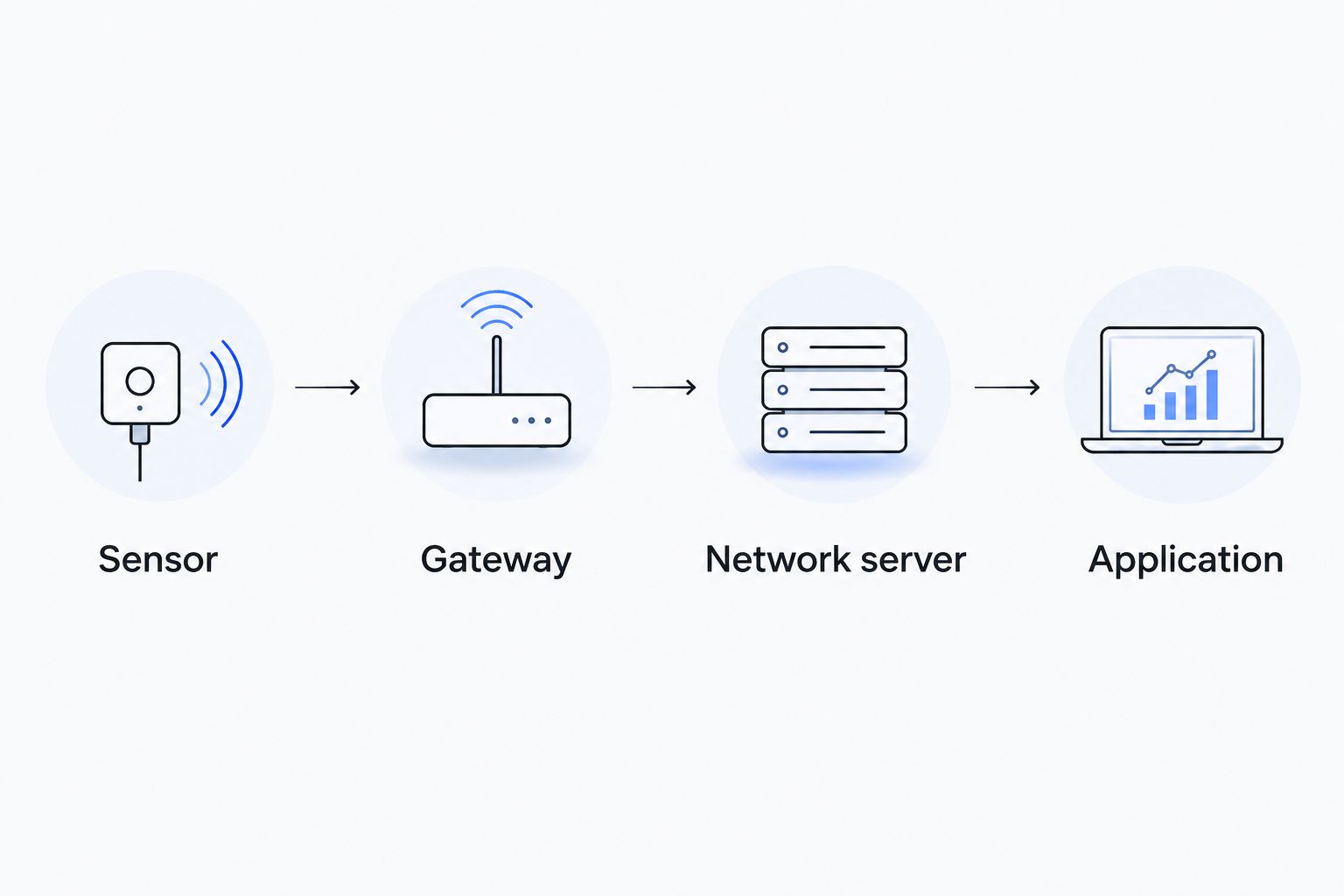
Avoid assuming that every missing application reading means the sensor must transmit more often. The fault can sit elsewhere in the system:
- Sensor: Measures conditions and transmits the encoded reading.
- Gateway: Receives radio traffic and forwards it over an internet connection.
- Network server: Handles LoRaWAN network functions and routes device data.
- Application: Decodes, displays, stores or acts on the reading.
A gateway internet outage does not necessarily stop the sensor from transmitting. Likewise, a payload-decoding problem can hide a reading that successfully crossed the radio network.
Improving gateway or antenna placement addresses a radio problem directly. Increasing sensor transmission frequency without diagnosing the fault can add activity without restoring useful data.
How do you assess a manufacturer's battery-life claim?
For a 2026 shortlist, compare documented assumptions side by side. A statement describing infrequent reporting at room temperature is not equivalent to one covering frequent measurements in a cold installation.
Use this sequence before accepting a lifetime estimate:
- Identify the exact device. Record the model, regional version, firmware where relevant and battery arrangement. Similar-looking variants need separate assessment.
- Read the operating assumptions. Find the measurement schedule, reporting schedule, radio assumptions and temperature conditions attached to the claim.
- Match the intended installation. Note differences such as external probes, frequent alarms, difficult reception or environmental exposure.
- Confirm the maintenance route. Establish whether the battery is replaceable, which replacement is approved and how the enclosure must be restored.
- Set an acceptance test. Confirm that readings arrive at the required interval from the final mounting position and that alerts behave as intended.
Battery capacity divided by average current gives a simplified lifetime estimate when the units are consistent. It is a planning calculation, not a guarantee: usable capacity, self-discharge, temperature, pulse loads and the device's operating-voltage limit also matter.
Do not turn a reporting-interval change into a proportional lifetime promise. Doubling the time between transmissions does not automatically double battery life because other loads remain.
Temperature and humidity versus CO₂: which lasts longer?
Temperature and humidity measurement can require less energy than some CO₂ measurement methods, but the category name alone does not establish which complete device lasts longer. Battery capacity, sensing technology, measurement frequency and firmware can change the comparison.
For CO₂ monitoring, distinguish the time between measurements from the time between transmitted updates. A device that continues measuring frequently while reporting less often still carries that measurement workload.
Also establish what the reading represents. Measured carbon dioxide and an estimated air-quality value derived from another sensing method are not interchangeable purchasing specifications.
For your 2026 comparison, choose the required measurement first. Selecting a lower-demand device that does not measure the quantity you need is not a useful battery-life improvement.
How do you plan battery replacement without losing data?
Start with the consequences of a missed reading and the effort needed to reach the sensor. Those determine how cautious the maintenance plan should be.
Record the commissioning date, installed battery type, configuration and mounting location. Where the device reports battery status, make that information visible in the application rather than leaving it buried in an undecoded payload.
Battery voltage is not automatically a reliable percentage gauge. Different battery chemistries have different discharge characteristics, and temperature or transmission pulses can affect the reported voltage. Interpret the value using the device's documented behaviour.
Use a missed-report alert alongside any supported low-battery warning. A sensor that stops reporting needs investigation even if its last battery reading looked acceptable.
Before replacement, confirm whether the device retains its configuration and how it resumes network operation. Afterwards, check the timestamp, measurement plausibility, enclosure closure and successful delivery to the application.
Where does hardware selection fit into the decision?
Kilo Electronics is a buying route for individuals and organisations comparing electronics and IoT hardware across manufacturers. As an online authorised dealer serving Europe, including the EU, UK and Switzerland, Kilo Electronics provides a hardware-purchasing route rather than determining a sensor's battery performance.
Build your shortlist around the required measurement, installation conditions and maintenance access. Then compare complete requirements: sensor, approved battery, mounting hardware, any external probe and the gateway or network access needed for the installation.
The limitation is straightforward: a catalogue category does not establish a model's runtime. For a 2026 order, keep the exact device's battery-life assumptions with the purchasing decision so that the installer and maintenance owner work from the same information.
FAQ
How long does a LoRaWAN environmental sensor battery last?
A LoRaWAN environmental sensor's battery lasts according to its usable battery capacity and operating workload, not a universal LoRaWAN duration. Use the exact model's documented estimate and compare its measurement, reporting, radio and temperature assumptions with your installation.
Does a longer reporting interval always extend LoRaWAN sensor battery life?
A longer reporting interval reduces routine transmission activity, but the overall benefit depends on measurement and standby consumption. It does not automatically change how often the sensor takes readings.
Can weak signal strength shorten sensor battery life?
Difficult radio conditions can shorten battery life through radio settings, repeated transmissions or joining behaviour. Diagnose reception and network operation before increasing the reporting frequency.
Do CO₂ sensors use more battery than temperature sensors?
CO₂ measurement can demand more energy than temperature measurement, depending on the sensing method and operating schedule. Compare complete devices and their documented conditions rather than assuming every CO₂ sensor has the same demand.
Can I replace a LoRaWAN sensor battery myself?
You can replace the battery only where the device is designed for user replacement and its instructions permit it. Use the approved battery type and follow the procedure for opening, resealing and recommissioning the device.
Does a LoRaWAN gateway power the sensor?
A normal battery-operated LoRaWAN sensor powers itself; the gateway receives its radio transmissions. The gateway's own power supply and internet connection are separate requirements.
Is battery voltage the same as remaining battery percentage?
Battery voltage is not the same as remaining battery percentage. Chemistry, temperature and load affect the reading, so interpret it using the device's documented battery-status method.
One last thing
The best battery-saving change can be a mounting change, not a reporting change. If moving a sensor or improving gateway placement produces a better radio link, you address the communication problem without deliberately making your environmental data less timely.
Before accepting the final installation, confirm both requirements together: the sensor measures the intended environment, and its messages reliably reach the application. A good radio position that measures the wrong conditions is not a successful installation.