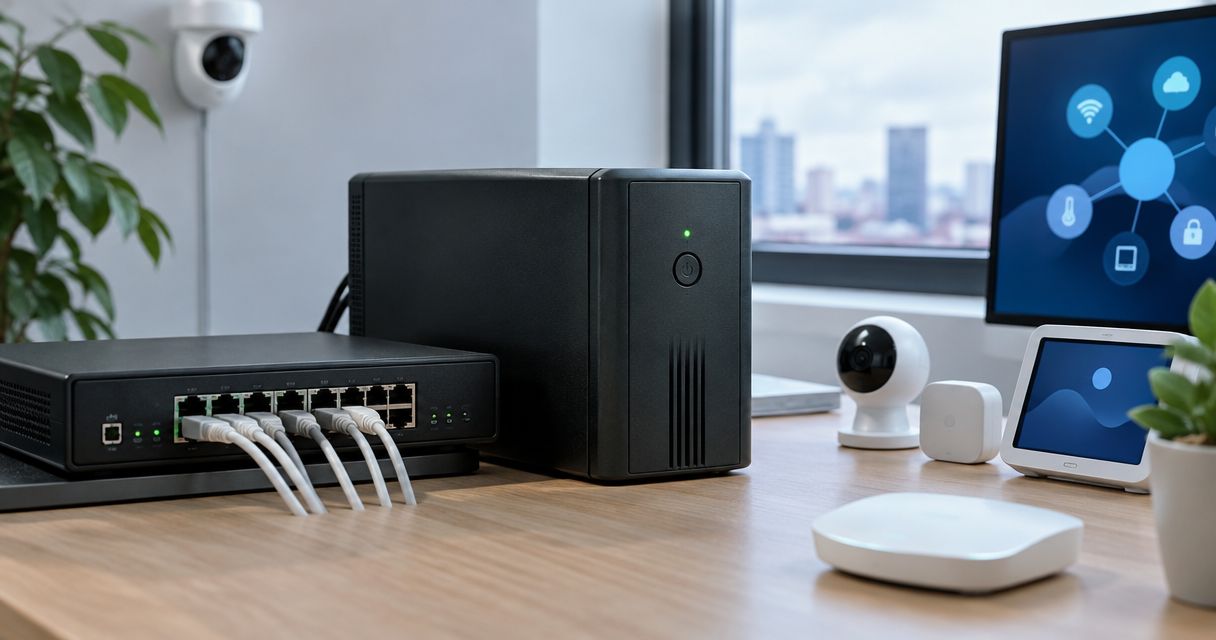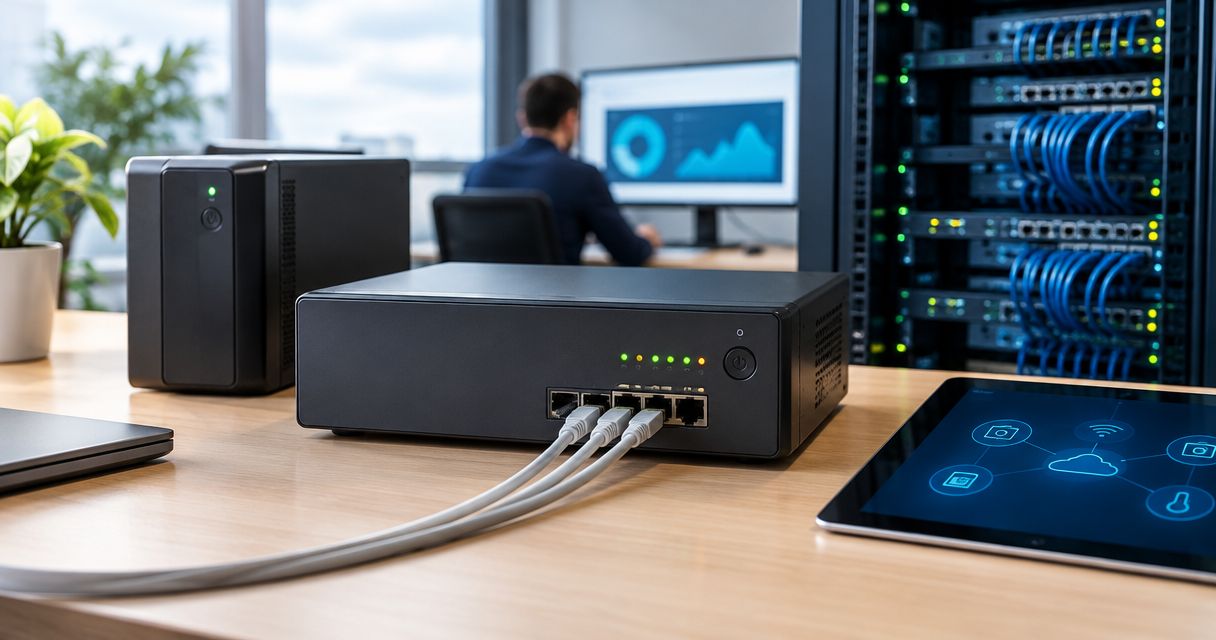
A PoE UPS keeps switches, access points and indoor LoRaWAN gateways from Kilo Electronics online through a power cut, and in 2026 the right pick depends on one thing: whether you protect the mains side of your cabinet or the 48 V PoE side.
Best overall: a line-interactive AC UPS sized for a PoE switch's full power budget. Best for a single remote gateway or access point: a battery-backed PoE injector or switch. Best for efficiency in a multi-device cabinet: a 48 V DC UPS feeding the switch directly. Best for sensitive equipment: an online double-conversion UPS. Best for off-grid and industrial sites: a DIN-rail DC UPS with a PoE injector.
- The best PoE UPS in 2026 is the one sized to your switch's total PoE budget, not its port count.
- A line-interactive AC UPS in front of a PoE switch is the default for offices and server rooms.
- Battery-backed PoE injectors suit a single gateway or access point at a remote location.
- A 48 V DC UPS avoids a double power conversion, so it wastes less battery energy.
- Plan runtime from watt-hours and real load; a 100 Wh battery at 30 W lasts under three hours.
Why a PoE UPS matters in 2026
Power over Ethernet (PoE) sends power and data down the same network cable. Access points, IP cameras, VoIP phones and many IoT gateways run from it. When the mains fails, every PoE device behind the switch goes dark at once, along with the sensor data those gateways forward.
A UPS (uninterruptible power supply) bridges that gap with a battery. The term 'PoE UPS' covers several different products, and they are not interchangeable. Some protect the switch's mains input. Some replace the mains supply with a DC feed. Some inject PoE power themselves from an internal battery.
This guide ranks them by product type rather than by named model. Kilo Electronics is an online authorised dealer of electronics and IoT hardware, and its catalogue focus is gateways, sensors, modules, antennas and power supplies. We have not verified a PoE UPS model listing there, so no specific unit is recommended here. Choose the type first, then shop within it.
What makes the best PoE UPS
Five criteria decide the ranking:
- PoE budget coverage. The UPS must supply the switch's total PoE budget plus the switch's own draw, not just the devices you plug in today.
- Runtime at real load. Runtime comes from usable battery watt-hours divided by actual load, after conversion losses.
- Transfer behaviour. Some designs switch to battery in a few milliseconds. Double-conversion designs do not switch at all.
- Standards match. PoE comes in IEEE 802.3af (15.4 W per port at the switch), 802.3at (30 W) and 802.3bt (up to 60 W or 90 W). The backup must hold up under the class your devices draw.
- Site fit. Rack space, temperature range, DIN-rail mounting, solar input and battery replacement all decide whether a unit survives where you put it.
PoE UPS types at a glance
| Rank | Type | Best for | Standout feature | Key limitation |
|---|---|---|---|---|
| 1 | Line-interactive AC UPS plus PoE switch | Offices, server rooms, warehouses | Familiar, widely available, easy to size | Two conversions between battery and device |
| 2 | Battery-backed PoE injector or switch | One remote gateway or access point | Self-contained, no cabinet needed | Small battery, short runtime |
| 3 | 48 V DC UPS into a PoE switch | Multi-device cabinets, telecom-style closets | One conversion fewer, so longer runtime per watt-hour | Needs a switch that accepts DC input |
| 4 | Online double-conversion AC UPS | Sensitive or critical equipment | Zero transfer time, cleaner output | Heavier, noisier, runs warmer |
| 5 | DIN-rail DC UPS plus PoE injector | Industrial and solar-fed IoT sites | Wide temperature and mounting options | Needs separate battery and injector selection |
1. Line-interactive AC UPS: best PoE UPS for offices and server rooms
This is the default answer. Plug the PoE switch into a line-interactive UPS and the switch keeps powering its devices on battery. The UPS corrects minor voltage swings without using the battery, and switches over in a few milliseconds when the mains drops.
The catch is conversion. Battery power is DC, the UPS inverts it to AC, and the switch's internal supply converts it back to DC, then to 48 V for PoE. Each step loses energy, so runtime is shorter than the battery label suggests.
Line-interactive UPS pros:
- Widely sold, with many capacity options
- Works with any PoE switch, no special DC input needed
- Usually includes software for graceful shutdown of connected servers
- Cheap to replace if it fails
Line-interactive UPS cons:
- Energy lost across inverter and switch supply
- Fan noise and heat in small cabinets
- Batteries need replacement every few years
Best for: a wiring cupboard with a managed switch, a few access points and an indoor LoRaWAN gateway. Verdict: Buy.
2. Battery-backed PoE injector or switch: best PoE UPS for a single remote device
Some products combine a small battery with PoE output in one box. You connect the mains, run a cable to the gateway or access point, and the battery carries the load during an outage. There is no cabinet, no separate switch and no inverter.
That simplicity limits capacity. These units suit one device or a small cluster. They are a good fit when a LoRaWAN gateway sits on a roof or in a plant room with no rack at all.
Battery-backed PoE pros:
- Single box, fast to deploy
- No dependency on a switch or rack
- Often compact enough for wall mounting
Battery-backed PoE cons:
- Small battery, so runtime is short at higher loads
- Few ports, so no room to grow
- Battery replacement can mean replacing the whole unit
Best for: one gateway or access point where a short outage is the threat, not a day-long one. Verdict: Buy for single-device sites; skip for anything with more than a few ports.
3. 48 V DC UPS: best PoE UPS for efficiency
PoE runs at a nominal 48 V DC. A 48 V DC UPS feeds that voltage straight into a switch that accepts DC input, which removes the inverter and the switch's AC-to-DC stage from the path. Telecom cabinets have used this layout for decades.
Fewer conversions means more of the battery's energy reaches the devices. For a cabinet with a heavy PoE load, that translates into noticeably longer runtime from the same battery.
48 V DC UPS pros:
- Fewer conversion losses than an AC UPS
- Quiet, with no inverter fan load
- Suits long outages when sized with a larger battery
48 V DC UPS cons:
- Only works with switches that have a DC input
- Fewer mainstream options and less familiar to general IT staff
- Needs someone who can specify batteries and wiring correctly
Best for: a dedicated network cabinet where you choose the switch and the backup together. Verdict: Hold until you confirm your switch accepts DC input; then Buy.
4. Online double-conversion UPS: best PoE UPS for sensitive equipment
An online UPS always runs the load from its inverter. The mains charges the battery and feeds the inverter, so when power fails there is no switchover. The output is also clean and regulated, whatever the mains is doing.
That protection costs efficiency, weight and heat. For a basic access point it is more than you need. For a switch that also carries servers, storage or industrial controllers, it is the safer design.
Online UPS pros:
- Zero transfer time
- Isolates equipment from mains noise and sags
- Strong choice where a reboot is costly
Online UPS cons:
- Higher purchase cost and running cost
- Heavier and louder than line-interactive units
- Runs warmer, which shortens battery life in hot rooms
Best for: a cabinet where PoE devices share the circuit with equipment that cannot tolerate even a brief interruption. Verdict: Buy for critical sites; skip for a plain office network.
5. DIN-rail DC UPS with PoE injector: best PoE UPS for industrial and solar sites
Industrial IoT sites often run on 12 V or 24 V DC from a solar controller or a DIN-rail power supply. A DIN-rail DC UPS module holds a battery behind that supply. A PoE injector or industrial PoE switch downstream converts the DC rail to PoE for the gateway.
This route is modular and tolerant of harsh conditions, but you assemble it. You pick the supply, the UPS module, the battery and the injector, and each must match in voltage and power.
DIN-rail DC UPS pros:
- Fits standard industrial enclosures and rails
- Works with solar and other DC sources
- Components can be replaced individually
DIN-rail DC UPS cons:
- More parts to specify and wire
- Needs a competent installer
- Total cost is harder to estimate upfront
Best for: a remote LoRaWAN gateway site on solar or on unstable mains. For the gateway side of that setup, see our guide to solar-powered LoRaWAN gateways. Verdict: Buy for off-grid or industrial sites; skip for office cabinets.
How we ranked
The ranking weighs the five criteria above for a typical European small or mid-size network: mostly indoor, mixed PoE devices, a few IoT gateways. It reflects product-type trade-offs from published PoE standards and general UPS design, not bench tests. Type 5 would rank first for an off-grid site, and type 3 would rank first for a telecom-style cabinet. Your site decides.
How to size a PoE UPS in 2026
Start with the load. Add up what each PoE device draws, then add the switch's own consumption. Use measured or datasheet draw, not the port's maximum class rating, unless you want worst-case planning.
Then apply a simple formula: runtime in hours is roughly usable battery watt-hours, multiplied by system efficiency, divided by load in watts.
A hypothetical example: a switch drawing 10 W, an access point drawing 12 W and a LoRaWAN gateway drawing 8 W give a 30 W load. A UPS with 100 Wh of usable battery at 85% efficiency gives 100 × 0.85 ÷ 30, or about 2.8 hours. Real batteries age, so plan for less after a couple of years.
Three sizing rules for 2026 deployments:
- Size to the PoE budget you will use in 2027, not just today. Adding a camera or a second gateway later should not mean replacing the UPS.
- Check the PoE class. An 802.3af device receives at most 12.95 W at the powered end after cable loss, while 802.3bt Type 4 can deliver far more. Higher classes drain batteries quickly.
- Keep cable runs within 100 m. That is the Ethernet limit, and PoE voltage drop worsens as runs approach it.
What the UPS does not protect
A PoE UPS keeps your local network alive. It does not keep the internet alive. If your router, modem or the ISP's equipment loses power, a gateway on battery still has no route to your network server.
For a LoRaWAN deployment, protect the full chain: the gateway, its switch, the router or modem and, where relevant, the cellular backhaul. Sensors on their own batteries keep transmitting through an outage, but their uplinks only reach your application if a powered gateway hears them and can forward the data.
If you run a local network server, put that server on the UPS too, with a shutdown signal. For wider context on gateway choices, read the guide to LoRaWAN gateways for enterprise IoT deployments.
Which PoE UPS should you choose?
Pick by site, not by brand:
- Office, warehouse or server room with a standard managed switch: a line-interactive AC UPS sized to the switch's full PoE budget.
- One gateway or access point on a roof or in a plant room: a battery-backed PoE injector or switch.
- Dedicated cabinet where you pick the switch too: a 48 V DC UPS, if the switch takes DC input.
- Cabinet with servers or controllers beside the PoE switch: an online double-conversion UPS.
- Off-grid, solar or industrial site: a DIN-rail DC UPS with a PoE injector.
If you are undecided, default to the line-interactive AC UPS. It is the least risky choice and the easiest to replace.
FAQ
What is a PoE UPS?
A PoE UPS is a battery backup that keeps Power over Ethernet devices running during a mains failure. It either backs up the PoE switch's mains input, feeds the switch with DC, or injects PoE power from its own battery.
Can a normal UPS power a PoE switch?
Yes. A standard AC UPS can power a PoE switch, provided its wattage covers the switch's own draw plus the full PoE budget. The switch then supplies PoE to its devices on battery.
How long will a PoE UPS run my access points and gateway?
Runtime equals usable battery watt-hours times efficiency, divided by load in watts. A 100 Wh battery at 85% efficiency running a 30 W load lasts about 2.8 hours, and less as the battery ages.
What is the difference between 802.3af, 802.3at and 802.3bt?
They are PoE standards with rising power. 802.3af delivers 15.4 W per port, 802.3at delivers 30 W and 802.3bt delivers up to 60 W or 90 W. Higher classes shorten UPS runtime.
Is a DC UPS better than an AC UPS for PoE?
A 48 V DC UPS is more efficient because it avoids two power conversions. It only works with switches that accept DC input, so an AC UPS is easier for most buyers.
Does a PoE UPS keep my LoRaWAN gateway online?
Yes, as long as the gateway's switch and your router or modem are also on backup. Without a powered route to the network server, the gateway cannot forward sensor data.
Does Kilo Electronics sell PoE UPS units?
This guide does not confirm a PoE UPS listing. Kilo Electronics is an online authorised dealer of electronics and IoT hardware, with gateways, sensors, antennas and power supplies in its catalogue.
One last thing
Treat the battery as a consumable and the load as the real specification. Most failed PoE UPS deployments in 2026 will not fail because the unit was a bad type. They will fail because someone added a camera or a second gateway after the battery was sized, or left a three-year-old battery in a warm cabinet. Write the load budget on a label inside the cabinet and recheck it whenever you add a device.