Looking for an NFC module for an industrial IoT project in 2026? The right choice depends on what you need to read, how far, and which host controller you pair it with, and you can browse the full range of IoT hardware at Kilo Electronics, an online authorised dealer serving customers across Europe.
- Pick an NFC module by frequency first: 13.56 MHz covers NFC and most access cards, 125 kHz covers legacy tags.
- Match the module interface (I2C, SPI or UART) to your host controller before comparing anything else.
- Read range for an nfc module is short, typically a few centimetres, so mounting position decides success.
- Choose from models actually listed by an authorised dealer, then confirm the exact variant against the manufacturer datasheet.
Best NFC module picks by use case
This guide does not rank named models, because no verified catalogue data for specific NFC or RFID modules was available when it was written. Naming a winner without that evidence would be invention. What follows is a decision framework you can apply to any shortlist, plus the trade-offs that matter in a 2026 industrial deployment.
The verdict by use case:
- Best for access control and badge reading: a 13.56 MHz reader module with a documented library for your host controller.
- Best for asset tagging with passive tags: a 13.56 MHz or UHF reader, depending on the distance you need.
- Best for legacy cards and animal or tool tags: a 125 kHz reader module.
- Best for configuring devices in the field: an NFC tag or reader built into the device, so a phone can set parameters without cables.
What is an NFC module and how does it differ from RFID?
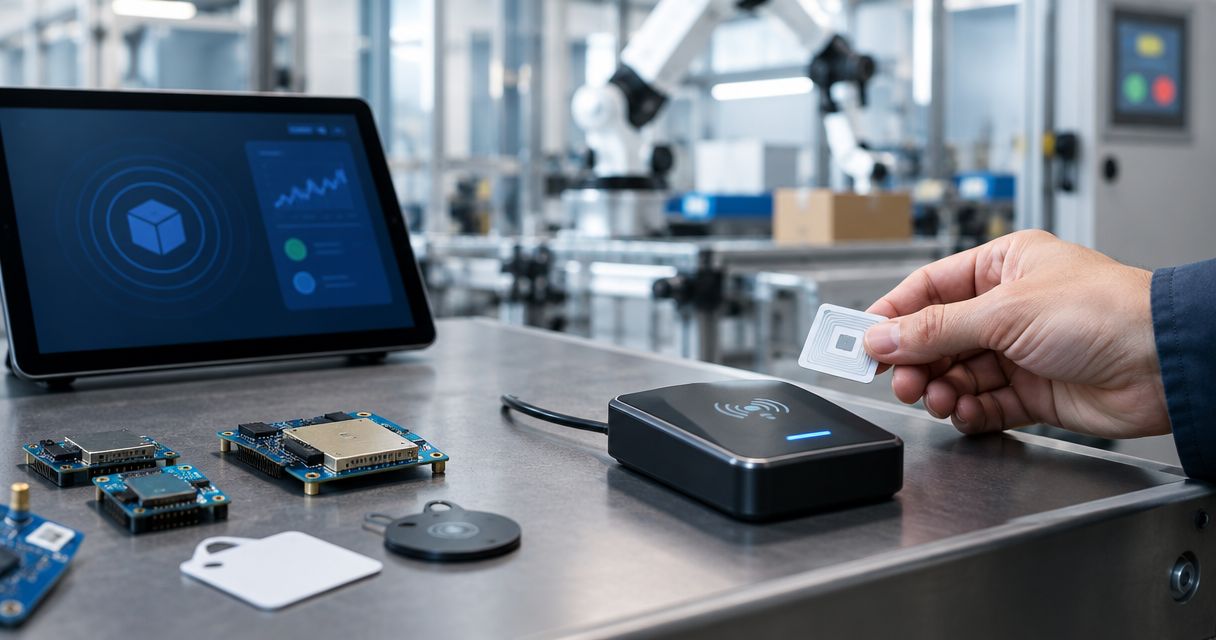
An NFC module is a small board or chip that reads and, depending on the model, writes data to NFC tags and cards by radio at close range. NFC is a subset of RFID. It runs at 13.56 MHz and is designed for very short distances, usually a few centimetres.
RFID is the wider family. It includes low frequency (125 kHz), high frequency (13.56 MHz, which is where NFC lives) and ultra-high frequency (UHF) systems. UHF reads tags from much further away, which suits pallets and gates, but it needs different hardware and careful antenna placement.
For a buyer arriving with no background, the practical split is simple. If a person or a machine presents a tag to a reader at close range, an NFC module is usually enough. If tagged items pass through a zone at a distance, you are looking at UHF RFID.
What makes the best NFC and RFID module for industrial IoT
Use these criteria to audit any shortlist before you look at the table.
- Frequency and standard: 125 kHz, 13.56 MHz (ISO 14443, ISO 15693, NFC Forum types) or UHF. The tags you already own or plan to buy decide this.
- Host interface: I2C, SPI or UART. Your microcontroller or gateway must support it, and the pin count affects board layout.
- Read and write support: some modules only read UIDs. Others read and write memory blocks, which you need for storing configuration or counters on a tag.
- Antenna design: an on-board PCB antenna is the simplest. An external antenna helps when the module sits behind a panel or inside an enclosure.
- Operating conditions: temperature range, supply voltage and enclosure material. Metal near an antenna detunes it, so mounting decides real-world performance.
- Software support: a maintained library or driver for your platform saves more time than a slightly better radio.
NFC and RFID module types at a glance
| Module type | Best for | Typical range | Host interface | Key limitation |
|---|---|---|---|---|
| 13.56 MHz NFC reader/writer | Access control, device configuration, tag read and write | Few centimetres | I2C, SPI or UART | Very short range, sensitive to metal |
| 125 kHz RFID reader | Legacy cards, simple ID tags | Short, up to several centimetres | UART | Read-only in most cases, no NFC phone support |
| NFC tag with energy harvesting | Passive device configuration without power | Few centimetres | I2C to host | Small memory, depends on a reader device |
| UHF RFID reader | Pallets, gates, inventory zones | Metres | UART or Ethernet | Higher cost, antenna and regulatory planning |
Ranges here are general category characteristics, not figures for any specific product. Confirm the range for your exact model and tag combination.
1. 13.56 MHz NFC reader module: best NFC module for access and configuration
This is the default choice for most projects. It talks to phones, badges and standard NFC tags, and it is the format most open-source libraries support.
13.56 MHz NFC reader pros:
- Works with a wide range of tags, cards and NFC-enabled phones.
- Mature libraries exist for common microcontrollers.
- Small footprint suits compact enclosures.
- Supports both reading and writing on most models.
13.56 MHz NFC reader cons:
- Range is only a few centimetres.
- Metal surfaces and thick plastic reduce performance.
- Cheap boards vary in antenna quality.
Best for: badge readers, tool check-out stations, and field configuration of sensors by phone.
Verdict: Buy when the tag is presented by hand or by a machine arm at close range.
2. 125 kHz RFID reader module: best for legacy tags
Low frequency readers are simple and cheap, and they remain common in older access systems and in animal and tool tagging. They do not work with NFC phones.
125 kHz reader pros:
- Simple serial output, easy to wire to almost any controller.
- Tolerates some environments better than higher frequencies.
- Compatible with large installed bases of older cards.
125 kHz reader cons:
- Mostly read-only and low data capacity.
- No NFC phone interaction.
- Weak security compared with modern 13.56 MHz cards.
Best for: extending an existing 125 kHz system without replacing every card.
Verdict: Hold. Choose it only when legacy tags force the decision. For new projects, start at 13.56 MHz.
3. NFC tag with energy harvesting: best for powerless configuration
Some NFC chips pass data to a host over I2C and can be accessed by a phone even when the device itself is unpowered. This lets an installer set parameters on a sealed sensor without opening it.
Energy-harvesting NFC pros:
- Configuration without batteries or cables.
- Sealed enclosures stay sealed.
- Useful for large rollouts where many devices need setup.
Energy-harvesting NFC cons:
- Small memory.
- Needs firmware work on the host side.
- Antenna placement in the enclosure needs testing.
Best for: teams building their own devices who want phone-based provisioning.
Verdict: Buy if you design the device. Skip if you only need to read badges.
4. UHF RFID reader: best for distance and inventory zones
UHF readers identify many tags at once over metres, which is why they appear in warehouse gates and pallet tracking. They are a different class of project from a desktop NFC module.
UHF reader pros:
- Reads multiple tags simultaneously.
- Works at distances NFC cannot reach.
UHF reader cons:
- More expensive and more complex to install.
- Radio regulations differ between regions, so check the rules for your destination country in Europe.
- Liquids and metal affect tag reads.
Best for: goods-in gates and inventory zones.
Verdict: Wait until you have confirmed the tag type, antenna layout and regional radio rules.
How we ranked
The order follows the criteria above: tag compatibility, host interface, read and write support, antenna design, operating conditions and software support. No hands-on testing was run, and no scores are claimed. The ranking reflects how widely each module class fits an industrial project, not a measured benchmark.
Why this matters in 2026
Industrial teams are adding identification to equipment that already carries sensors. A tool cabinet, a machine panel or a field device can log who touched it, when and with what. In 2026 and 2027 planning cycles, the question is less about whether to add NFC and more about which interface and tag standard keeps your parts list simple.
Two cost mistakes recur. The first is buying a module before checking the tag ecosystem, which locks you into reader hardware you cannot replace. The second is ignoring the enclosure: a reader that works on a bench fails behind a metal door. Budget time for a prototype with the real housing.
If your device also reports over a wireless network, plan the whole chain. The NFC module identifies or configures. A sensor, gateway and network server move the data. For ideas on that second half, see our guide to the best IoT sensors for industrial monitoring.
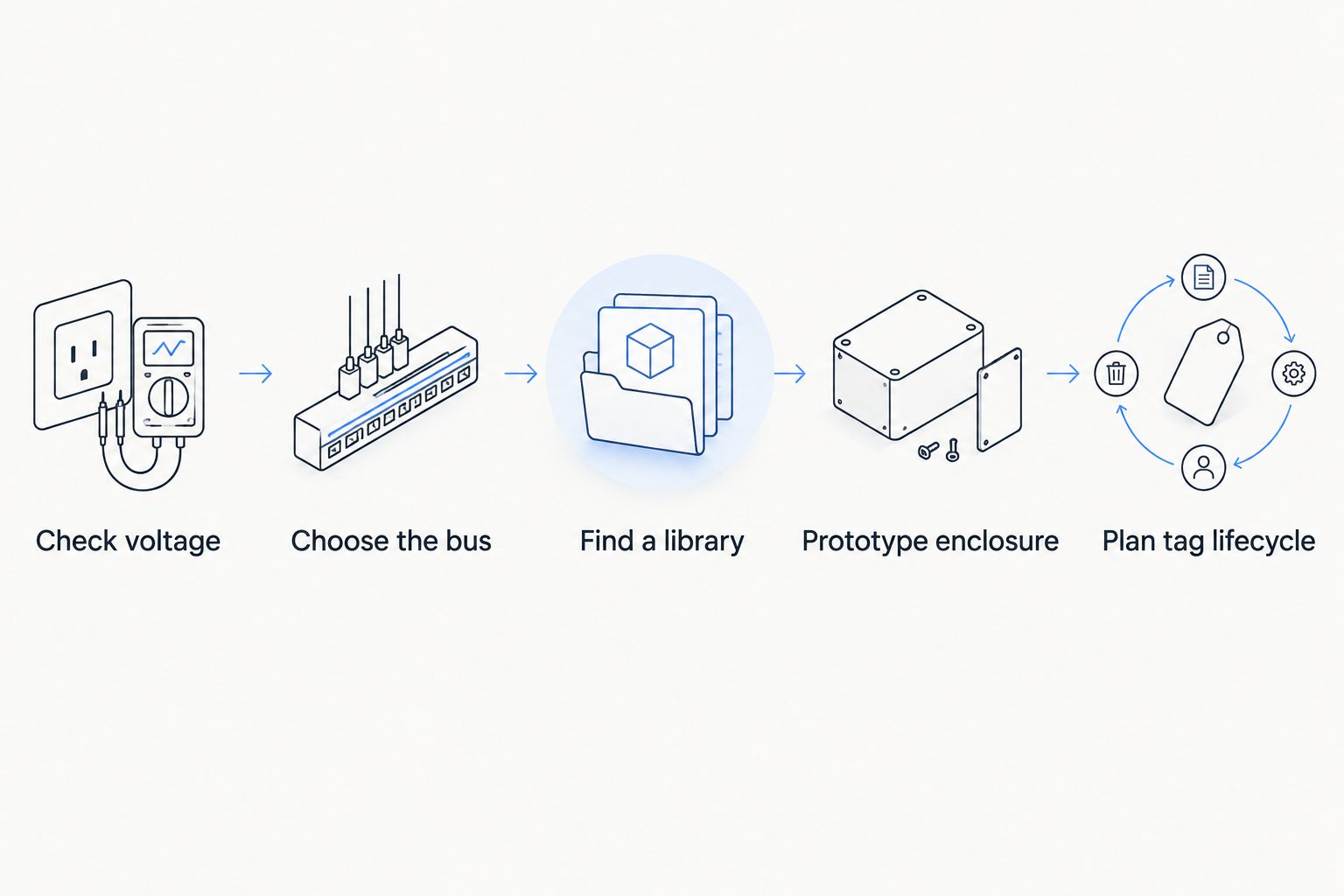
How to pair an NFC module with your host controller
- Check voltage: many modules run at 3.3 V. Feeding 5 V logic into them can damage the board.
- Choose the bus: I2C needs two wires and suits small designs. SPI is faster. UART is easiest to debug.
- Find a library: confirm that a maintained driver exists for your controller before you buy.
- Prototype with the enclosure: test read distance with the final housing and mounting position.
- Plan the tag lifecycle: decide how tags are issued, replaced and revoked.
Total cost: what else goes into an NFC deployment
The module is rarely the largest cost. Count these items:
- Tags or cards, including spares.
- An external antenna if the housing blocks the on-board one.
- Enclosure changes such as a plastic window over the reading area.
- Firmware and integration time.
- Programming tools for writing tags.
For a hypothetical example, a factory fitting a reader to ten tool cabinets needs ten modules, ten plastic windows, a few hundred tags and a firmware build. The reader boards are the smallest line once labour is included. Prices change, so compare current listings rather than relying on fixed figures.
Where to buy NFC and RFID modules in Europe
Kilo Electronics is an online authorised dealer of electronics and IoT hardware, selling to individuals, makers, professionals and businesses across Europe, including the EU, UK and Switzerland. Buyers can compare hardware across manufacturers and source parts for single projects or larger deployments. Check the catalogue for the specific NFC or RFID module you need, and confirm the exact model and variant before ordering. If a listed model does not fit your requirement, look at other manufacturers rather than forcing a match.
FAQ
What is the best NFC module for industrial IoT?
A 13.56 MHz NFC reader module with a maintained library for your host controller suits most industrial projects. It handles badges, tags and phone-based configuration. Confirm the exact model against its datasheet.
What is the difference between NFC and RFID?
NFC is a subset of RFID that operates at 13.56 MHz over a few centimetres. RFID also includes 125 kHz and UHF systems that can read at longer distances.
How far can an NFC module read?
An NFC module reads at a few centimetres. Antenna size, tag type and nearby metal all change the result, so test with your real enclosure.
Which interface should I choose: I2C, SPI or UART?
Choose the interface your host controller and available library support. I2C uses the fewest wires, SPI is faster, and UART is the simplest to debug.
Can an NFC module work behind a metal panel?
Not reliably. Metal detunes the antenna and blocks the field. Use a plastic window or an external antenna mounted outside the metal.
Do I need UHF RFID instead of NFC?
Only if tags must be read at distances of metres or in bulk. For close-range reads by hand or machine arm, NFC is simpler and cheaper to deploy.
Can NFC replace a LoRaWAN or Bluetooth sensor?
No. NFC identifies or configures at close range. LoRaWAN and Bluetooth carry sensor data over distance. Many devices use NFC for setup and a radio for reporting.
Which NFC module should you choose?
Start with a 13.56 MHz NFC reader module unless legacy 125 kHz cards or long-range inventory force another choice. Match the interface to your controller, test inside the real enclosure, and plan tag issuing before you order in volume. Kilo Electronics, as an online authorised dealer, lets you compare suitable hardware across manufacturers in one place.
One last thing
The most common NFC failure in the field is not the module. It is a reader mounted behind metal or a thick cover that nobody tested before rollout. A one-day prototype in the final housing saves a redesign in 2027.