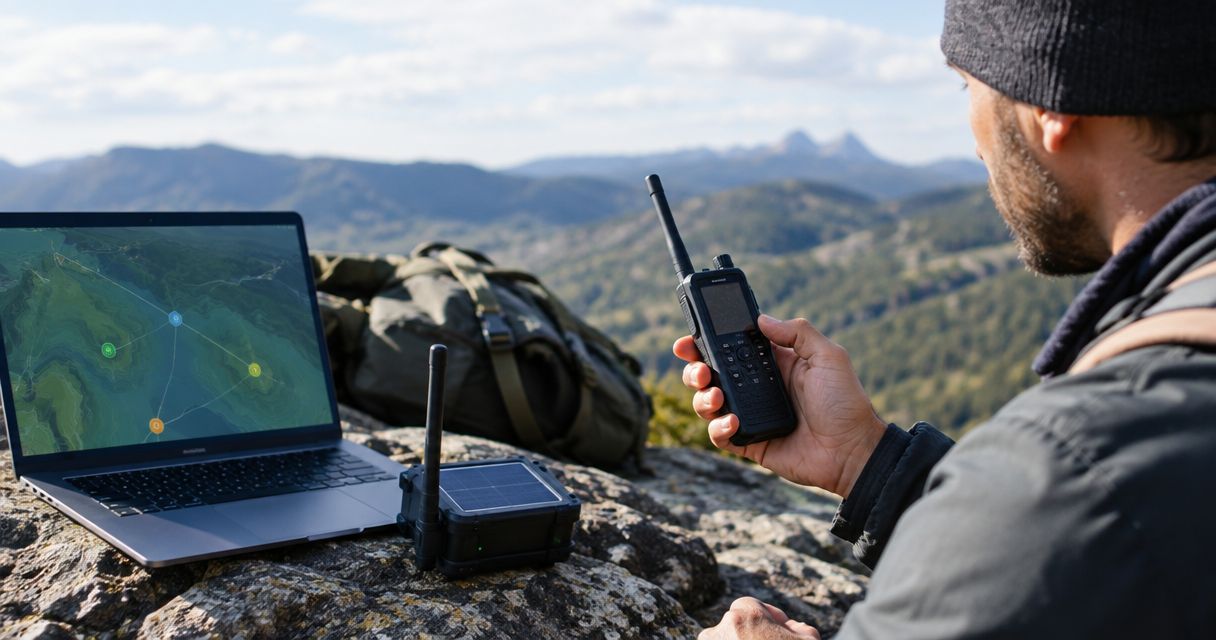
Meshtastic can replace a two-way radio for non-urgent text updates, but not for live voice coordination; compare Meshtastic alternatives if speaking is essential. For site work, keep a suitable voice system wherever people need immediate instructions, and use Meshtastic for messages that can tolerate a delay or missed delivery.
- Can Meshtastic replace a two way radio? Yes for routine text updates; no for live voice coordination.
- Meshtastic supports off-grid messaging, but coverage and message delivery still depend on the radio path.
- Two-way radios suit spoken instructions; Meshtastic suits written locations, references and non-urgent status updates.
- Use both when written records help but immediate voice contact remains necessary.
Can Meshtastic replace a two-way radio for site communication?
Meshtastic replaces a messaging task, not every function of a two-way radio. It sends small data messages over LoRa radio links rather than carrying a continuous voice conversation. A two-way voice radio lets someone press a button and speak to colleagues listening on the same channel or talkgroup.
For this comparison, “two-way radio” means a handheld push-to-talk voice radio. Professional radio systems can also support data and other functions, but those capabilities depend on the equipment and system.
| Approach | Best for | Main advantage | Main limitation |
|---|---|---|---|
| Meshtastic | Non-urgent written updates and off-grid project coordination | Sends text without requiring mobile coverage or an internet connection | Does not provide normal push-to-talk voice; delivery depends on connectivity and channel conditions |
| Two-way voice radio | Spoken instructions and immediate back-and-forth | Lets users communicate without composing a message | Speech can be missed, misunderstood or unsuitable for detailed written references |
| Meshtastic alongside voice radio | Sites needing both written details and spoken coordination | Keeps routine text separate from voice traffic | Adds equipment, charging and operating procedures |
Choose by the consequence of a missed message. “The spare cable is in the west store” and “stop moving the vehicle” do not belong in the same communications category.
Why this matters on a working site
A successful message demonstration does not prove that a system is suitable for daily operations. On a working site, people move behind buildings, put devices in pockets, work around machinery and forget to charge equipment.
The communication method must also fit the job. A clear text message is useful when a technician needs an equipment reference, but reading that message is inappropriate while driving or handling equipment that demands full attention.
For a 2026 deployment, start with the task rather than a range claim. Decide whether the receiver needs to read information later, acknowledge it promptly or respond while keeping attention on the work.
When Meshtastic is a good replacement
Best for: routine text communication where delays do not create a hazard. Meshtastic is useful when colleagues need short written updates without depending on mobile data, particularly on private projects, temporary sites or outdoor work areas.
Examples include asking where a spare part is stored, telling a colleague that an inspection is complete, or sharing a meeting location. Text preserves the actual reference instead of requiring someone to remember spoken details over background noise.
Meshtastic nodes are the radio devices participating in the network. Depending on the hardware, users interact through a connected phone or a device with its own controls and display. That distinction changes the buying decision: a small radio board is not automatically a complete handheld communicator.
The limitation is interaction. A worker must notice the message, open or view it, understand it and reply when necessary. A message reaching equipment is not proof that a person has read it or acted on it.
When a two-way voice radio remains the better choice
Best for: rapid spoken coordination and tasks needing immediate clarification. Push-to-talk voice lets someone give an instruction and hear the response without typing a sentence.
This matters when workers need to describe a changing situation, coordinate movement or correct a misunderstanding immediately. Voice also communicates urgency through speech, although noise, microphone technique and overlapping transmissions still affect intelligibility.
A radio is not automatically a safety system. Coverage, operating procedures, appropriate equipment and staff training remain necessary, and safety-critical duties require a system selected for those duties.
The trade-off is that spoken details are easy to miss. Equipment identifiers, names and directions sometimes need repetition. Where accurate written references matter, adding text communication is more useful than trying to make voice carry every detail.
When using both makes sense
Best for: mixed workflows with immediate coordination and detailed follow-up. Keep voice for instructions requiring attention now, and use Meshtastic for supporting information that people can read when the task allows.
For example, a supervisor might use voice to request a maintenance visit, then send the equipment reference and location as text. This is a hypothetical workflow, not evidence that a particular site has adequate Meshtastic coverage.
The combined approach only works if everyone knows which channel takes priority. Agree that urgent instructions use the designated voice system, and that an unread text is never treated as an accepted instruction.
The disadvantage is operational overhead. Users have more equipment to charge, carry and maintain. If the written messages add little value, a second system complicates the job without solving a real problem.
Why Meshtastic suitability varies between sites
Meshtastic performance depends on more than the distance between users. These factors determine whether text messaging is practical:
- Radio path: Buildings, terrain, metal structures and antenna placement affect whether devices can communicate. A route across open ground does not represent a route through plant rooms.
- Network settings: Nodes need compatible regional, channel and radio settings. Devices running Meshtastic are not automatically members of the same usable communications group.
- Traffic: Messages and retransmissions share radio airtime. Busy channels and repeated attempts reduce the room available for other traffic.
- Relay placement: A well-positioned node can help connect areas, but only while that node has power and a usable radio path. A relay is another dependency to maintain.
- User interface: A phone-connected node and a self-contained messaging device create different charging, handling and training requirements.
- Operating discipline: Charging, acknowledgements and escalation procedures determine whether people can rely on the workflow, even when the radio link works.
Do not buy against an advertised maximum distance. Test the actual locations, equipment positions and operating conditions your users will encounter.
Can Meshtastic work without mobile coverage or internet?
Yes, Meshtastic can exchange messages over its local radio network without mobile coverage or internet access. The participating devices still need compatible settings and a radio path, directly or through other participating nodes.
A phone connected locally to a Meshtastic node acts as an interface; it does not need mobile data for that local messaging route. However, a connected-phone workflow adds dependencies such as the phone battery, permissions and the local connection to the node.
Do not confuse Meshtastic with LoRaWAN. Both use LoRa radio technology, but Meshtastic is not a LoRaWAN sensor network. A LoRaWAN gateway is not a substitute for a Meshtastic node simply because both mention LoRa.
Does a mesh network guarantee message delivery?
No, a mesh network does not guarantee that every message reaches its recipient. Meshtastic can relay messages between nodes, but relaying cannot remove every coverage gap, channel conflict or power failure.
A node on a high point can help only if the required links reach it. Placing several devices together in the same obstructed room does not create a useful path around that obstruction.
Treat acknowledgements carefully as well. A delivery indication concerns the system's handling of a message, not necessarily a person's understanding. For operational instructions, require a clear human reply and define what happens when that reply does not arrive.
What should European buyers know about radio rules?
Choose the radio region for the country of use, not just the shop where you buy the device. Meshtastic regional settings govern radio behaviour, and the hardware must support the intended frequencies. Transmit power, antenna arrangements and airtime restrictions also matter.
For comparison, European PMR446 equipment operates in the 446 MHz band, with a maximum effective radiated power of 500 mW under the applicable PMR446 framework. Analogue PMR446 provides 16 channels. These are category characteristics, not specifications for Meshtastic devices or professional licensed radios.
Meshtastic is not a way to communicate directly with PMR446 handsets. The radio technology and communications formats differ, so matching the general purpose of “off-grid communication” does not create interoperability.
For work across the EU, UK and Switzerland, confirm the destination's current requirements before deployment. Licence-exempt operation does not mean unrestricted operation, and a software setting alone does not establish that a complete device complies.
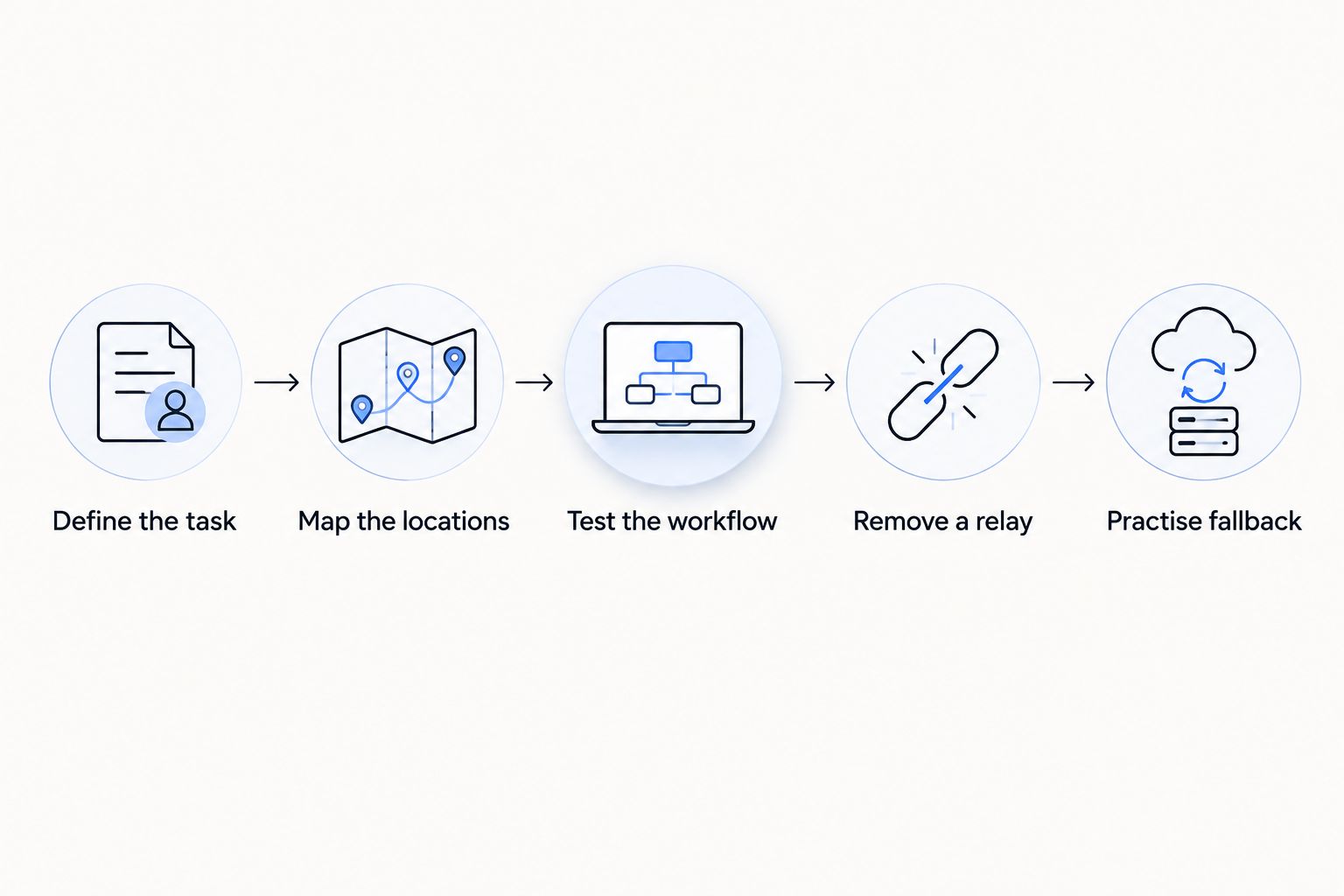
How do you test Meshtastic before replacing site radios?
Run a trial alongside the existing communication method. The trial should answer whether the proposed workflow works, not simply whether a message can travel between two convenient positions.
- Define the task. List the actual messages you want to move to Meshtastic. Separate routine status updates from instructions requiring immediate attention, and exclude safety-critical functions from an informal trial.
- Map the locations. Include entrances, storage areas, work zones and known obstructions. Test devices where people actually carry them, rather than holding every antenna in an unusually favourable position.
- Test the workflow. Send realistic messages with the chosen phones or standalone devices. Ask users to read and reply while following normal site rules, including restrictions on phone use.
- Remove a relay. Switch off a relay node deliberately and repeat the important routes. Record which areas lose service so the team understands the network's dependencies.
- Practise fallback. Agree what users do when a message receives no human reply. Keep the existing voice method available until the new workflow has a clear, accepted operating boundary.
Record missed messages and practical problems rather than relying on impressions. A result such as “works outside the workshop but not inside the metal store” gives you an installation decision; “the range seems good” does not.
Repeat the relevant tests after changing relay positions, antennas or settings. Those changes alter the system you evaluated, so earlier results no longer describe every part of the deployment.
What belongs on your buying checklist?
Shortlist complete working arrangements, not bare radio boards. Establish whether each user needs a phone, a display, input controls, an enclosure, an antenna, a battery and a charging arrangement.
For outdoor or dusty work, match the finished device to the environment. Protection claimed for an enclosure does not automatically cover exposed connectors, an open charging port or a different assembly built from separate parts.
Include installation and operating effort in the comparison: mounting relays, supplying power, replacing batteries, maintaining settings and training users. A low component count does not by itself mean a simple deployment.
Kilo Electronics is best suited to buyers comparing electronics and IoT hardware across manufacturers. The online authorised dealer serves individuals, makers, professionals and businesses across Europe; a catalogue purchase still needs to be matched to the communication task rather than treated as proof of site suitability.
Before ordering, write a short acceptance requirement: where communication must work, what users must do, and what happens if a message is missed. That requirement makes the shortlist more useful than a comparison based only on radio range.
FAQ
Can Meshtastic replace a two way radio on a construction site?
Meshtastic can replace some non-urgent text exchanges, but not live push-to-talk voice. Keep a suitable voice system for immediate coordination and assess any safety-related communication separately.
Can I talk through Meshtastic like a walkie-talkie?
No, standard Meshtastic messaging does not provide normal walkie-talkie voice communication. Choose a voice radio when users need to speak and respond immediately.
Do I need a phone for Meshtastic?
A phone is not required for every Meshtastic hardware arrangement. Some devices provide their own display and controls, while others need a connected phone for practical message entry and reading.
Will Meshtastic communicate with my existing PMR446 radios?
No, Meshtastic does not communicate directly with PMR446 voice radios. They use different radio systems and message formats.
Is Meshtastic suitable for emergency stop instructions?
Do not use Meshtastic as a substitute for a safety-rated emergency stop or an assessed safety communications system. Message delivery and human attention are not guaranteed.
Does adding more Meshtastic nodes always improve coverage?
No, additional nodes help only when their placement creates useful radio paths. Extra transmissions also consume shared airtime, so node count alone is not a coverage plan.
One last thing
Test whether people notice messages, not just whether devices receive them. A technically successful delivery can still fail the job when the recipient is wearing gloves, concentrating on machinery or unable to look at a screen.
Give trial users a realistic routine task and observe the full exchange, including the reply. If the workflow needs someone to shout “check your phone” before every useful response, Meshtastic has not replaced that site's voice communication.