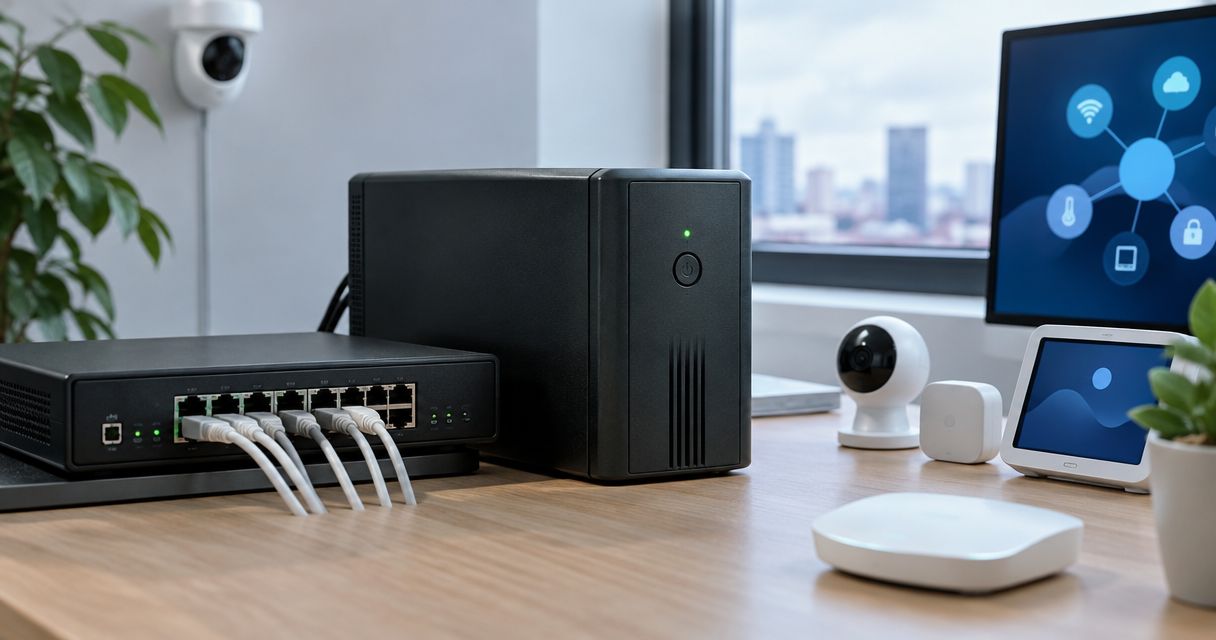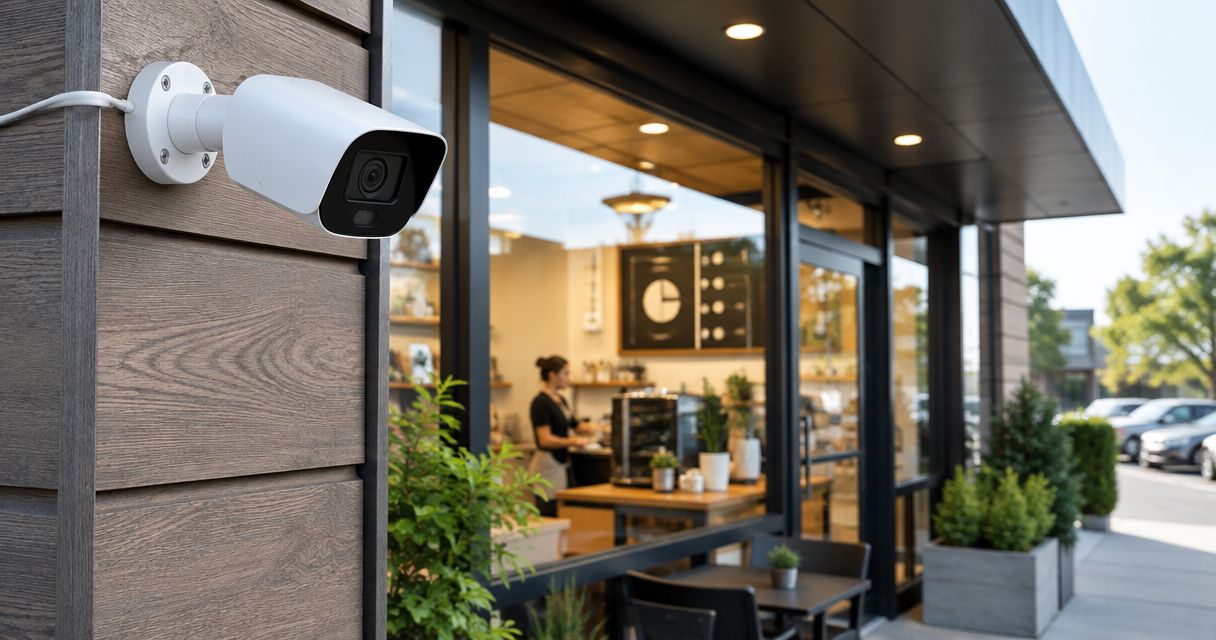
A PoE security camera takes power and video over a single network cable, and pairing it with a PoE UPS unit keeps a small business recording through short power cuts. This guide ranks camera types for 2026, not individual models, because the right choice depends on the space you are covering.
Best overall: the fixed turret or dome camera. Best for car parks and building perimeters: the bullet camera. Best for large open yards: the PTZ camera. Best budget set-up: a four-camera kit of fixed cameras on one PoE switch.
- A fixed 4MP turret or dome PoE security camera is the right default for most small businesses in 2026.
- Add up camera wattage before buying a PoE switch; 802.3af gives 15.4 W per port, 802.3at 30 W.
- Use bullet cameras outdoors, PTZ only where one operator needs to follow movement.
- Buy an NVR or recording software and a PoE UPS at the same time as the cameras.
Why PoE suits small business surveillance in 2026
PoE stands for Power over Ethernet. One Cat5e or Cat6 cable carries both data and electricity, so you do not need a mains socket next to every camera. A shop, workshop or small office can fit cameras at the ceiling line, the loading door and the car park without an electrician for each position.
The cable limit is the standard Ethernet run of 100 metres from switch to camera. For longer runs you add a PoE extender or a second switch in a cabinet. Plan this at the drawing stage, not on installation day.
PoE also puts all the power in one place. A single switch, backed up by one UPS, powers every camera. That is the main operational reason to choose it over cameras with separate power adapters or Wi-Fi cameras that still need a plug.
Kilo Electronics is an online authorised dealer of electronics and IoT hardware for individuals, makers, professionals and businesses across Europe, including the EU, UK and Switzerland. This guide is a buying framework for camera types and the supporting network hardware. It does not claim that every camera category below is in the Kilo Electronics catalogue, so match the criteria to whichever models you shortlist.
What makes the best PoE security camera
Six criteria decide the ranking below. You can audit the list before reading the table.
- Coverage fit: the camera type matches the space, whether a doorway, a corridor, a yard or a perimeter.
- Image quality in poor light: sensor size, infrared range and low-light processing matter more than the headline megapixel figure.
- PoE power draw: the camera must work within the port budget of your switch. Heaters, IR illuminators and motors raise the draw.
- Weather and tamper resistance: IP66 or IP67 for dust and water, IK10 for impact resistance on exposed outdoor mounts.
- Compression and storage: H.265 uses less storage than H.264 for the same picture, which directly lowers recorder cost.
- Recording and software: compatibility with a standard NVR through ONVIF, so you are not locked to one brand of recorder.
PoE security cameras at a glance
| Camera type | Best for | Standout feature | Key limitation |
|---|---|---|---|
| Fixed turret or dome | Shops, offices, corridors, entrances | Simple install, no glare from the lens glass | Fixed view, cannot follow movement |
| Bullet | Car parks, building perimeters, loading bays | Long visible body, clear deterrent, long IR reach | Easier to reach and aim away |
| PTZ | Large yards, sites with a security operator | Pan, tilt and optical zoom on one camera | Highest power draw, moving parts, blind spots while turned |
| Multi-sensor panoramic | Wide open areas, warehouse floors | Several lenses in one housing, one cable run | More expensive, needs a stronger PoE port |
| Fisheye 360 | Small shops, reception areas, meeting rooms | One camera covers a whole room | Distorted image until dewarped, poor detail at distance |
| Licence plate capable | Vehicle entrances, gates | Tuned shutter and angle for plates | Narrow job, needs precise mounting |
| Compact PoE indoor camera | Back offices, stock rooms, home offices | Small size, low power draw | Not weatherproof, limited low-light range |
1. Fixed turret or dome: best PoE security camera for shops and offices
A fixed turret or dome camera is the workhorse of small business surveillance. The turret style is a ball-shaped lens pod mounted on a flat base. The dome is a lens under a clear cover. Both mount quickly on a ceiling or wall.
Turret cameras avoid one common indoor problem. The infrared lights sit beside the lens, not behind a glass dome, so they do not bounce back and wash out the night image. Vandal-resistant domes suit areas where customers can reach the camera.
Turret or dome pros:
- Simple, cheap to install and cheap to replace.
- Low power draw, so most switches can run many of them.
- Wide range of resolutions from 2MP to 8MP.
- Dome covers hide the viewing direction.
Turret or dome cons:
- Fixed field of view; a bad aim at install time stays bad.
- Limited zoom, so facial detail drops quickly with distance.
Best for: shop floors, reception, corridors, small offices.
Verdict: Buy. This is the default PoE security camera for 2026 for anyone covering interior space.
2. Bullet camera: best PoE security camera for car parks and perimeters
A bullet camera is a tube-shaped body on a bracket. It is the usual outdoor choice because the housing has room for a larger sensor, a longer lens and a stronger infrared array.
The visible shape is also a deterrent. People see it and know they are on camera. That is useful at a car park entrance or a rear loading door.
Bullet pros:
- Longer infrared range than a similarly priced dome.
- Good weather sealing; look for IP66 or IP67.
- Easy to aim at a specific doorway or lane.
- Suits varifocal lenses, so you can adjust the field of view after install.
Bullet cons:
- Easier to knock out of alignment or turn away by hand if mounted low.
- Spiders and dust gather around the infrared window, which can cause night glare.
Best for: exterior walls, car parks, loading bays, fence lines.
Verdict: Buy for outdoor perimeters. Mount at a height out of reach and use a junction box for the cable entry.
3. PTZ camera: best PoE security camera for large yards
PTZ means pan, tilt and zoom. One camera can sweep a yard, then zoom in on a vehicle. For a site with someone watching a screen, one PTZ can replace several fixed cameras at the far end of a large space.
The trade-off is that a PTZ only watches one direction at a time. If it is zoomed on the gate, it is not recording the fence. Many sites pair a PTZ with fixed cameras that give continuous overview coverage.
Power is the other issue. Motors and heaters push many outdoor PTZ models beyond 802.3af. Check whether the camera needs 802.3at (30 W) or 802.3bt (up to 60 W or 90 W depending on type) and size your switch to match.
PTZ pros:
- Optical zoom gives usable detail at distance.
- Automatic tracking and preset tours on many models.
- One cable run covers a very large area.
PTZ cons:
- Highest power draw of any type here.
- Moving parts wear out.
- Blind spots whenever the camera is pointed elsewhere.
Best for: yards, depots, sites with a live operator.
Verdict: Hold. Buy only when someone will actually use it. Otherwise two fixed bullets cover more of the time.
4. Multi-sensor panoramic camera: best PoE security camera for open floors
A multi-sensor camera puts several lenses in one body and stitches or presents their views together. It covers a wide arc, such as a warehouse aisle junction or a large car park, on a single network cable and a single licence on many recorders.
Multi-sensor pros:
- Wide continuous coverage without gaps between separate cameras.
- One cable, one mounting point.
- Often supports high combined resolution.
Multi-sensor cons:
- Higher cost than two or three fixed cameras for similar coverage.
- Draws more power and needs more recorder bandwidth.
Best for: warehouses, large open-plan areas, wide forecourts.
Verdict: Wait until a simple layout of fixed cameras has proved insufficient. For small premises it is rarely worth the premium.
5. Fisheye 360 camera: best PoE security camera for single-room coverage
A fisheye camera sits flat on the ceiling and sees the whole room. Software flattens the circular image into usable views. In a small shop, one fisheye can replace two or three domes.
Detail drops sharply at the edges and with distance. Treat it as an awareness camera, not an identification camera. Use it for staff movement and general activity, and add a fixed camera at the entrance where you need faces.
Fisheye pros:
- Complete room view from one camera.
- No blind angles in a square or round room.
Fisheye cons:
- Poor facial detail at range.
- Dewarping needs software support on your recorder or viewer.
Best for: small shops, reception areas, meeting rooms.
Verdict: Buy for single rooms under roughly ceiling-height reach of the lens. Skip for corridors and long spaces.
6. Licence plate capable camera: best PoE security camera for vehicle gates
Plate capture is a different job from general surveillance. It needs a fast shutter, controlled infrared and a narrow angle to the vehicle lane. A standard bullet usually blurs plates at speed.
If you only need to record vehicles entering a site, a normal bullet with a good angle may be enough. If you need automatic plate reading, buy a camera sold for that job and follow the maker's mounting-angle guidance.
Plate camera pros:
- Sharp plate images in motion and at night.
- Often includes on-camera plate recognition.
Plate camera cons:
- Does a single job; no use as a general overview camera.
- Mounting position is critical and hard to correct later.
Best for: gated entrances, vehicle barriers.
Verdict: Hold. Buy only if reading plates is a real requirement.
7. Compact PoE indoor camera: best PoE security camera for back rooms
Compact indoor cameras are small, light and low-power. They suit stock rooms, server cupboards, back offices and home offices where you want a record of access without a full-size housing.
Compact pros:
- Low power draw, easy to fit on any PoE port.
- Small enough to place on shelves or in corners.
Compact cons:
- Not weatherproof.
- Weaker low-light performance than larger turrets.
Best for: stock rooms, small offices, plant cupboards.
Verdict: Buy for indoor-only jobs, Skip for anything exposed to weather.
Build the PoE chain: switch, recorder and backup power
The camera is only one link. A working system needs a PoE switch, a recorder and backup power.
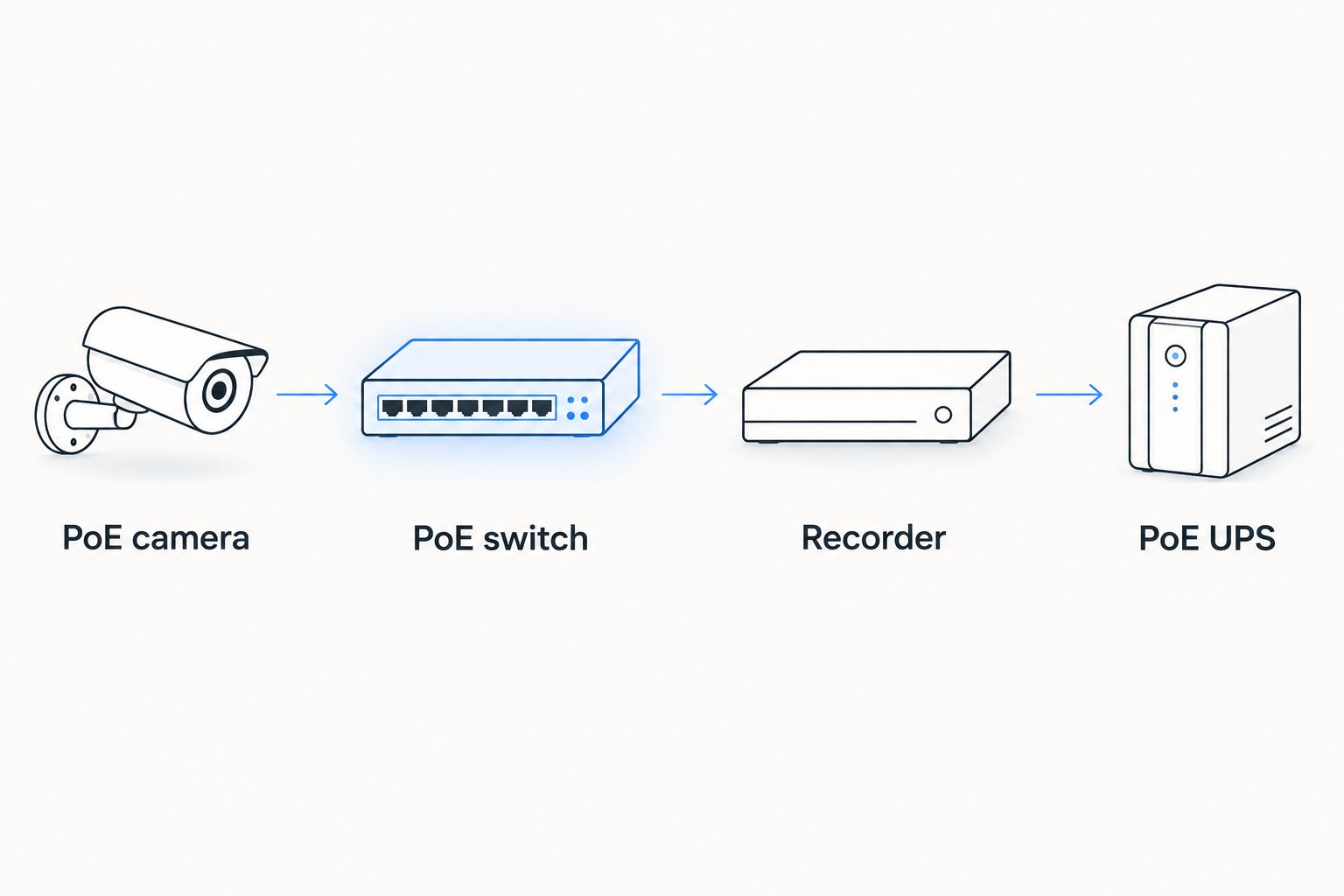
PoE switch and power budget
A switch lists a total PoE budget in watts, which is often lower than the per-port maximum multiplied by the port count. A 8-port switch with a 120 W budget cannot run eight 30 W cameras. Add up the maximum wattage of each camera, then leave headroom.
The three common standards are 802.3af at 15.4 W per port, 802.3at at 30 W and 802.3bt at 60 W or 90 W. Fixed turret and bullet cameras usually fit within 802.3af. PTZ and heated housings often need 802.3at or 802.3bt.
Recorder and storage
An NVR (network video recorder) is a box that records camera streams to disk. Pick one that supports ONVIF so cameras from different makers work together. H.265 compression reduces storage per camera, so a four-camera business can often use a single disk where H.264 would need more.
Cloud recording avoids the box but adds an ongoing subscription and depends on your upload bandwidth. For a small site with a stable connection, local recording with an occasional off-site copy is the more predictable setup.
Backup power
A PoE UPS or a standard UPS on the switch keeps cameras alive through short cuts. Size it to the switch's real load, not its maximum budget. The recorder needs backup power too, otherwise you keep the cameras running but lose the recording.
How we ranked
The ranking uses the six criteria above: coverage fit, low-light quality, power draw, weather resistance, storage cost and recorder compatibility. It is an editorial recommendation by use case, not a lab test. Camera types that suit the widest range of small business premises rank first; specialist types rank lower because they solve one job.
Planning a small business system in 2026
Three short examples show how the choices combine. These are hypothetical layouts, not customer installations.
- Small shop: one fisheye or two turrets inside, one bullet over the entrance, a 8-port PoE switch, a small NVR and a UPS.
- Workshop with a yard: turrets in the workshop, two bullets covering the yard approaches, one PTZ only if someone monitors it, an 802.3at switch.
- Office with a car park: domes in reception and corridors, bullets on the building corners, a PoE switch in a lockable cabinet.
Whatever the layout, test the picture at night before fixing cables in their final route. Check the field of view on a laptop at the actual mounting height. Keep cable runs under 100 metres, and use outdoor-rated cable where it leaves the building.
Which PoE security camera should you choose?
Start with fixed turrets or domes for indoor areas and bullets for outdoor perimeters. That combination covers most small businesses in 2026 at the lowest cost and power budget. Add a PTZ only when a person will operate it, and a plate camera only when you must read plates. Buy the switch, the recorder and the UPS in the same order as the cameras.
FAQ
What is the best PoE security camera for a small business in 2026?
A fixed 4MP turret or dome camera is the best default for indoor areas, and a bullet camera suits outdoor perimeters. Both draw low power and work with standard recorders.
How far can a PoE security camera be from the switch?
The standard limit is 100 metres of Cat5e or Cat6 cable. Beyond that you need a PoE extender or a second switch closer to the camera.
Do PoE cameras need a separate power supply?
No. The switch or a PoE injector supplies power through the network cable. You only need mains power at the switch, injector and recorder.
What PoE standard do I need for a PTZ camera?
Most PTZ cameras need 802.3at (30 W) or higher, and some heated outdoor models need 802.3bt. Check the camera's maximum draw before choosing a switch.
Is a PoE security camera better than a Wi-Fi camera?
For a business, yes. A wired PoE camera has stable video, no wireless interference and a single cable for power and data. Wi-Fi cameras still need a power source.
How many PoE cameras can one switch run?
It depends on the switch's total PoE budget in watts, not just the port count. Add the maximum draw of every camera and keep some headroom.
Do I need an NVR for PoE cameras?
You need somewhere to record. An NVR is the usual local option, and ONVIF support lets you mix camera brands. Cloud recording is an alternative with a subscription.
One last thing
The most common failure in small business surveillance in 2026 is not a bad camera. It is a switch with too small a power budget or a recorder with no backup power, so the system fails exactly when the power does. Size the switch and the UPS first, then choose cameras that fit inside them.