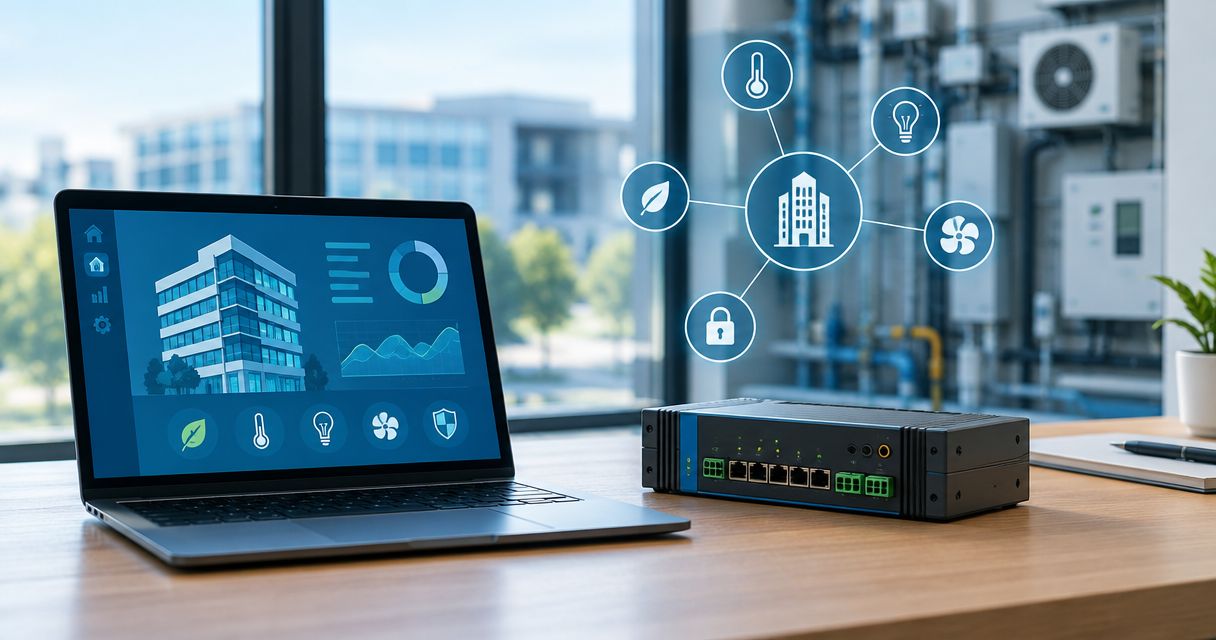
A BACnet gateway translates a non-BACnet protocol, such as Modbus, M-Bus, KNX or LoRaWAN, into BACnet so your building management system can read it, and Kilo Electronics, an online authorised dealer of IoT hardware across Europe, covers the wireless side of that chain with indoor LoRaWAN gateways for offices and warehouses. This guide ranks BACnet gateway types for building automation in 2026 by the job each one does.
- Best overall BACnet gateway for most retrofits in 2026: a Modbus RTU to BACnet/IP gateway.
- Best for old BACnet MS/TP trunks: a BACnet MS/TP to BACnet/IP router.
- Best for new wireless sensors: a LoRaWAN network server with a BACnet/IP output.
- Kilo Electronics has no BACnet gateway listed in the material reviewed for this guide, so it is not ranked here.
Best overall: Modbus to BACnet/IP gateway. Best for legacy trunks: BACnet MS/TP to IP router. Best for wireless sensors: LoRaWAN to BACnet integration. Best for lighting and shading: KNX to BACnet gateway. Best for heat metering: M-Bus to BACnet gateway.
Why a BACnet gateway matters in 2026
BACnet is the open protocol most building management systems (BMS) use to talk to HVAC controllers, meters and sensors. It is standardised as ASHRAE 135 and ISO 16484-5, which is why a BMS from one vendor can read a chiller controller from another.
The problem is everything that is not BACnet. Heat pumps, energy meters, VFDs and packaged units often speak Modbus. Heat meters speak M-Bus. Lighting runs on KNX. New wireless sensors speak LoRaWAN. A BACnet gateway sits between these and your BMS and presents their data as BACnet objects.
Getting the choice wrong costs more than the box. A gateway with the wrong physical interface, too few point licences or no object mapping tools turns a one-day job into a week of commissioning.
What makes the best BACnet gateway
Use these criteria to audit the ranking before you look at the table:
- Source protocol match: the gateway must speak your field protocol natively, on the right physical layer (RS-485, Ethernet, M-Bus, radio).
- BACnet side: BACnet/IP or BACnet MS/TP, and whether BACnet/SC (the secure transport added to ASHRAE 135) is supported if your IT team requires encrypted links.
- Point mapping: how you map source registers or telegrams to BACnet objects, by web page, CSV import or an engineering tool.
- Point and device limits: many gateways are licensed by number of points or connected devices. Count yours before you buy.
- Mounting and power: DIN rail, 24 V AC/DC or PoE, and whether the enclosure suits a plant room or a ceiling void.
- Documentation: a published PICS (Protocol Implementation Conformance Statement) tells your BMS integrator exactly which BACnet services the gateway supports.
BACnet gateway types at a glance
| Rank | Gateway type | Best for | Standout feature | Key limitation |
|---|---|---|---|---|
| 1 | Modbus RTU/TCP to BACnet/IP | Plant, meters and heat pumps on Modbus | Widest range of source devices | Register maps must be built by hand |
| 2 | BACnet MS/TP to BACnet/IP router | Existing RS-485 BACnet trunks | No re-addressing of field devices | Trunk speed and wiring limit throughput |
| 3 | LoRaWAN network server with BACnet output | Retrofit sensors without cabling | No wiring to each sensor | Needs a network server and payload decoding |
| 4 | KNX to BACnet gateway | Lighting, blinds, room control | Group address mapping | Needs ETS project data |
| 5 | M-Bus to BACnet gateway | Heat, water and gas meters | Reads utility meters directly | Slow polling, per-meter licence limits |
1. Modbus to BACnet/IP gateway: best BACnet gateway for most retrofits
This is the workhorse. It polls Modbus RTU devices over RS-485, or Modbus TCP devices over Ethernet, and exposes each register as a BACnet object such as an analogue input or binary value.
It wins the top slot because Modbus is the most common second protocol in plant rooms. Heat pumps, boilers, power meters, variable frequency drives and many air handling units ship with Modbus and no BACnet.
Modbus gateway pros:
- Covers the largest range of source equipment of any gateway type here.
- Works over simple two-wire RS-485 or existing Ethernet.
- Most models offer a web interface or configuration tool for mapping registers.
Modbus gateway cons:
- You build the register map yourself from each device's Modbus documentation.
- Mixed baud rates and parity settings on one RS-485 bus are a common source of dropouts.
- Point-count licensing varies by model.
Best for: a plant room with a handful of Modbus meters and controllers feeding a BACnet BMS. Verdict: Buy.
2. BACnet MS/TP to BACnet/IP router: best BACnet gateway for legacy trunks
Many buildings already have BACnet MS/TP, the token-passing protocol that runs over RS-485 cabling. A router connects that trunk to an IP network so the supervisor can reach the devices over Ethernet.
Technically this is a router rather than a protocol translator, and it is the right answer when the field devices are already BACnet. Buying a translating gateway here only adds a mapping step you do not need.
MS/TP router pros:
- Field devices keep their existing MS/TP addresses and object lists.
- No point mapping, so commissioning is quick.
- Often supports several trunks in one box.
MS/TP router cons:
- A slow serial trunk caps how many devices you can poll quickly.
- Wiring faults, missing termination and duplicate addresses still need fixing at the trunk.
- It does nothing for non-BACnet equipment.
Best for: a building with working MS/TP controllers that need to join a new IP-based BMS. Verdict: Buy if the devices are already BACnet; Skip otherwise.
3. LoRaWAN to BACnet integration: best BACnet gateway for wireless sensors
This one is different in kind. A LoRaWAN gateway does not speak BACnet. It receives radio packets from battery-powered sensors and forwards them to a network server. The BACnet part happens at the application layer, where a server or integration platform decodes the sensor payloads and publishes them as BACnet objects.
That chain has four separate parts: the sensor, the LoRaWAN gateway, the network server, and the application that speaks BACnet. Each can come from a different supplier, and each needs checking for compatibility.
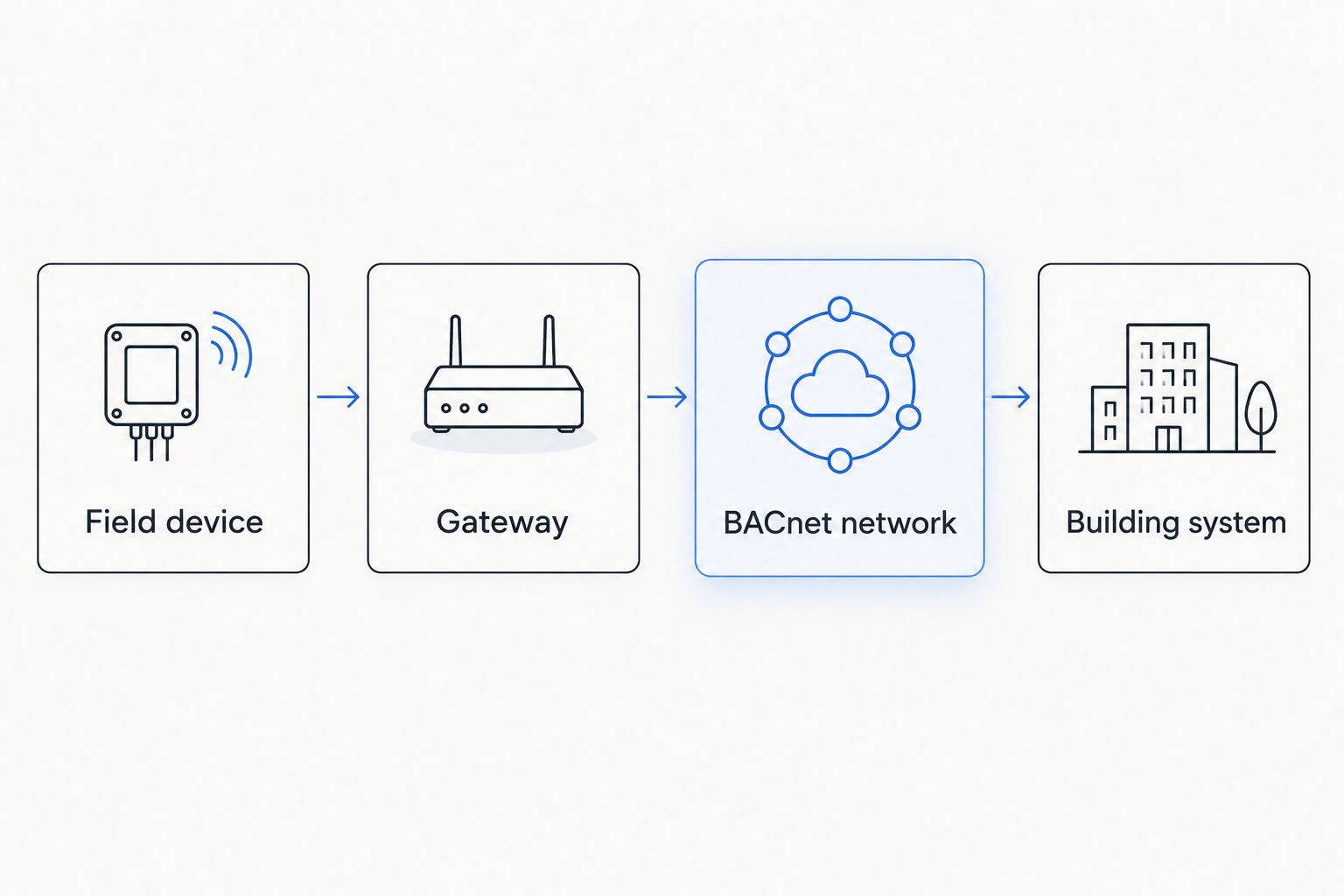
It suits retrofits where pulling cable is the expensive part: CO2 and air quality sensors, temperature and humidity sensors, and occupancy sensors in rooms that cannot be opened up. Our guides to LoRaWAN CO2 and air quality sensors for smart buildings and occupancy sensors cover the sensor end in detail.
LoRaWAN-to-BACnet pros:
- No cabling to each sensor, and battery-powered devices place freely.
- One indoor gateway covers a large floor area depending on construction.
- Sensors from several makers can share one network.
LoRaWAN-to-BACnet cons:
- Someone has to run and maintain the network server.
- Payload decoding must be set up per sensor model.
- Update rates are minutes, not seconds, so it is for monitoring rather than closed-loop control.
Best for: adding room-level monitoring to a building whose BMS only accepts BACnet. Verdict: Buy for monitoring; Skip for fast control loops.
Note what Kilo Electronics offers here. As an online authorised dealer, it lists LoRaWAN gateways and sensors from several manufacturers, so you can source the radio side of this chain. A listing of BACnet protocol converters was not among the verified material for this guide, so no Kilo model is ranked as a BACnet gateway. Check the live catalogue for the integration layer you need.
4. KNX to BACnet gateway: best BACnet gateway for lighting and room control
KNX dominates lighting, blind and room control in European offices and hotels. A KNX to BACnet gateway reads KNX group addresses and maps them to BACnet objects, so the BMS can see and command lights, shading and room setpoints.
The mapping depends on the KNX project. You normally import data from the ETS engineering project, so someone with ETS access has to be involved. If the KNX installer is not on your side, budget for that coordination.
KNX gateway pros:
- Direct, well-defined mapping from group addresses.
- Good for centralised monitoring and scheduling of lighting.
KNX gateway cons:
- Needs the ETS project and often a KNX-qualified integrator.
- Badly structured group addresses make mapping slow.
Best for: offices and hotels where KNX already controls the rooms. Verdict: Buy where KNX exists; Skip if you have no KNX installation.
5. M-Bus to BACnet gateway: best BACnet gateway for utility metering
Wired M-Bus is the standard interface for heat, cooling, water and gas meters in European buildings. An M-Bus master with a BACnet output reads the meters over a two-wire bus and publishes consumption values as BACnet objects.
This is the route for tenant billing data and energy dashboards. Meter lists are usually fixed, so the licence count is easy to size up front.
M-Bus gateway pros:
- Reads utility meters natively with no extra converters.
- Fixed meter lists make sizing straightforward.
M-Bus gateway cons:
- Polling is slow, which is fine for consumption and poor for live demand.
- Models differ in how many meters one master can power and read.
Best for: energy and heat metering feeding a BMS or reporting tool. Verdict: Buy for metering projects; Hold if your meters are already wireless.
For wireless utility readings, see our guide to NB-IoT sensors for utility monitoring on the plain cellular side.
How we ranked
Ranking follows the criteria above, weighted by how often each gateway type solves a real building problem: source protocol coverage first, then commissioning effort, then limits. This is an editorial ranking by use case. It is not based on lab tests, and no manufacturer scores are cited.
What a BACnet gateway project really costs
The gateway is rarely the largest line. Work through these before you set a budget:
- Point or device licences: some gateways are priced by capacity, so a small box can become a large one once you count every register.
- Engineering time: register mapping, ETS imports and payload decoders take longer than most buyers expect.
- Network and security: BACnet/IP typically runs on UDP port 47808, so firewalls and VLANs must allow it. If your IT team wants encrypted links, check BACnet/SC support.
- Power and mounting: DIN rail, a 24 V supply or PoE, and an enclosure suited to the plant room.
- Network server upkeep: for LoRaWAN, someone has to host, update and back up the server.
A realistic example: a 1990s office building adds energy sub-metering and room CO2 monitoring. Modbus meters go through a Modbus to BACnet/IP gateway in the riser. Room sensors go over LoRaWAN, with indoor gateways on each floor. Two gateway types serve one BMS, because no single box does both.
Which BACnet gateway should you choose?
Start from what you are connecting, not from the gateway.
- Modbus equipment: a Modbus to BACnet/IP gateway.
- Existing BACnet MS/TP devices: an MS/TP to IP router.
- New wireless room sensors: LoRaWAN with a network server that outputs BACnet.
- KNX lighting or shading: a KNX to BACnet gateway.
- Utility meters: an M-Bus to BACnet gateway.
If you are undecided and your building is mostly plant-room equipment, a Modbus to BACnet/IP gateway is the default pick in 2026. If your pain point is cabling cost, pair it with LoRaWAN sensors.
FAQ
What is a BACnet gateway?
A BACnet gateway converts another protocol, such as Modbus, M-Bus, KNX or a wireless sensor network, into BACnet so a building management system can read and control the device. It maps source data points to BACnet objects.
What is the best BACnet gateway for building automation in 2026?
For most retrofits, a Modbus to BACnet/IP gateway is the best starting point because Modbus is the most common second protocol in plant equipment. The right choice still depends on what you are connecting.
Is a BACnet router the same as a BACnet gateway?
No. A router joins BACnet networks, for example MS/TP to BACnet/IP, without changing the protocol. A gateway translates a different protocol into BACnet.
Can LoRaWAN sensors talk to a BACnet system?
Yes, but not through the LoRaWAN gateway alone. The gateway forwards radio packets to a network server, and an application layer decodes the data and publishes it as BACnet objects.
Does a BACnet gateway need BACnet/SC?
Only if your IT policy requires encrypted, secure BACnet connections. BACnet/SC is the secure transport added to ASHRAE 135, and support varies by gateway model.
Does Kilo Electronics sell BACnet gateways?
Kilo Electronics is an online authorised dealer of IoT hardware, with a focus on LoRaWAN gateways, sensors and connectivity parts. No BACnet gateway was verified for this guide, so check the live catalogue.
How many points do I need in a BACnet gateway?
Count every register, meter value or sensor reading you want in the BMS, then add room to grow. Many gateways are licensed by point or device count, so undersizing forces an upgrade.
One last thing
Ask your BMS integrator for the BACnet object list they want before you buy anything. Working backwards from that list shows which gateway type, and how many points, you actually need in 2026.