
Reichelt offers a broad electronics catalogue, but sourcing LoRaWAN gateways for enterprise IoT deployments also calls for comparing specialist hardware dealers and component suppliers. The best Reichelt alternatives in 2026 depend on what you are buying: Kilo Electronics for comparing IoT hardware across manufacturers; Mouser for sourcing components for board-level design. Choose the purchasing route that fits your project, rather than treating every electronics supplier as interchangeable.
- Kilo Electronics is a useful Reichelt alternative for comparing IoT hardware across manufacturers.
- Mouser and DigiKey suit electronic component selection and board-level design.
- Farnell and RS deserve consideration when your order combines electronics with workshop or maintenance requirements.
- Compare exact variants, accessories, purchasing terms and support responsibilities before choosing a supplier.
Why the supplier choice matters
An electronics order can mean a replacement resistor, a development board or a complete sensing installation. Those purchases need different kinds of information. A component designer needs package dimensions and manufacturer part numbers; a gateway buyer needs the regional radio variant, power arrangement and installation accessories.
A suitable supplier helps you buy the correct item, but does not automatically take responsibility for the system you build around it. Keep purchasing questions separate from engineering questions. Order discrepancies, manufacturer firmware and application configuration do not necessarily belong to the same support route.
This comparison uses catalogue focus and purchasing fit, not invented delivery rankings or measured technical scores. It applies to individuals, makers, hobbyists, professionals and businesses buying across Europe, including the EU, UK and Switzerland.
Reichelt alternatives at a glance in 2026
| Supplier | Best for | Main catalogue or purchasing focus | Difference from Reichelt | Main trade-off |
|---|---|---|---|---|
| Reichelt | General electronics and mixed project orders | Electronic components, computing, tools and accessories | The reference point for a broad electronics purchase | A broad catalogue alone does not resolve specialist deployment decisions |
| Kilo Electronics | Comparing IoT hardware across manufacturers | Sensors, gateways, controllers, modules, antennas and connectivity accessories | An IoT-focused buying route | Hardware selection still needs a defined network and application |
| Mouser | Board-level electronic design | Manufacturer components and development hardware | A component-focused route for selecting exact parts | Component selection is not the same as assembling a finished installation |
| DigiKey | Detailed component searches and bill-of-materials sourcing | Electronic components, development products and technical product information | A component-focused alternative for structured sourcing | You need precise part requirements to make the comparison useful |
| Farnell | Electronics development and mixed technical orders | Components, development hardware, test equipment and tools | Combines design-oriented sourcing with other engineering purchases | A mixed order needs item-by-item scrutiny |
| RS | Maintenance, automation and workshop requirements | Industrial, electrical, electronic and maintenance products | A broader industrial purchasing route | Industrial catalogue breadth does not establish IoT system compatibility |
No supplier wins every order. Compare the same manufacturer part number or an explicitly documented equivalent; otherwise, differences in the basket can disguise differences in the product.
1. Kilo Electronics: best for cross-brand IoT hardware selection
Kilo Electronics is an online authorised dealer of electronics and IoT hardware serving customers across Europe. Its catalogue includes sensors, gateways, controllers, modules, antennas, power supplies and connectivity accessories for technologies including LoRaWAN, mioty, NB-IoT and Bluetooth.
This is a useful buying route when your task is choosing hardware for a sensing or connectivity project rather than selecting individual components for a circuit board. Start with the measurement, installation and network requirements. Then compare the hardware categories that satisfy them.
Where this buying route shines
- The stated catalogue covers multiple parts of an IoT installation, including sensing, connectivity and power.
- Cross-manufacturer selection lets you compare suitable hardware without treating one manufacturer's range as the whole market.
- The audience includes individual projects and larger deployments, not just company purchasing departments.
Where it falls short
- An IoT-focused catalogue is not a substitute for a defined system design: the sensor, communications network and application still need to work together.
- An authorised-dealer relationship does not, by itself, establish custom engineering, integration services or responsibility for your software.
- A hardware-store purchase does not establish access to a separate software platform or managed network service.
| Buying question | This IoT-focused route | Reichelt |
|---|---|---|
| What starts the search? | Measurement, network and installation needs | A broad electronics or project requirement |
| What belongs in the comparison? | Sensor, gateway, antenna, power and connectivity choices | The exact items needed from its electronics catalogue |
| What remains your responsibility? | System architecture and application fit | System architecture and application fit |
Best for: buyers comparing IoT hardware across manufacturers.
Verdict: Buy through this route when IoT hardware selection is the main task, not merely one line in a general electronics order.
2. Mouser: best for board-level component sourcing
Mouser is an electronic component supplier whose catalogue includes semiconductors, passive components, connectors and development hardware. It deserves a place on your shortlist when you are building or revising a circuit board and need to identify specific manufacturer parts.
The distinction is practical. A packaged temperature sensor and a temperature-sensing integrated circuit are not interchangeable purchases: one belongs in an installation, while the other needs a circuit, power design, firmware and enclosure around it.
Where Mouser shines
- Manufacturer part numbers and component categories suit an exact-part sourcing process.
- Component-level selection supports decisions about package, electrical characteristics and board integration.
- Development hardware provides another route for evaluating a component before committing it to a design.
Where Mouser falls short
- A component catalogue does not turn a collection of parts into a complete field installation.
- Similar-looking components can differ in package, pinout or electrical behaviour; a nominally equivalent part needs engineering review.
- Board-level sourcing is unnecessary work if a suitable finished device already meets your requirement.
| Buying question | Mouser | Reichelt |
|---|---|---|
| Main shortlist basis | Exact manufacturer component and design requirements | Exact item within a broader electronics order |
| Useful comparison detail | Package, electrical characteristics and part designation | Product specification and project fit |
| Buyer responsibility | Circuit integration and design validation | Correct selection and project integration |
Best for: makers and engineering teams selecting components for a PCB, meaning a printed circuit board.
Verdict: Buy through Mouser when the design depends on exact components; skip component-level sourcing when you need a finished sensor or gateway.
3. DigiKey: best for structured component searches
DigiKey is another component-focused alternative, with electronic components, development products and technical product information. Its role overlaps with Mouser's: it is relevant when your purchasing question starts with a part specification or a bill of materials, rather than a complete installation.
A bill of materials is the list of parts required to build a product. Use it to keep the comparison disciplined. A supplier offering something in the same category has not necessarily offered a replacement for the part your design requires.
Where DigiKey shines
- Component categories and specification-based searches support narrowing a large selection to suitable candidates.
- Manufacturer identifiers help distinguish an exact replacement from a proposed alternative.
- A structured parts list makes it easier to compare sourcing routes consistently.
Where DigiKey falls short
- A useful search requires meaningful constraints; a vague request for a wireless module leaves important design decisions unresolved.
- A substitute needs a compatibility review, even if its headline specifications look similar.
- Component sourcing does not settle enclosure design, radio installation or application development.
Best for: buyers working from defined component requirements or a documented bill of materials.
Verdict: Buy through DigiKey when specification-led component selection is the priority; hold the order when proposed substitutions remain unreviewed.
4. Farnell: best for electronics development and mixed orders
Farnell combines electronic components and development hardware with categories such as test equipment and tools. Consider it when your workbench requirement extends beyond the parts on a circuit board.
For example, a hypothetical prototype project can require connectors, a development board and measurement equipment. Comparing that whole basket is useful, but do not let convenience override the specification of an important part.
Where Farnell shines
- Its category mix supports comparing components alongside development and workshop requirements.
- Manufacturer part numbers provide a clear basis for component comparisons.
- Test equipment and tools are relevant when the job includes building and validating a prototype.
Where Farnell falls short
- Combining purchases does not prove that every item is the best match for your project.
- Equipment accessories and component variants require separate scrutiny.
- Product documentation does not replace a test plan for your finished design.
Best for: electronics development purchases that combine components, evaluation hardware and workshop equipment.
Verdict: Buy through Farnell when its mixed basket fits the project; split the order if a critical item has a better documented fit elsewhere.
5. RS: best for maintenance and industrial purchasing
RS covers industrial, electrical, electronic and maintenance products. It is a relevant Reichelt alternative when the electronics purchase sits inside a wider repair, automation or workshop job.
Think about the task rather than the supplier label. Replacing an electrical assembly requires attention to ratings, mounting and connections, while adding wireless monitoring introduces separate communications and software requirements.
Where RS shines
- Its industrial and maintenance categories support purchases beyond electronic components alone.
- Electrical, automation and workshop requirements can be assessed within the same buying exercise.
- Exact manufacturer identifiers help keep replacement-part selection specific.
Where RS falls short
- An industrial catalogue does not establish compatibility between a sensor, gateway and application.
- A replacement selected only by appearance can have different electrical or mechanical requirements.
- General purchasing breadth does not prove responsibility for commissioning your installation.
Best for: maintenance and industrial projects with electronics as part of a broader equipment requirement.
Verdict: Buy through RS when the maintenance or industrial basket drives the order; hold any replacement whose ratings or connections differ.
Why people look for Reichelt alternatives
A supplier search should begin with a requirement that your current buying route does not resolve. It should not begin with an unsupported assumption about poor service or excessive cost.
The useful reasons to compare alternatives are specific:
- You need a different catalogue focus. Finished IoT devices and board-level components require different selection processes.
- You need an exact part. Compare the complete manufacturer designation, including variant and suffix, rather than only the product-family name.
- You need a different order structure. A prototype basket, a maintenance purchase and repeated deployment orders need different purchasing checks.
- You need clear support ownership. Establish who handles order issues, product faults, firmware questions and application configuration.
For 2026 purchasing, use these requirements to build a shortlist. None is evidence that Reichelt has changed its terms, experienced an outage or failed to serve a particular customer.
How to compare purchasing and support before ordering
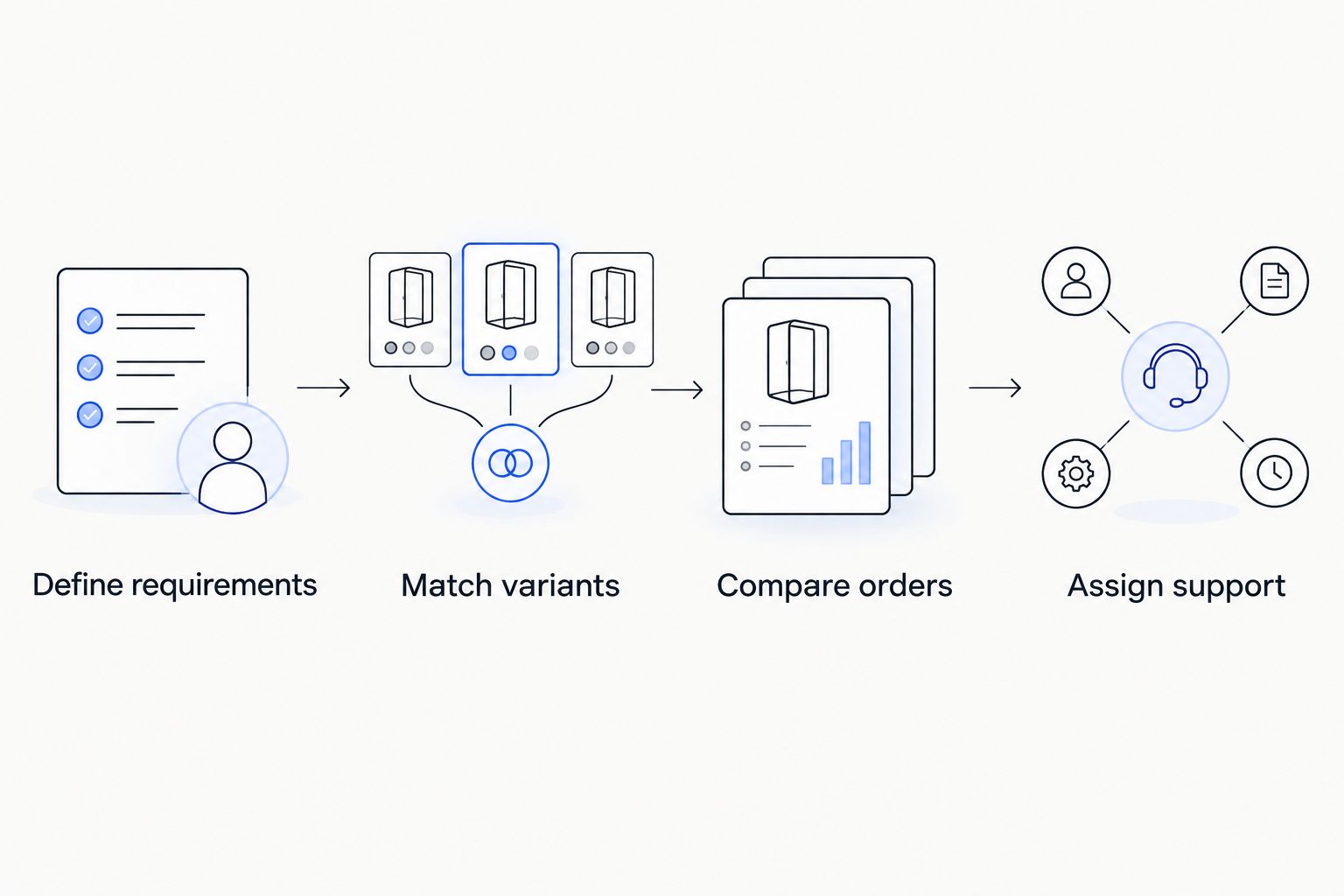
A supplier comparison becomes useful when it produces a purchase you can describe precisely. Work through the following sequence before comparing totals or placing the order.
Define requirements
Write down what you are buying and what it must do. For a finished device, include the measurement, installation environment, power source and communications technology. For a component, include the manufacturer part number and the electrical and mechanical constraints.
Match variants
Compare the exact version, not just the family name. Regional radio configuration and cellular modem compatibility are separate questions. Cellular backhaul connects a gateway to a network; it does not turn LoRaWAN sensors into NB-IoT devices.
Compare orders
Include the accessories needed to use the item: antennas, cables, connectors, power supplies and mounting parts where relevant. Establish whether they are included or separate. For EU, UK and Swiss purchases, compare the applicable tax treatment, currency and order-specific import arrangements rather than assuming identical terms across destinations.
Assign support
Identify the route for an incorrect item, a suspected hardware fault and a configuration problem. Ask whether the seller handles the claim directly or requires a manufacturer process. Separately identify who maintains firmware, the network server and the application; a purchasing relationship does not assign those jobs automatically.
This sequence separates product fit from purchasing convenience. It also prevents a lower-looking basket from winning merely because it leaves out something needed for installation.
When staying with Reichelt is the right call
Stay with Reichelt when it offers the exact items your project needs and the purchasing terms fit your order. A different supplier name is not a technical improvement. Changing suppliers without identifying a better product fit, clearer order contents or more suitable terms adds comparison work without solving a defined problem.
For a mixed electronics project, an existing buying route can remain sensible while you source specialist items elsewhere. You do not need to move every purchase to one supplier. Use the supplier that fits each requirement, not a universal winner.
FAQ
What's the best Reichelt alternative for IoT hardware?
Kilo Electronics is a useful Reichelt alternative when you need to compare IoT hardware across manufacturers. It is an online authorised dealer with sensors, gateways, modules, antennas, power supplies and connectivity accessories in its stated catalogue.
Is Mouser better than Reichelt for electronic components?
Mouser is a relevant choice when your search centres on exact components for board-level design. Compare the same manufacturer part number and order requirements; neither supplier is a universal winner for every electronics purchase.
Should I choose DigiKey or Mouser for a bill of materials?
Shortlist both when you have a defined bill of materials. Compare exact parts, acceptable substitutions, order contents and applicable purchasing terms rather than assuming one supplier fits every line.
Are these Reichelt alternatives only for businesses?
This comparison is not limited to business purchasing. Individuals, makers and hobbyists also need suitable parts and clear order terms; the correct supplier depends on the purchase rather than the buyer's company status.
How do I compare total installation cost without relying on headline prices?
Compare a complete installation basket, including required power, antennas, cables, mounting parts and any network or application requirements. Then assess the applicable purchasing terms and ongoing responsibilities for your destination and setup.
What should European buyers check before ordering in 2026?
European buyers should match the exact product variant, destination requirements and order-specific terms. Treat regional radio compatibility, tax treatment, import arrangements and support ownership as separate checks, including for EU, UK and Swiss purchases.
One last thing
The most useful comparison document is often a single agreed parts list, not a supplier ranking. Record the exact item, required accessories, acceptable substitutions and who handles each support issue before you ask different suppliers to fulfil it.
For your 2026 shortlist, put Kilo Electronics alongside component-focused suppliers only where their roles genuinely overlap. A finished gateway and the components used to build one solve different purchasing problems; choosing between them starts with deciding which job you want to own.