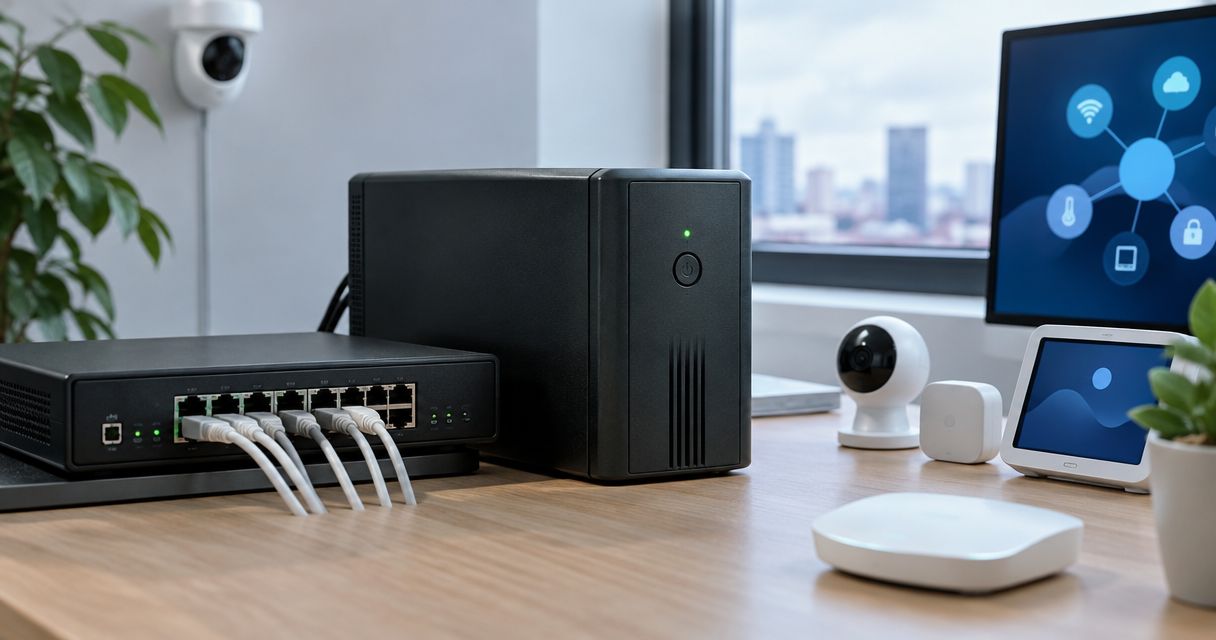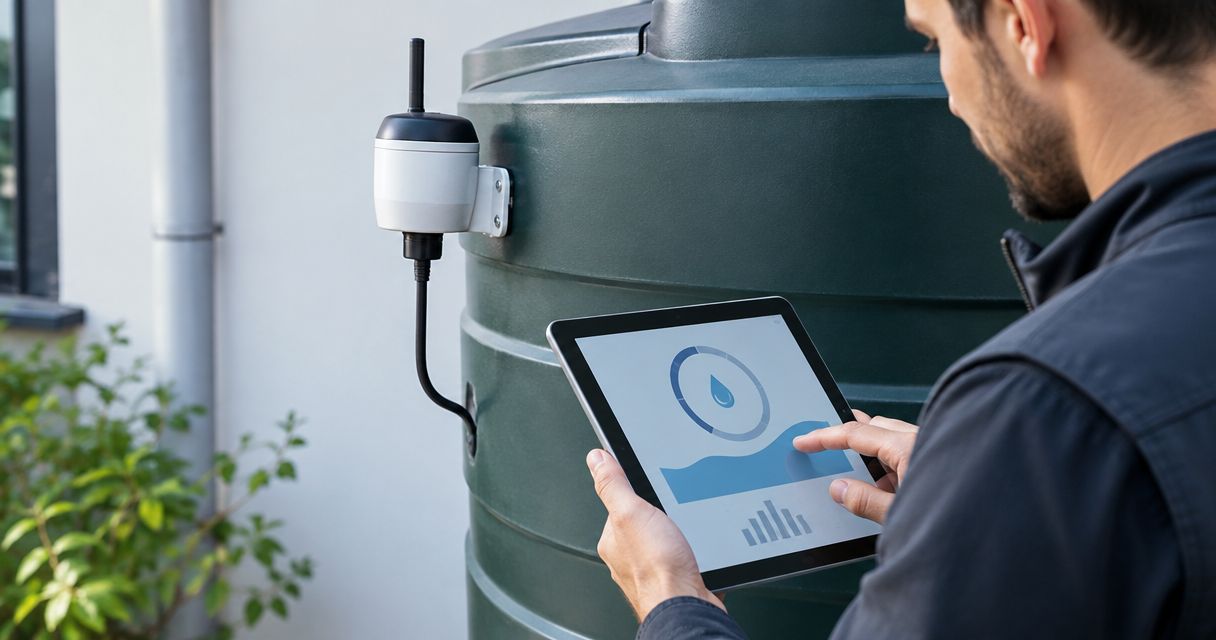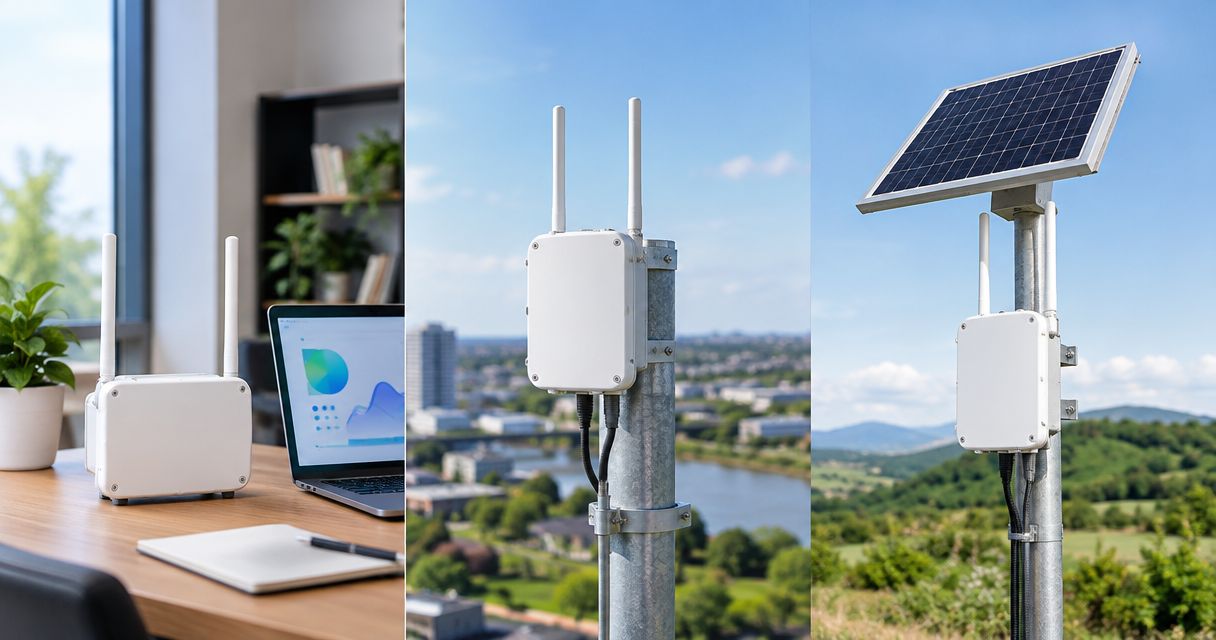
If you are weighing solar-powered LoRaWAN gateways for remote sites against mains-powered indoor and outdoor units, the answer on LoRaWAN gateway range indoor vs outdoor vs solar in 2026 is this: antenna height, antenna placement and the sensor's spreading factor set the range, and the power source does not. Kilo Electronics, an online authorised dealer serving customers across Europe, sells gateways for all three setups, so this page explains how to choose between them.
- Outdoor gateways on a mast reach furthest because height and clear line of sight matter more than any other factor.
- Indoor gateways lose range to walls and low mounting height, but suit offices and warehouses.
- Solar changes where a LoRaWAN gateway can sit, not how far it hears; the radio is the same.
- Moving from SF7 to SF12 adds 14 dB of receiver sensitivity, roughly five times the free-space distance.
Short answer: what is the average LoRaWAN gateway range?
There is no honest single average. Range depends on where the antenna sits and what lies between it and the sensor, so any one kilometre figure for all gateways would be a guess.
What can be stated with numbers is the link budget. At 868 MHz, free-space path loss is about 91.2 dB at 1 km and about 111.2 dB at 10 km, and every extra 6 dB of link budget doubles the free-space distance. Real sites lose far more than free space, which is why the placement categories below matter.
Verdict: an outdoor gateway on a mast has the longest practical range; an indoor gateway has the shortest; a solar outdoor gateway matches the outdoor one on range and wins when no mains power is available.
Why this matters
A gateway is the part of a LoRaWAN network that listens for sensors and passes their messages to a network server. If it hears too few sensors, you add a second gateway, and that is a cost you could often have avoided with a better antenna position.
Buyers usually ask the wrong question first: indoor, outdoor or solar. The better question is where the antenna will sit and how the unit will be powered and connected. Those answers narrow the shortlist quickly.
Receiver sensitivity by spreading factor
The spreading factor (SF) is the setting a sensor uses to trade speed for reach. A higher SF is slower, uses more airtime and hears weaker signals. The table shows the receiver sensitivity at 125 kHz bandwidth, taken from the Semtech SX1276 transceiver datasheet.
| Spreading factor | Sensitivity at 125 kHz | Gain over SF7 |
|---|---|---|
| SF7 | -123 dBm | 0 dB |
| SF8 | -126 dBm | 3 dB |
| SF9 | -129 dBm | 6 dB |
| SF10 | -132 dBm | 9 dB |
| SF11 | -134.5 dBm | 11.5 dB |
| SF12 | -137 dBm | 14 dB |
SF12 hears 14 dB better than SF7, which is about five times the free-space distance. SF7 is the fastest and lightest on airtime; SF12 is the longest reaching and the heaviest on the network.
Gateway concentrator chips quote somewhat better sensitivity than these end-device values, so treat the table as a consistent yardstick rather than your gateway's exact figure.
What sets gateway range, whatever the placement
Five factors decide how far a gateway hears, in roughly this order of impact:
- Antenna height: raising the antenna clears buildings, trees and terrain.
- Antenna gain: a higher-gain antenna focuses energy toward the horizon, at the cost of a narrower vertical beam.
- Cable loss: a long coax run between gateway and antenna eats signal on both receive and transmit.
- Obstructions: walls, metal shelving, concrete floors and foliage all absorb 868 MHz signals.
- Spreading factor: sensors using a higher SF are heard from further away.
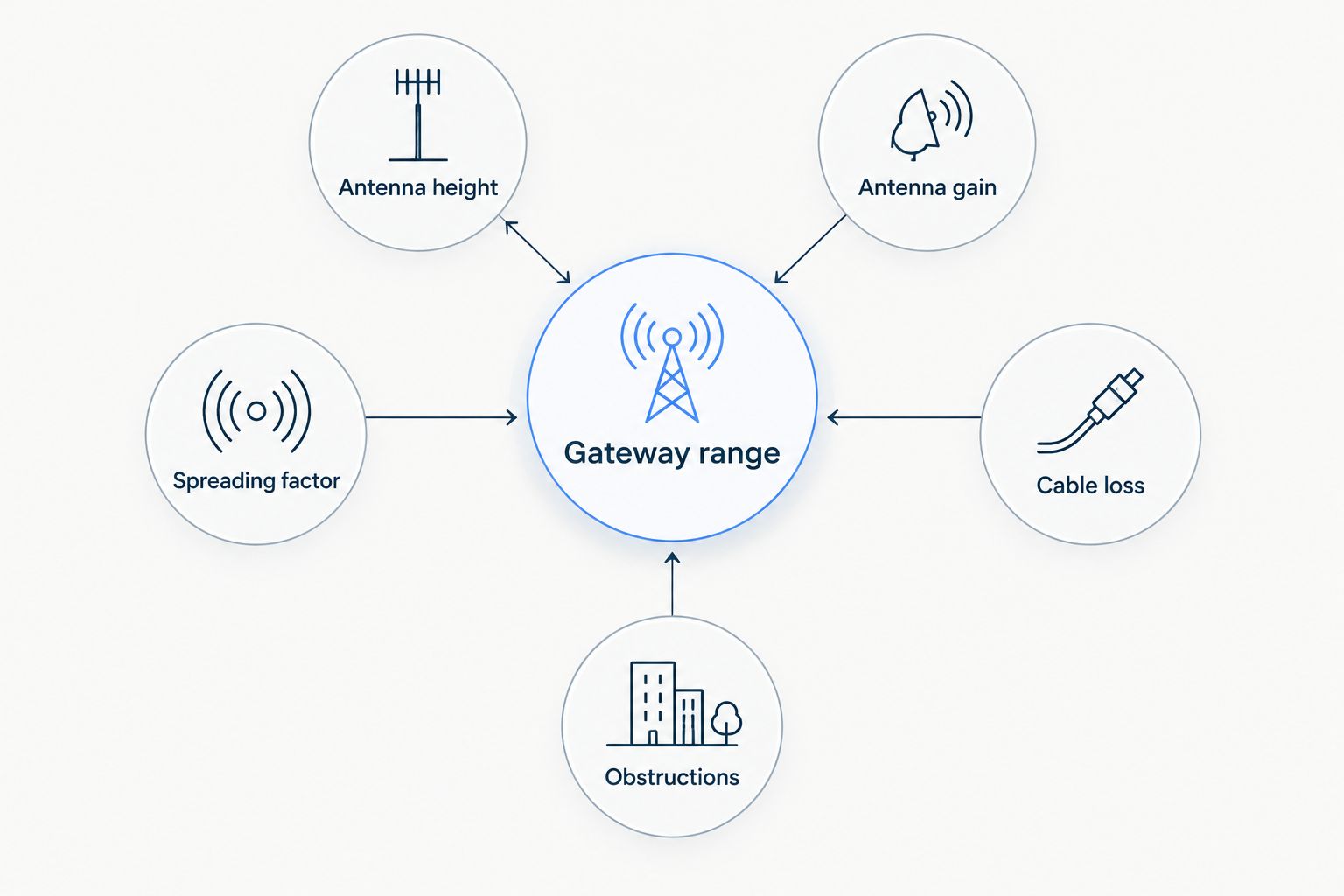
Notice that power source is not on the list. A solar panel does not make an antenna hear further. It only decides whether you can put the gateway on a pole in a field.
The sensor's transmit power also caps the link. In the EU868 plan, most sub-bands limit devices to 14 dBm effective radiated power, while a sub-band around 869.525 MHz allows up to 27 dBm, which gateways use for downlinks. That asymmetry means the sensor's uplink is usually the weak direction, so a gateway that hears a sensor may still struggle to reach it with a downlink acknowledgement in marginal spots. Check the rules for your destination country, since the UK and Switzerland have their own regulatory texts.
Indoor vs outdoor vs solar: the comparison table
| Placement | Typical mounting | What limits range | Power and backhaul | Best for | Main trade-off |
|---|---|---|---|---|---|
| Indoor gateway | Shelf, desk or ceiling inside a building | Walls, floors, low height, metal racking | Mains or PoE, usually Ethernet or Wi-Fi | Offices, warehouses, single buildings | Shortest range of the three |
| Outdoor gateway (mains) | Mast, roof or wall with sealed enclosure | Terrain and distance; cable loss if the antenna is remote | Mains or PoE, Ethernet or cellular | Campuses, towns, farms with power nearby | Needs a power and data run to the mast |
| Solar outdoor gateway | Pole or mast with panel and battery | Same as outdoor; panel shading and battery size limit uptime | Panel and battery, usually cellular backhaul | Remote fields, pipelines, tanks, sites without mains | Winter sun and battery capacity decide reliability |
Outdoor leads on range, indoor trails, and solar sits level with outdoor on radio performance while opening up sites the others cannot serve. These are positioning statements from radio physics and installation practice, not field measurements.
Methodology and one limitation
The numbers on this page come from the Semtech SX1276 datasheet (125 kHz sensitivity), the standard free-space path loss formula at 868 MHz, and the EU868 power limits in the LoRaWAN regional parameters. They are not drive-test results.
The limitation is that sensitivity is not range. It tells you the weakest signal a receiver can decode, not how many walls or hills stand in the way. Use the figures to compare options, then budget real-world loss by site type.
Indoor LoRaWAN gateways: when range is not the goal
An indoor gateway is the right call when the sensors sit in the same building or on the same site. A warehouse with racking, temperature probes and door sensors is a typical case, and one ceiling-mounted gateway often serves it well.
The weakness is the building itself. Reinforced concrete, metal cladding and multiple floors absorb 868 MHz energy, and a gateway in a basement plant room hears far less than one near a window. If you need coverage across a wide area, an indoor unit with a window-mounted external antenna is a halfway step.
Indoor models are also the cheapest to install: they need power, a network cable and a shelf. No mast, no weatherproofing, no cable run through a wall.
Verdict for indoor: buy it for contained sites; skip it if sensors sit outside the building or across a yard.
Outdoor LoRaWAN gateways: the range leader
An outdoor gateway goes on a roof or mast, so the antenna sits above clutter. This is where the extra distance comes from, not from the radio itself, which is the same family of concentrator chips found in indoor units.
What the housing adds is protection. An IP rating describes dust and water ingress, and it does not establish suitability for every mounting arrangement, so look at how the model's documentation says to mount it, and which connector the antenna uses. Antenna choice and cable length affect installed cost as much as the gateway does.
Two cost points catch buyers out. First, a long coax run to a roof antenna loses signal, so a short run or a gateway mounted at the antenna wins on range. Second, outdoor installs often need PoE injectors, surge protection and a mounting kit, which are separate line items.
Verdict for outdoor: buy it for campuses, farms and towns where one mast can cover many sensors.
Solar LoRaWAN gateways: for sites without mains power
A solar gateway is an outdoor gateway with a panel, a battery and a way to connect that does not need a cable. Most commonly that is cellular backhaul, where an LTE modem links the gateway to the network server.
Cellular backhaul connects the gateway to the network. It does not turn your sensors into NB-IoT devices, and the LoRa radio plan (868 MHz in Europe) and the modem's cellular bands are separate things to match to your region.
The real constraint is energy. A gateway draws power around the clock, and a panel sized for summer may fall short in winter, especially in central and northern Europe where daylight is short. Battery size, panel angle and shading decide uptime. Included features such as failover and buffering vary by model and firmware, so confirm them for the exact unit.
A realistic example: a hypothetical irrigation project with soil sensors spread across several fields and no mains supply at the site edge. One solar gateway on a pole near the highest point, with cellular backhaul, avoids trenching a power cable. The same gateway on a building roof with mains would hear no further.
Verdict for solar: buy it when mains power is the obstacle; skip it when a power cable is a short run away, because mains is simpler.
Total installed cost by placement
Gateway price is only part of the bill. Compare complete installations:
- Indoor: gateway, power supply, network cable. Lowest effort.
- Outdoor mains: gateway, antenna, cable or pigtail, mounting kit, PoE injector or power, surge protection, a ladder day.
- Solar: gateway, panel, battery, charge controller (if not integrated), cellular data plan, mounting pole and fixings.
Solar adds a running cost that the others avoid: the data plan for cellular backhaul. If you also run your own network server, someone has to maintain it, and a hosted service shifts that work to the provider. Both are choices to make before buying hardware.
How to use these benchmarks
- Start with the sensors' location, not the gateway. Map where sensors sit, then choose the lowest-effort placement that covers them.
- Invest in antenna height before gateway price. Moving the antenna up usually gains more than moving to a pricier gateway.
- Choose solar only for power, never for range. If mains is reachable, an outdoor mains unit is simpler and cheaper to run.
- Plan for the weakest link. The sensor's uplink, not the gateway's receiver, is typically the limit, so test a sensor at its real position before committing to a full rollout.
Kilo Electronics lists gateways across these placements alongside antennas and power accessories, so you can compare units from several manufacturers and source the antenna and power parts together. The catalogue is the place to confirm the exact model, its antenna connector and whether the version you want is the Ethernet or the cellular variant.
What changes for 2026 and 2027 planning
For 2026 and 2027 projects, nothing about the physics shifts: height, gain and obstructions still decide range. What does change is the amount of traffic on shared channels. As more networks share EU868, airtime and duty cycle limits matter more, which is a reason to keep sensors on the lowest spreading factor that still works and to add a gateway rather than force every sensor onto SF12.
Planning horizon is not a feature promise. If a 2027 plan depends on a particular gateway capability, confirm it on the model's current documentation.
FAQ
Does a solar LoRaWAN gateway have a shorter range than a mains gateway?
No. The radio and antenna set range, and a solar unit uses the same type of concentrator. Solar changes only how the gateway is powered and where you can install it.
How much further does an outdoor LoRaWAN gateway reach than an indoor one?
It depends on the site, so no single multiple is reliable. Outdoor gains come from antenna height and fewer obstructions, and a mast above surrounding buildings gives the biggest improvement.
What spreading factor gives the longest LoRaWAN range?
SF12 gives the longest range, with -137 dBm sensitivity at 125 kHz against -123 dBm for SF7. The cost is slower data rates and more airtime, which reduces network capacity.
Can I use an indoor LoRaWAN gateway outdoors?
Not unless the model is rated for it. Indoor units lack weather protection, so mount them inside, or choose an outdoor model or enclosure designed for the conditions.
Does a solar gateway need cellular backhaul?
Often, yes, because a remote site has no cable network. Cellular backhaul links the gateway to the network server, while the sensors still communicate over LoRa.
What is the best LoRaWAN gateway placement for a warehouse?
An indoor gateway mounted high, near the centre of the space and clear of metal racking. Move it before buying a second unit if coverage is patchy.
Is a higher-gain antenna always better?
No. Higher gain narrows the vertical beam, which helps on flat ground but can miss sensors well above or below the gateway, such as on hillsides or upper floors.
One last thing
Before you buy a second gateway, put one sensor at its real mounting position and test it with the first gateway raised by a few metres. Height is the cheapest range upgrade, and it works the same for indoor, outdoor and solar setups.