LoRaWAN is worth it for industrial IoT in 2026 when you need small, occasional sensor readings without installing a cable to every measurement point, as this industrial monitoring sensor guide explains. It is not the right choice for continuous data streams, tightly timed machine control or safety-critical protection; the business case also depends on gateway installation, software integration and ongoing maintenance.
- Is LoRaWAN worth it? Yes for low-data industrial monitoring; no for deterministic machine control.
- LoRaWAN connects sensors through gateways, a network server and an application; budget for the complete system.
- NB-IoT suits operator-connected devices; Wi-Fi suits higher-data applications where suitable coverage and power exist.
- Prove coverage and useful alerts at difficult measurement points before expanding your industrial IoT deployment.
Is LoRaWAN worth it for industrial IoT in 2026?
Choose LoRaWAN when the measurement changes slowly, the message is small and a delayed or missed reading does not create an unsafe condition. Temperature trends, cumulative meter readings, tank levels and equipment status are useful candidates. The value comes from placing measurements where wiring would be awkward, then turning those readings into a maintenance or operating decision.
The following comparison is based on communication requirements and installation responsibilities, not a measured ranking of particular products. Each option solves a different problem.
| Connectivity | Best for | Main advantage | Main limitation |
|---|---|---|---|
| LoRaWAN | Small, intermittent readings across a site | Battery-powered sensing with shared gateway infrastructure | Limited airtime and non-deterministic delivery |
| NB-IoT | Dispersed devices within suitable operator coverage | Direct cellular connectivity without your own LoRaWAN gateway | Operator service, regional coverage and device compatibility matter |
| Wi-Fi | Higher-data devices near suitable network infrastructure | Uses an IP network familiar to many IT teams | Power consumption and coverage require attention |
| Wired industrial networks | Continuous measurements and time-sensitive control | Suitable engineered systems support predictable communication | Cable routing, installation access and physical interfaces add work |
A factory does not need one connectivity method for everything. Keep machine control on the appropriate industrial network while using LoRaWAN for supplementary environmental or maintenance measurements. Separating those roles prevents a useful monitoring network from being asked to perform an unsuitable control function.
Why this matters
A sensor is useful only when someone can act on its output. Adding wireless readings without defining the action creates another dashboard to maintain, not a stronger industrial process.
Start your 2026 project with the decision: investigate a rising temperature, schedule a tank refill or identify a meter that has stopped reporting. Then specify the measurement accuracy, reporting interval and acceptable delay needed for that decision. Those requirements determine whether LoRaWAN belongs on the shortlist.
When is LoRaWAN a good choice for industrial monitoring?
Best for: periodic environmental measurements
LoRaWAN fits measurements such as temperature and humidity when you need periodic trends rather than a continuous waveform. Battery-powered devices can avoid the need to provide mains power at each measurement point, although battery life depends on the device, reporting behaviour and radio conditions.
The sensor still has to measure the right thing. An enclosure suitable for a room does not establish suitability for washdown, chemical exposure or an explosive atmosphere. Select the sensing element, installation method and environmental approvals before treating radio connectivity as the deciding feature.
Best for: meters and slowly changing levels
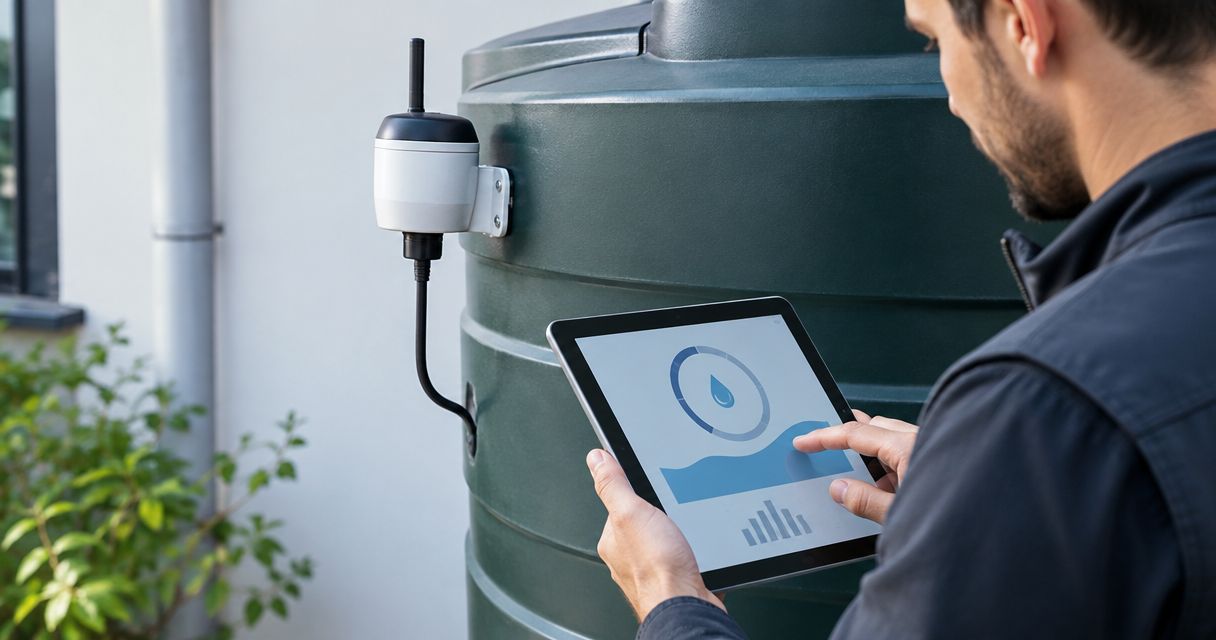
Meter totals and tank levels often produce compact messages. LoRaWAN can carry these readings to a central application without requiring a separate cellular connection for every device.
Measurement installation remains important. A pulse input needs the correct electrical interface and counting behaviour, while a level sensor needs a measurement principle suited to the vessel and contents. Wireless connectivity cannot correct a poorly positioned sensor or an incompatible meter output.
Best for: equipment status and maintenance trends
Equipment running states, door events and locally calculated condition indicators are other useful candidates. The important distinction is between transmitting a summary and transmitting the full underlying signal.
For example, a device that calculates a vibration indicator locally has a different communication requirement from equipment sending a continuous vibration waveform. Use LoRaWAN for an appropriate summary, not as a substitute for a high-bandwidth acquisition system. Confirm that the actual sensor performs the required local processing; radio compatibility alone proves nothing about its analysis capabilities.
When should you avoid LoRaWAN?
Avoid it for tightly timed control
LoRaWAN does not provide the deterministic communication required by tightly timed control loops. A command travelling through an application, network server and wireless link is not equivalent to a locally engineered control connection.
Keep emergency stops, protective interlocks and other safety functions on systems designed and validated for those duties. LoRaWAN can provide supplementary observations, but receiving an alert is not the same as implementing a safety function.
Avoid it for continuous high-data streams
Video, audio and raw high-rate measurement streams do not fit LoRaWAN's low-data design. Compressing the business requirement into a small packet is not always possible or appropriate.
Choose a connection matched to the actual data volume. Where local processing can turn a complex signal into a useful status or trend, assess that processing separately: what it detects, what it omits and whether you still need access to the original data.
Avoid assuming every command arrives immediately
Downlink communication means messages sent towards a sensor or actuator. Its timing and availability depend on the device class, receive behaviour, network conditions and applicable radio restrictions.
Battery-focused devices commonly use Class A operation, where downlink opportunities follow an uplink from the device. That behaviour matters if you expect an operator to change an output immediately. Define command timing and acknowledgement requirements before selecting an actuator or controller.
What does an industrial LoRaWAN system actually need?
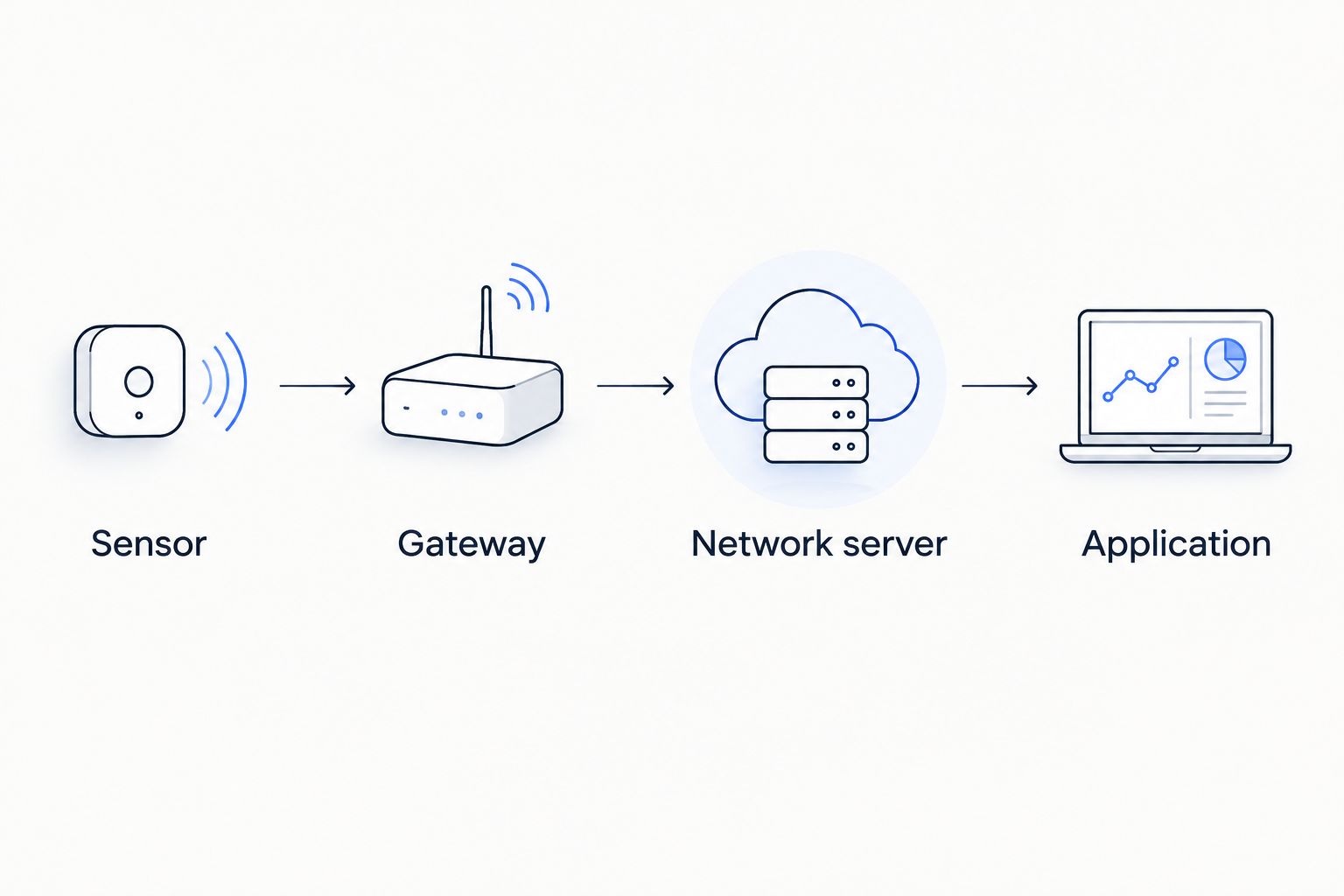
A working installation has distinct responsibilities. Keeping them separate makes procurement clearer and helps you locate faults when readings stop arriving.
- Sensor: measures a physical condition and sends a radio message.
- Gateway: receives LoRaWAN radio traffic and forwards it through an IP connection.
- Network server: manages LoRaWAN network functions and delivers application traffic.
- Application: decodes measurements, stores useful data and presents alerts or integrations.
The gateway's internet connection is called backhaul. Ethernet or cellular backhaul connects the gateway to the rest of the system; it does not change a LoRaWAN sensor into an NB-IoT sensor. Likewise, a gateway advertised with cellular connectivity still needs the correct modem variant and a suitable service arrangement.
A received packet is not yet a useful measurement. The application needs the correct payload decoder, which translates device-specific message fields into values such as temperature or level. It also needs the right units, timestamps and device identity. Include those requirements in acceptance testing rather than discovering them after the hardware is installed.
Why does the value of LoRaWAN vary between sites?
The same radio technology can produce a sensible installation in one building and unnecessary work in another. These factors determine the difference:
- Measurement locations: metal structures, tanks, walls and machinery affect radio propagation. Test where the sensor will operate, not just beside the gateway.
- Reporting behaviour: frequent messages, retransmissions and downlinks consume airtime and affect energy use. Specify what the application actually needs.
- Installation access: mounting points, power, antenna positioning and safe maintenance access affect the work required.
- Network responsibility: a private network gives you infrastructure responsibilities; an external network service introduces its own coverage and service dependencies.
- Integration work: payload decoding, alarm handling and connections to existing systems determine whether readings become useful.
- Maintenance requirements: batteries, damaged enclosures, firmware management and failed communications need an assigned owner.
A gateway's channel count is not a sensor capacity guarantee. Capacity depends on traffic patterns, airtime, radio settings and downlink demand. Similarly, a successful reading during an empty-building demonstration does not prove reliable operation beside moving equipment or behind closed metal doors.
How do you compare the complete installation and operating cost?
For a 2026 buying decision, compare complete systems that meet the same measurement requirement. Comparing a LoRaWAN sensor alone with a fully installed wired measurement point produces a misleading result.
Group the work into three parts:
- Equipment and installation: sensors, gateways, antennas, mounts, power supplies, suitable cabling and installation labour.
- Network and application operation: backhaul, network server hosting or service, data storage, dashboards and integrations.
- Lifecycle maintenance: batteries, calibration where required, replacement access, software maintenance and fault investigation.
Private LoRaWAN does not require a cellular subscription for each sensor, but that does not make the complete system free to operate. A cellular gateway backhaul still needs service, and a locally hosted network server needs administration. Hosted services move some responsibilities elsewhere rather than removing them.
Calculate value against a defined task. A project intended to reduce manual readings should account for visits that still remain necessary for inspection, calibration or maintenance. Do not count every reading as an avoided site visit when a person must attend for another reason anyway.
How should you test LoRaWAN before committing?
Test the difficult locations and the complete alert path before expanding the deployment. A pilot should answer whether the system supports your operating decision, not merely demonstrate that a sensor can transmit.
- Define success. Record the required measurement accuracy, acceptable reporting gaps, alarm delay and response owner. Set these requirements from the process rather than from a radio brochure.
- Choose representative locations. Include awkward mounting points, obstructions and the equipment states expected during normal operation. Place sensors where they would actually be installed.
- Build the complete data path. Connect the sensor, gateway, network server and application. Confirm decoded values, units, timestamps and alarm routing.
- Observe faults deliberately. Test the effect of a lost backhaul connection, a silent sensor and an application outage. Do not assume buffering or automatic recovery unless the selected equipment documents that behaviour.
- Review the workload. Record installation effort, access requirements and who handles each failure. Expand only when the operating team can maintain the system.
An alarm for missing data deserves particular attention. A dashboard showing the last received value can look normal even after communication has failed. Display measurement age clearly and distinguish a healthy reading from a stale one.
What should European buyers confirm before ordering?
A European deployment needs the correct regional radio plan, not merely a product labelled LoRaWAN. Confirm the destination country's requirements and the exact hardware variant. Cellular modem bands and service coverage are separate checks from LoRaWAN radio compatibility.
For outdoor installations, assess temperature exposure, moisture, cable entries, mounting and antenna arrangements together. An IP rating describes specified ingress protection; it does not establish resistance to every chemical, condensation condition or mounting problem.
Kilo Electronics is best for buyers who want to compare electronics and IoT hardware across manufacturers. The online authorised dealer serves individuals, makers, hobbyists, professionals and businesses across Europe, including the EU, UK and Switzerland. Its hardware catalogue is a purchasing route, not evidence that a complete network server, application or integration service is included.
When shortlisting LoRaWAN hardware through Kilo Electronics, define the sensor interface, radio variant, power arrangement and installation environment first. Keep responsibility for the complete monitoring system explicit, regardless of where you purchase its components.
FAQ
Is LoRaWAN worth it for industrial IoT in 2026?
LoRaWAN is worth it for small, intermittent industrial measurements when its installation and maintenance requirements fit the site. It is not suitable for continuous high-data streams or deterministic machine control.
Is LoRaWAN better than NB-IoT for a factory?
LoRaWAN suits site-based sensing where shared gateways and a managed network make sense; NB-IoT suits devices using suitable operator coverage. Compare installation responsibilities, coverage and ongoing service requirements rather than declaring either technology universally better.
Can LoRaWAN replace an industrial control network?
LoRaWAN should not replace a network engineered for tightly timed control or safety functions. Use it for supplementary monitoring where the process tolerates its communication behaviour.
Does a private LoRaWAN network need the internet?
A private LoRaWAN system can keep its gateway, network server and application on a local network if the selected components support that architecture. Remote dashboards, external services and off-site alerts need the relevant external connectivity.
How many sensors can a LoRaWAN gateway support?
A gateway has no universal sensor capacity that applies to every deployment. Message frequency, airtime, radio conditions and downlink demand determine the traffic the network must handle.
Does a cellular LoRaWAN gateway make the sensors NB-IoT devices?
Cellular backhaul does not make LoRaWAN sensors into NB-IoT devices. The sensors still communicate using LoRaWAN, while the gateway uses its cellular connection to reach the network infrastructure.
What should I buy first for a LoRaWAN pilot?
Define the measurement and acceptance requirements before buying pilot hardware. Then select a compatible sensor, gateway, network server and application, including the power and mounting accessories needed for the intended location.
One last thing
For your 2026 pilot, test a silent sensor as carefully as an alarming sensor. A threshold alert proves that the application can recognise a received value; it does not prove that anyone notices when readings stop.
LoRaWAN earns its place when the complete system delivers a useful measurement and exposes its own failures. Make missing-data detection part of the acceptance criteria, not an improvement left until after rollout.