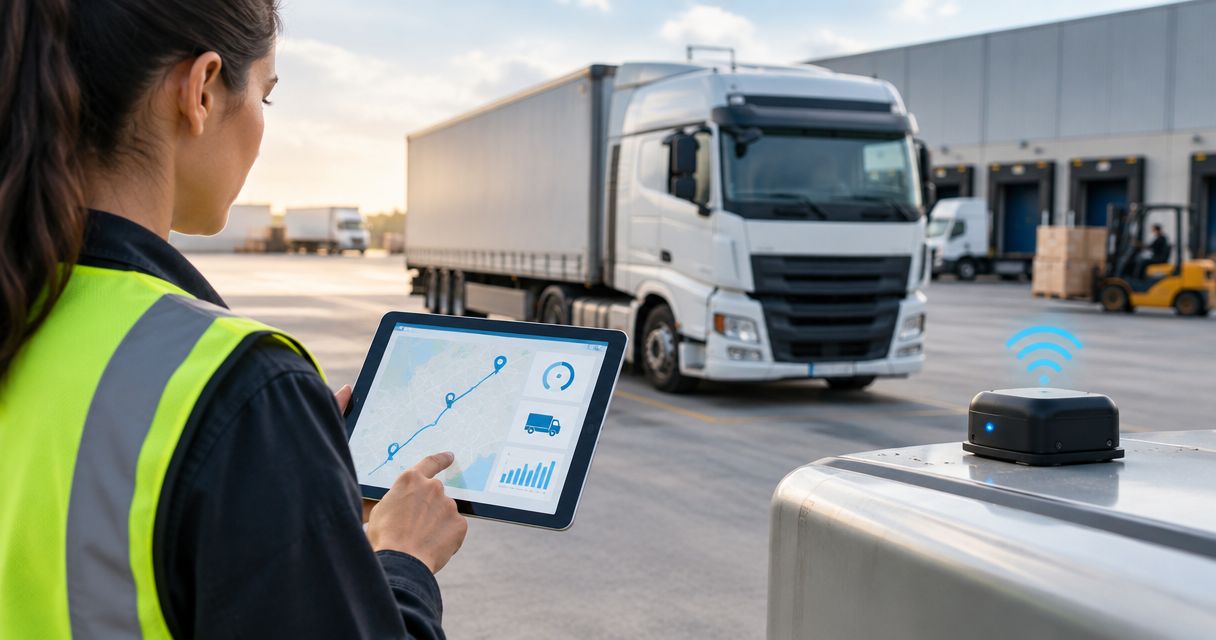
Logistics and fleet management IoT sensing is the use of IoT sensors for logistics and fleet management to measure cargo, vehicle and asset conditions so you can act on exceptions. Unlike fixed-site monitoring, transport monitoring must account for moving vehicles, changing network coverage and equipment that passes between operators.
- Choose IoT sensors for logistics and fleet management by the decision each measurement supports, not by radio technology alone.
- Kilo Electronics suits buyers comparing IoT hardware across manufacturers; hardware purchasing remains separate from application design.
- Use GNSS for outdoor positioning, temperature sensors for cargo conditions and door contacts for opening events.
- Test the complete journey: measurement, transmission, storage, alert delivery and operational response.
Why IoT sensing matters for logistics and fleet operators
A vehicle location does not tell you whether its cargo is overheating. A temperature reading does not tell you whether someone opened a trailer door. Select measurements around operational questions rather than expecting a tracker to answer everything.
Transport also changes the installation problem. A sensor can work beside a depot gateway yet lose its reporting path when the vehicle leaves. Metal bodies, refrigeration equipment, loading patterns and mounting positions affect the radio environment.
For your 2026 shortlist, separate three needs: finding an asset, understanding its condition and recording events. Decide which needs demand an immediate response and which need a reliable historical record. That distinction determines connectivity, power requirements and the application behind the hardware.
How to choose fleet and logistics sensors
Define the event and the response
Start manually with a journey map and a simple exception log. Ask drivers, warehouse staff and dispatchers where information disappears: loading, transit, handover, storage or return. Existing records help identify what a sensor must improve without committing you to a particular platform.
Write each requirement as a decision. For refrigerated cargo, the requirement is not simply to collect temperature; it is to identify an unacceptable condition and assign someone to respond. For reusable containers, it might be to identify which depot last received them.
Keep thresholds separate from sensor specifications. The acceptable temperature for a shipment comes from its product requirements and operating procedures, not from the measuring device. An instrument's measurement range does not establish what is safe for your cargo.
- Name the asset, shipment or vehicle being monitored.
- Define the condition or event that requires action.
- Assign an operational owner for each alert.
- Separate immediate alerts from historical reporting.
- Record the evidence needed at handover or investigation.
Match the sensor to the physical measurement
Build a measurement list before comparing connectivity. Temperature, humidity, door state, acceleration and position answer different questions. Combining them is useful only when your operational process can interpret the resulting events.
A hypothetical refrigerated shipment illustrates the distinction. An air-temperature sensor records conditions where it is mounted; it does not directly establish the temperature inside every package. A door contact records opening and closing, but does not prove who opened the door or why.
Choose the measurement location as carefully as the sensor type. An exposed sensor near a door can experience conditions different from those deeper inside the load. Specify whether you need ambient air measurement, an external probe or another documented sensing arrangement.
- Use temperature sensing to monitor a defined location or probe point.
- Add humidity sensing only where moisture affects the cargo or process.
- Use door contacts to record opening and closing events.
- Use acceleration sensing for movement or shock investigation, with suitable event interpretation.
- Use positioning hardware when location itself drives a decision.
Choose connectivity for the complete journey
Map the route manually before selecting a radio. Mark depots, loading areas, roads, customer sites and buildings where reporting matters. Distinguish places you control from places where you depend on an operator's network or another organisation's infrastructure.
LoRaWAN connects end devices through gateways to a network server, which handles network functions and passes data towards an application. Bluetooth needs a suitable nearby receiving device. Cellular technologies depend on compatible service, coverage and device capabilities. GNSS calculates position; it is not the connection that sends that position to your application.
Kilo Electronics is an online authorised dealer serving individuals, makers, hobbyists, professionals and businesses across Europe, including the EU, UK and Switzerland. Its catalogue includes sensors, gateways, modules, antennas and connectivity accessories for comparing hardware approaches. That purchasing role does not establish that a particular device fits your route.
- Map reporting requirements at depots and away from them.
- Match radio variants to destination-specific requirements.
- Assess cellular service and roaming arrangements separately from positioning.
- Identify who operates every required gateway or receiver.
- Specify what the device must do when its reporting connection disappears.
Specify the data path and alert behaviour
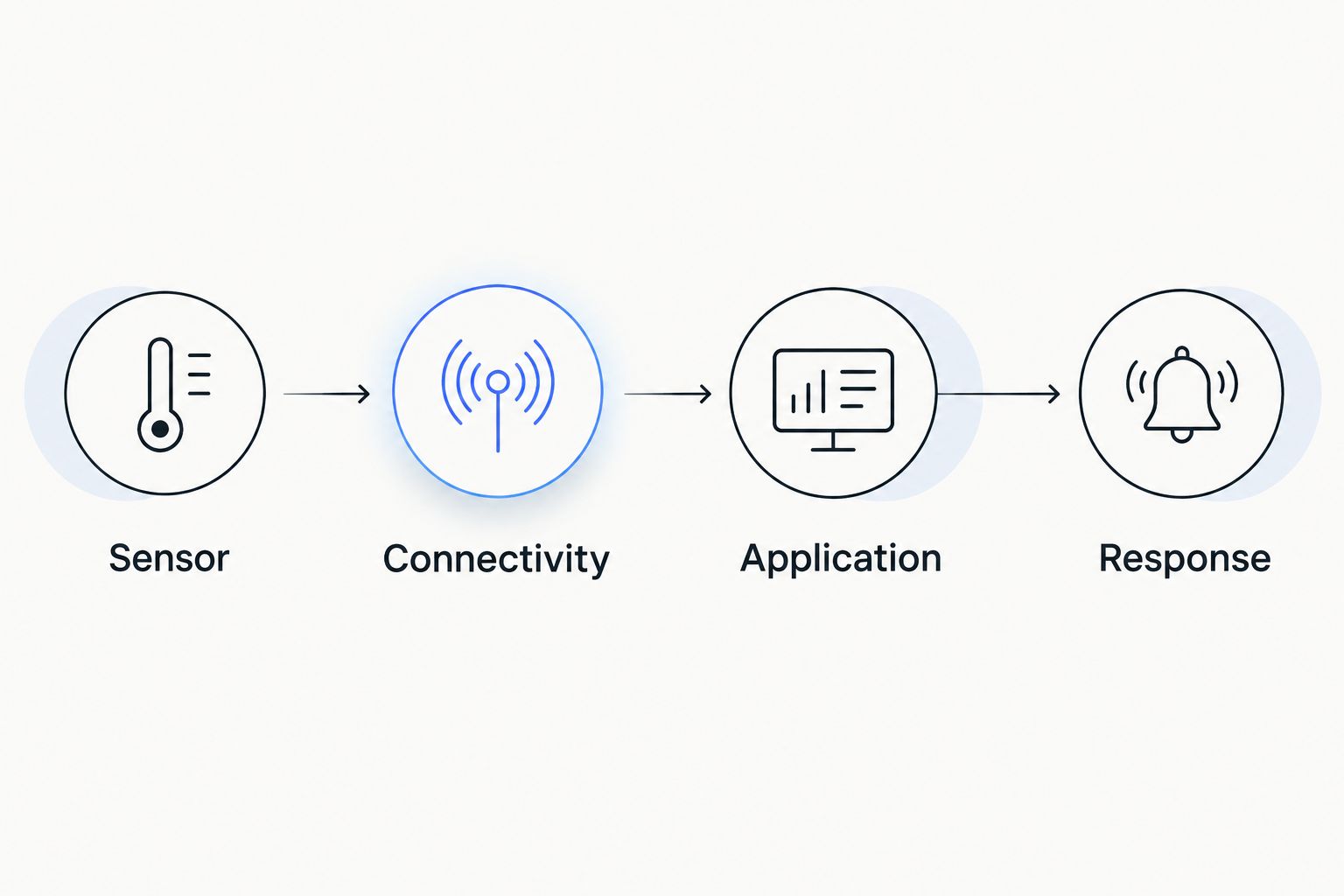
Sketch the system before buying hardware. A useful data path has identifiable stages: the sensor takes a reading, a connection carries it, an application interprets it and a person receives an actionable alert. Each stage needs an owner.
For LoRaWAN, the gateway is not the fleet dashboard. Payload decoding translates a device's transmitted data into usable values, while the application associates those values with an asset and applies your rules. A shared radio protocol alone does not prove that this complete chain is ready.
A recorded measurement and a delivered alert are different outcomes. Local storage and later upload, where supported, can preserve history without delivering an immediate warning. For a 2026 deployment, write these as separate acceptance requirements rather than treating connectivity as a single pass-or-fail feature.
- Specify Sensor, Connectivity, Application and Response as separate responsibilities.
- Confirm the exact device payload can be decoded.
- Keep measurement time distinct from receipt time.
- Define missing-data and low-battery notifications.
- Document who acknowledges and closes an exception.
Plan mounting, power and maintenance
Inspect a representative vehicle, container or storage area before standardising the installation. Record mounting surfaces, access restrictions, cleaning practices and available power. A device that is easy to install on an empty trailer can be difficult to reach once that trailer is loaded.
Battery life depends on the actual device and operating configuration. Measurement frequency, transmissions, positioning activity, temperature and radio conditions all matter. Do not turn a manufacturer's conditional battery estimate into an unconditional fleet maintenance interval.
For vehicle-powered equipment, establish the permitted electrical connection and installation method. For battery-powered equipment, decide who replaces or recharges it and how the asset stays identifiable during that work. An enclosure rating alone does not establish suitability for vibration, cleaning chemicals or every mounting position.
- Document the mounting position and permitted attachment method.
- Include brackets, probes, cables and antennas in the equipment list.
- Match the power arrangement to the vehicle or asset.
- Assign battery inspection and replacement responsibilities.
- Assess cleaning, weather exposure and access after loading.
Pilot the workflow before expanding
Start with a manual reference record and a representative journey. Compare the sensor record with observed events, then trace discrepancies through measurement, transmission and application handling. A clean dashboard does not prove that every expected event reached it.
Use explicit test scenarios. For example, a pilot with 2 depots and 10 trailers is a proposed test design, not a capacity claim: choose assets that expose different loading and coverage conditions. If you propose a 15-minute reporting interval, test whether it supports the response you require; it is not a universal recommendation or a promised device feature.
Kilo Electronics IoT hardware purchasing can follow the resulting bill of materials. Kilo Electronics is best suited to buyers comparing IoT hardware across manufacturers. Its catalogue breadth supports that comparison, but the purchasing decision does not replace application integration or acceptance testing.
- Test loading, transit, arrival and return separately.
- Include a deliberate reporting interruption.
- Compare recorded timestamps with observed events.
- Test whether the assigned person receives and understands an alert.
- Approve expansion only against written acceptance criteria.
Compare sensing and connectivity options
Choose among these approaches by operating environment, not by a universal ranking. Some deployments combine them: a positioning device can report through cellular connectivity while separate cargo sensors communicate with an onboard receiver.
| Option | Best for | Practical advantage | Key limitation |
|---|---|---|---|
| Standalone temperature logger | Historical cargo-condition records | Records measurements without requiring a live reporting connection | Data retrieval and alerting depend on the exact device and workflow |
| Bluetooth sensors with a receiver | Cargo or reusable assets near a managed receiver | Separates small sensing devices from the onward connection | Reporting depends on receiver presence and the tested radio environment |
| LoRaWAN sensors with gateways | Depots, yards and other areas with planned network coverage | Supports a managed sensing network across a defined site | A depot installation does not establish coverage throughout a transport route |
| Cellular sensor or tracker | Moving assets that need reporting beyond your own sites | Uses compatible operator infrastructure rather than your depot gateways | Service, roaming, coverage and power consumption require route-specific assessment |
| GNSS positioning with a reporting connection | Outdoor vehicle or asset location | Provides position information for tracking workflows | GNSS is not itself a data connection and needs suitable reception |
| Vehicle-connected telematics hardware | Fleet workflows requiring available vehicle data | Connects tracking with supported vehicle information | Vehicle compatibility, permissions and installation requirements vary |
For IoT sensors for logistics and fleet management, the strongest shortlist states both the measurement and the reporting arrangement. “Temperature sensor with a managed Bluetooth receiver” is a more useful specification than “wireless sensor”. It identifies an infrastructure dependency before installation.
Build the full installation and operating budget
Compare complete systems rather than device purchase totals. A low-complexity sensor can still require receivers, cabling, an application and installation work. Conversely, adding another sensing function is not useful if nobody will act on its data.
For a 2026 budget, separate initial equipment and installation from recurring operations. Include connectivity subscriptions, application access, calibration where required, batteries, replacement units and the staff time needed to investigate exceptions. These categories identify costs without pretending that a universal fleet-monitoring price exists.
- Hardware: sensors, receivers, gateways, antennas and mounting accessories.
- Installation: electrical work, configuration, commissioning and access to vehicles.
- Operations: connectivity, software, batteries and maintenance visits.
- Data management: device identities, decoding, retention and access controls.
- People: alert ownership, training and incident investigation.
Request a complete bill of materials with included and optional accessories separated. Keep the hardware supplier's scope distinct from network operation, software provision and installation responsibilities. That makes offers comparable without assuming that a seller provides services absent from its stated offer.
Common mistakes logistics and fleet operators make
Treating vehicle location as cargo visibility
A vehicle tracker follows the vehicle, not necessarily every pallet, container or detachable trailer. Tie the monitored identity to the operational object you need to find. Record handovers when cargo separates from its original vehicle.
Assuming a depot test proves route coverage
A successful reading beside a gateway proves that specific connection worked. It does not establish connectivity at customer premises, inside a loaded trailer or across a border. Test representative operating conditions before defining the reporting commitment.
Confusing missing data with normal conditions
An empty alert screen does not prove that cargo conditions stayed acceptable. The sensor might have stopped reporting. Distinguish normal readings, late readings and absent readings in both the application and the response procedure.
Collecting driver data without clear controls
Vehicle and location records can relate to identifiable people. Define the purpose, authorised users and retention rules before rollout, and assess applicable privacy and employment requirements. Cargo monitoring does not remove the need to consider how location data affects drivers.
FAQ
What are the best IoT sensors for logistics and fleet management?
The best fit depends on the decision: temperature sensors monitor cargo conditions, door contacts record opening events, and positioning devices support asset location. Choose the reporting connection and installation arrangement alongside the measurement.
Can one GPS tracker monitor cargo temperature as well?
Only a tracker with documented temperature sensing or support for a suitable external sensor can do both. Positioning capability alone does not establish temperature measurement, probe compatibility or cargo-monitoring suitability.
Is LoRaWAN suitable for tracking vehicles throughout Europe?
LoRaWAN requires a suitable network wherever reporting is needed; a private depot gateway does not provide Europe-wide route coverage. Assess the actual network footprint and operating conditions before choosing it for moving vehicles.
Do Bluetooth cargo sensors need a gateway?
Bluetooth cargo sensors need a compatible receiving device to send readings onwards to a remote application. That receiver might be a gateway, phone or other supported device, depending on the sensor and system design.
What happens when a fleet sensor loses its connection?
The outcome depends on the exact device and application. A device with documented local storage and later upload can preserve a record, but that does not deliver an immediate alert during the interruption.
What should I include when comparing fleet sensor costs?
Compare sensors, receivers, installation, connectivity, software and ongoing maintenance as one system. Include accessories and operational responsibilities so that apparently similar hardware offers do not conceal different project scopes.
One last thing
Test a missing report before testing a normal one. Disconnect the reporting path during your pilot and confirm what the application displays, who notices and how recovery appears in the record. A fleet-monitoring workflow needs to tell you when it cannot tell you what is happening.