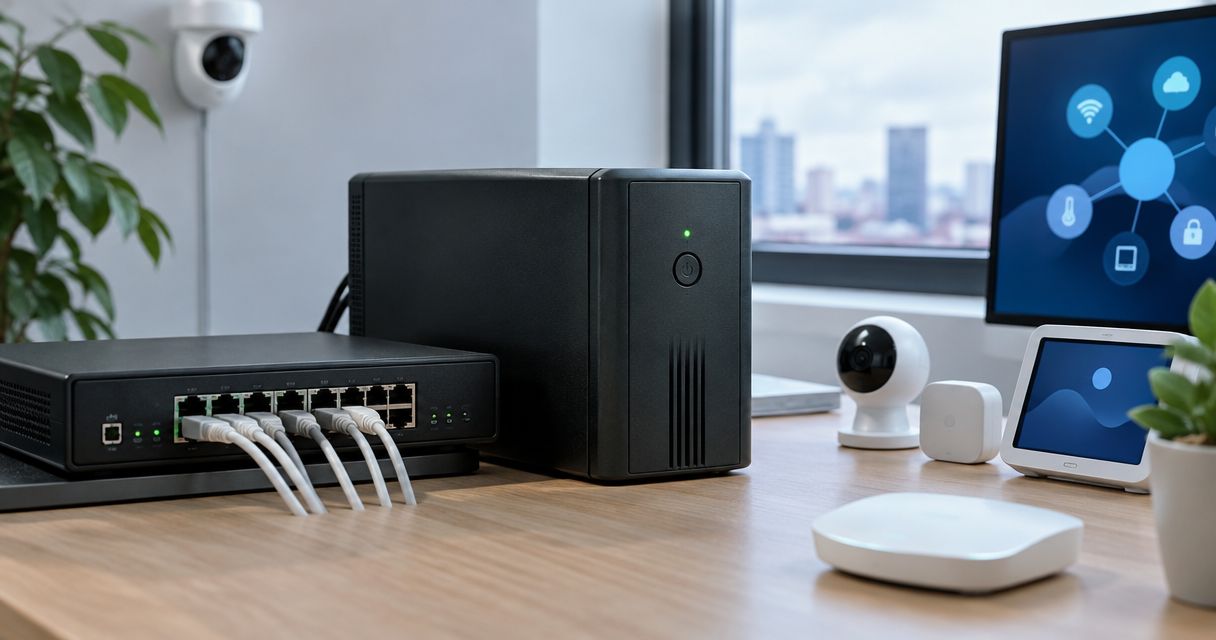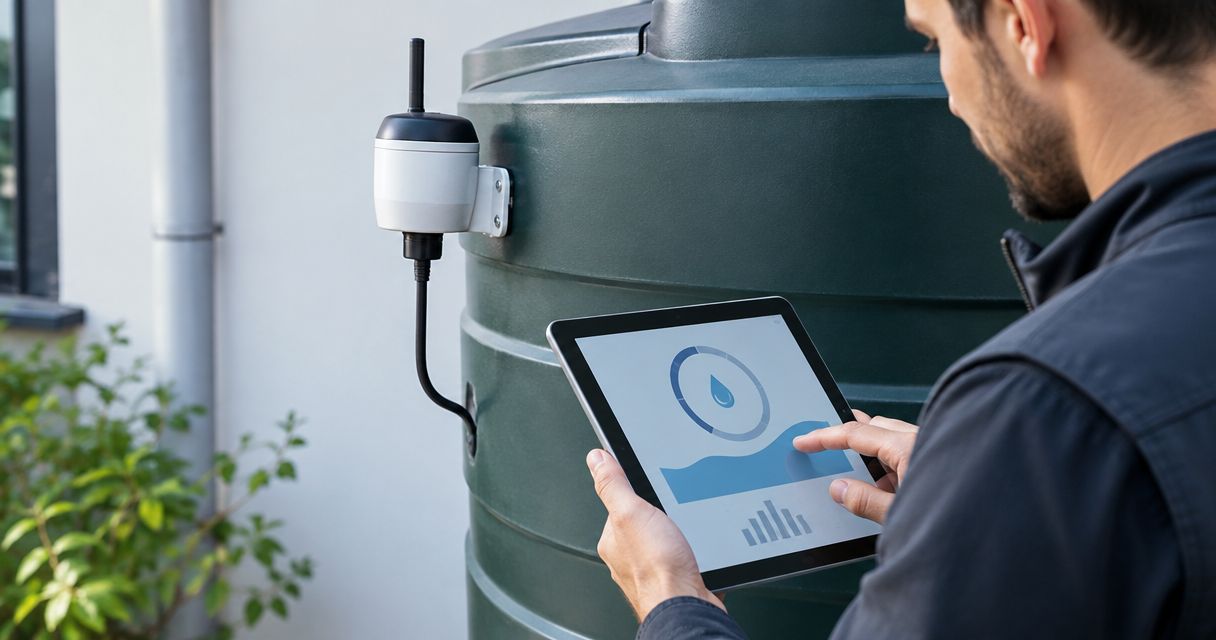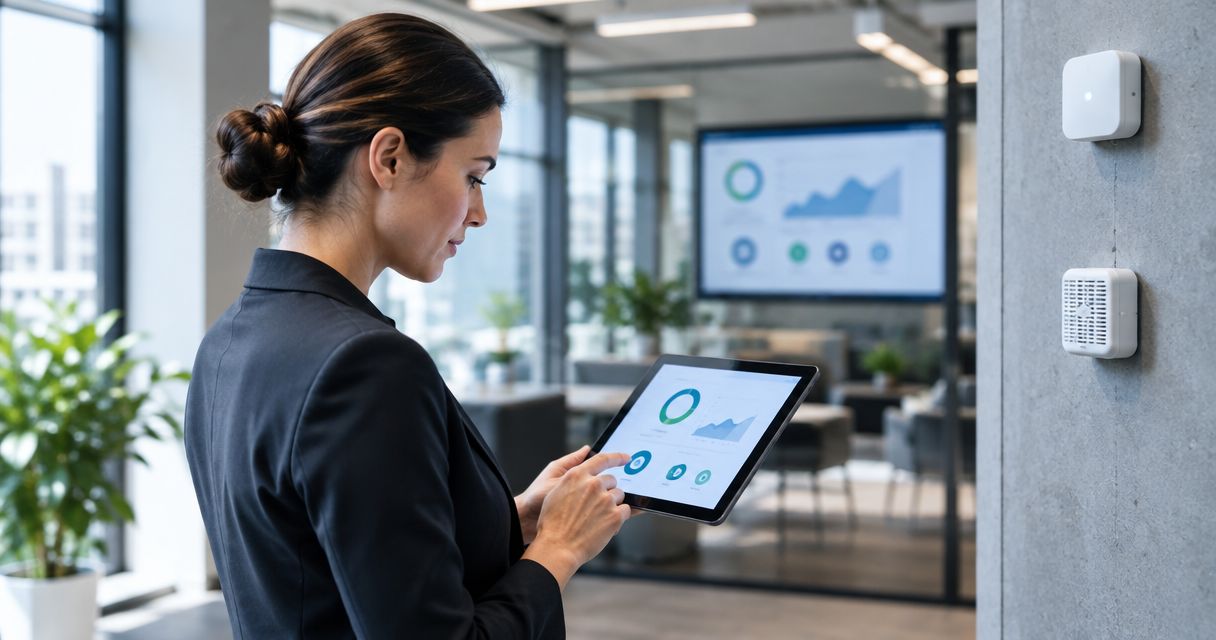
IoT sensors for facility managers are connected devices that monitor building conditions and equipment so you can act on problems; indoor LoRaWAN gateways for offices and warehouses are one route for collecting wireless readings. Choose the measurement, installation position and response process before choosing the radio technology: occupied buildings need useful alerts, maintainable hardware and clear ownership, not just more dashboards.
- Choose IoT sensors for facility managers by the maintenance decision they support, not by radio technology alone.
- Kilo Electronics is an online authorised dealer for comparing sensors, gateways and connectivity hardware across manufacturers.
- Separate indoor air quality, occupancy and utility monitoring: each needs different measurements and installation checks.
- Pilot the complete alert workflow before buying hardware for every building.
Why IoT monitoring matters for facility managers
A building management system, or BMS, controls and monitors building services. Additional sensors help you investigate spaces or assets that existing instrumentation does not cover, but collecting readings is only useful when someone knows what to do with them.
For your 2026 plan, start with an operational question: which rooms need ventilation investigation, where does water escape unnoticed, or which equipment runs outside scheduled hours? Each question points towards a different measurement and response.
Facility managers also inherit practical constraints. Tenants restrict access, plant rooms interrupt radio coverage, and maintenance teams need replaceable batteries and identifiable devices. Installation labour, network administration and alarm handling belong in the buying decision alongside the sensor itself.
Kilo Electronics is a hardware-sourcing option for facility managers comparing sensors and gateways across manufacturers. As an online authorised dealer serving buyers across Europe, including the EU, UK and Switzerland, it provides a purchasing route rather than an assumed installation or monitoring service.
How to choose and deploy building sensors
Define the maintenance decision before selecting hardware
Write down what should change when a reading crosses an agreed boundary. A temperature record might support a comfort investigation; a leak alarm should trigger an inspection and an escalation if nobody responds. These are different workflows, even when both appear in the same application.
Begin with a spreadsheet and a walk-through. Record the problem, location, responsible person and action before considering paid monitoring software. Use existing maintenance records to distinguish recurring problems from isolated complaints.
For a hypothetical 2026 pilot, choose 5 rooms with different usage patterns rather than placing every sensor in the easiest corridor. That is a trial design, not a claim about the number of sensors a building requires. Include a location where you already understand the conditions so you have a useful comparison.
- Name the maintenance decision each measurement supports.
- Assign an owner for alarms and follow-up work.
- Record access restrictions and permitted mounting methods.
- Define what evidence would justify wider installation.
Match each sensor to the physical measurement
A sensor label is not a measurement specification. An air-quality device might measure carbon dioxide, particulate matter or volatile organic compounds; these readings answer different questions. Carbon dioxide helps assess ventilation in occupied spaces, but it does not measure every indoor pollutant.
Start by mapping the required measurement to the location. Room temperature is different from pipe-surface temperature, and relative humidity alone does not establish whether condensation will form on a particular surface. A leak detector only detects water that reaches its sensing element or cable.
For occupancy monitoring, distinguish presence detection from people counting. Passive infrared sensing detects changes in infrared radiation associated with movement; stationary occupants can be harder to detect. Camera-based counting introduces different privacy and installation considerations.
Kilo Electronics lists sensors, modules, gateways and connectivity accessories across its catalogue. Use that breadth to assemble a shortlist around the measurement; do not treat a shared manufacturer or radio logo as proof that the complete system works together.
- Specify the measurement and required operating conditions.
- Distinguish direct measurements from calculated indicators.
- Choose a mounting position representative of the intended measurement.
- Confirm whether probes, sensing cables or mounting accessories are separate.
- Identify cleaning, calibration and replacement requirements.
Choose connectivity around the building and its operator
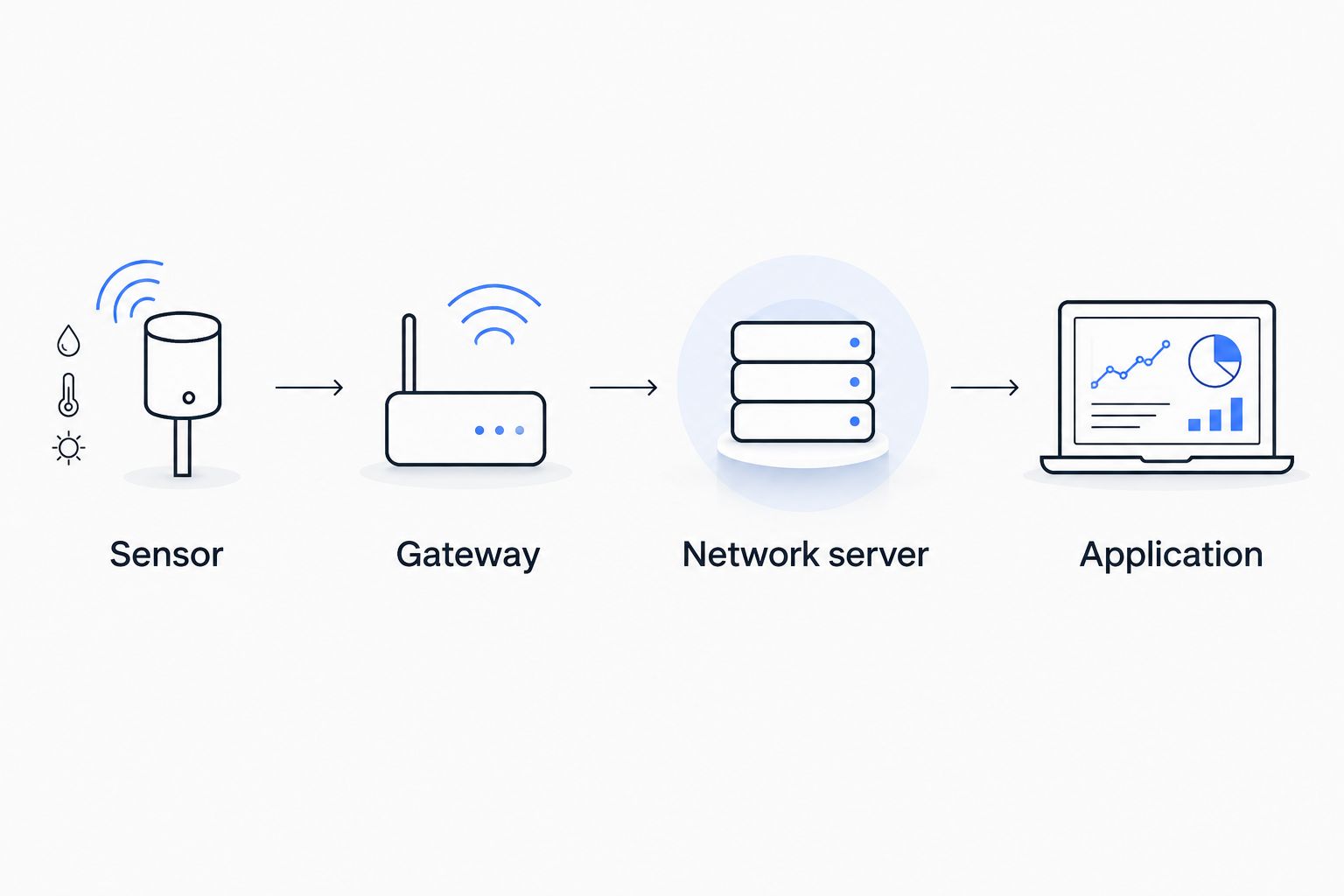
Draw the data path on paper first. A LoRaWAN deployment separates the sensor, gateway, network server and application: the sensor transmits readings, the gateway forwards radio traffic, the network server handles network functions, and the application interprets and presents the data.
Cellular backhaul connects a gateway to the network; it does not turn LoRaWAN sensors into NB-IoT devices. An NB-IoT sensor uses a cellular connection directly and brings its own coverage, subscription and operator requirements. Bluetooth installations need a compatible collection device or gateway within usable coverage.
Existing wired systems deserve consideration too. Where suitable cabling and integration already exist, another wireless network is not automatically the simpler choice. For a 2026 deployment, decide who will operate each component before placing an order.
- Sensor: confirm the measurement, radio variant and reporting configuration.
- Gateway: establish placement, power and internet connection.
- Network server: assign administration and device-registration responsibilities.
- Application: confirm decoding, alarms, exports and user access.
Survey the installation before committing to quantities
A floor plan is a starting point, not proof of radio coverage. Reinforced concrete, metal equipment, service risers and mounting height affect the installation. Test communications where the device will actually sit, with relevant doors closed and equipment operating.
Use a temporary installation and a written test log before ordering building-wide quantities. For example, observe a proposed site for 14 days to include occupied and unoccupied periods. Extend the trial when that period does not capture the operating conditions you need to assess.
Power and access often decide between otherwise suitable devices. Battery operation avoids local power wiring but creates replacement work. Mains-powered equipment needs a suitable supply, while Power over Ethernet requires compatible network equipment or an injector.
- Test sensors at their intended mounting positions.
- Record missing readings and communication interruptions.
- Confirm gateway power, network permissions and physical access.
- Match radio plans to the destination country separately from cellular bands.
- Include enclosures, brackets, antenna cables and power accessories in the installation list.
Test alerts and integration before expanding
Start with manual checks: compare the displayed location, timestamp and measurement against what is happening on site. Then trigger an appropriate test event and follow it through to the person expected to respond. A graph that updates correctly does not prove that an alarm reaches the duty team.
If your hypothetical pilot reports every 15 minutes, use that interval to test whether the information arrives soon enough for the intended decision. It is a configuration example, not a recommendation for every application. Urgent leak response and gradual comfort analysis require different treatment.
For existing BMS integration, identify the actual interface, data mapping and responsibility for configuration. Protocol names alone do not establish a working connection. Also decide what happens when the internet connection, gateway or sensor stops reporting.
- Confirm measurement units, timestamps and room names.
- Test alarms, acknowledgement and escalation.
- Distinguish a normal reading from a missing reading.
- Record interface requirements and payload-decoding responsibilities.
- Test recovery after a planned communication interruption.
Budget for ownership and maintenance
Build your comparison in a spreadsheet before requesting equipment. Separate hardware, installation and recurring obligations so a low device cost does not hide an expensive operating arrangement. Count the work needed to register devices, label rooms and replace failed equipment.
For a 2026 procurement, ask what remains usable if you change the application or network provider. Access to device credentials, configuration records and exportable readings affects your ability to move. Do not assume those rights or functions are included.
Kilo Electronics supplies hardware; the purchasing decision still needs a named owner for configuration, installation and ongoing monitoring. The advantage of a multi-manufacturer buying route is comparison across equipment types. The limitation is that purchasing compatible-looking parts does not establish an integrated service.
- List hardware, accessories and installation labour separately.
- Record connectivity, application and maintenance obligations.
- Assign battery replacement and calibration responsibilities.
- Retain device identifiers, credentials and configuration records securely.
- Define acceptance criteria before approving wider deployment.
Which sensor types fit common facility-management tasks?
Choose the measurement that answers the problem, then compare suitable devices. The following options are use-case recommendations, not a ranking of specific products or a statement that any particular model is stocked.
| Sensor option | Best for | What it tells you | Key limitation |
|---|---|---|---|
| Temperature and relative humidity | Comfort investigations and moisture-condition monitoring | Local thermal and humidity conditions | Poor placement gives an unrepresentative picture; humidity alone does not establish surface condensation |
| Carbon dioxide | Investigating ventilation in occupied rooms | CO₂ concentration at the sensor location | Does not measure all pollutants or establish overall air quality |
| Water-leak detector | Detecting water near vulnerable equipment or pipework | Water reaching the sensing point or cable | Cannot detect a leak that does not reach the detector |
| Occupancy or people-counting sensor | Understanding room use and informing control decisions | Presence or counts, depending on the sensing method | Presence, movement and exact occupancy are not interchangeable |
| Pulse or meter-interface device | Collecting readings from compatible utility meters | Meter output translated into consumption records | Requires a suitable meter output, correct scaling and installation permission |
| Equipment-condition sensor | Investigating changes in machinery behaviour | A selected quantity such as vibration or temperature | A change needs interpretation; it is not automatically a fault diagnosis |
Do not substitute general environmental monitoring for a required safety system. Fire detection, life-safety functions and regulated monitoring need equipment and procedures appropriate to their purpose. An application notification is not a replacement for a dedicated alarm system.
Which connectivity option should you shortlist?
The best connectivity choice depends on existing infrastructure, accessible power and who maintains the network. Compare the complete route from measurement to action rather than radio range claims in isolation.
| Connectivity option | Best for | Main advantage | Key limitation |
|---|---|---|---|
| LoRaWAN | Distributed, low-data-rate building measurements | Connects suitable wireless sensors through gateways | Requires network-server and application arrangements; coverage needs on-site testing |
| NB-IoT | Suitable cellular-connected devices where operator coverage is confirmed | Avoids installing a local LoRaWAN gateway | Depends on device bands, service coverage and subscription arrangements |
| Bluetooth | Local collection and compatible gateway-based monitoring | Useful for nearby devices and commissioning workflows | Continuous remote monitoring needs a suitable collection architecture |
| Wired interfaces | Accessible locations with suitable existing infrastructure | Avoids battery maintenance for appropriately powered devices | Cabling, interface configuration and installation disruption can dominate the work |
Common mistakes facility managers make
Buying an air-quality label instead of a measurement
A device reporting temperature and humidity is not a carbon-dioxide monitor. Write the required quantities into the brief and decide how each reading changes an operational decision.
Installing sensors where access is easiest
A convenient wall near a doorway can give readings that do not represent the occupied area. Select positions for the measurement first, then solve access and mounting constraints.
Treating the gateway as the whole monitoring service
A gateway does not automatically provide decoded readings, alarm routing or BMS integration. Assign the network-server and application responsibilities before installation.
Approving a pilot without testing the response
A successful transmission is not a successful maintenance workflow. Test who receives the alarm, who attends and how the incident is closed.
FAQ
What are the best IoT sensors for facility managers?
The best IoT sensors for facility managers measure a condition that triggers a defined maintenance decision. Shortlist temperature and humidity, carbon dioxide, leak, occupancy or meter-interface devices according to the building problem, not a universal product ranking.
Should I choose LoRaWAN or NB-IoT for a building?
Choose LoRaWAN when a gateway-based network fits your site and operating arrangements; choose NB-IoT when suitable devices and confirmed cellular service fit the task. Compare coverage, administration and recurring obligations for the complete installation.
Do I need a gateway for every room?
A gateway is not assigned by room count alone. Building construction, sensor positions and tested radio coverage determine gateway placement and the number required.
Can IoT sensors connect to my existing BMS?
IoT sensor data can reach a BMS through a compatible integration path. Establish the interface, data mapping, decoding and configuration responsibilities rather than assuming a radio or protocol logo proves compatibility.
How much does a facility sensor installation cost?
Installation cost depends on the selected devices, accessories, labour, connectivity and application arrangements. Compare complete itemised proposals, including maintenance responsibilities, rather than sensor hardware alone.
Can I use carbon dioxide sensors to measure occupancy?
Carbon dioxide readings are not an exact people count. Ventilation, room conditions and occupant activity affect concentrations, so use a suitable occupancy or counting method when that is the required measurement.
One last thing: test silence as well as alarms
Before signing off your 2026 pilot, disconnect a test sensor under controlled conditions and observe what the system reports. A missing reading must not look like a healthy building. Give communication failures an owner and a response process, just as you do for leaks or abnormal temperatures.