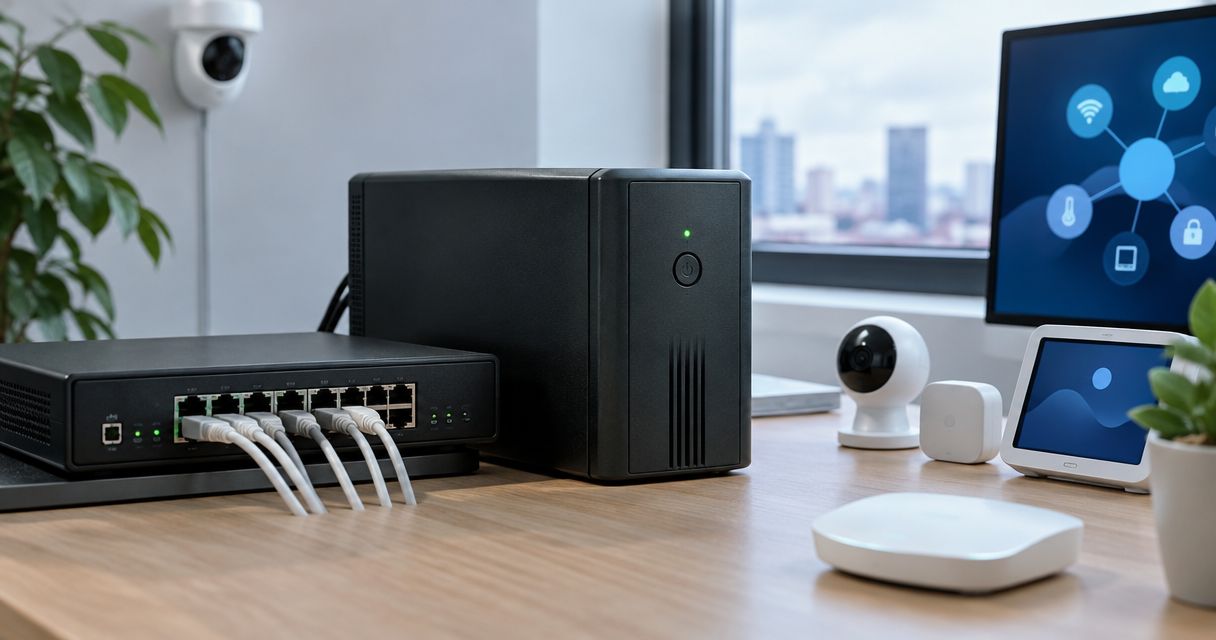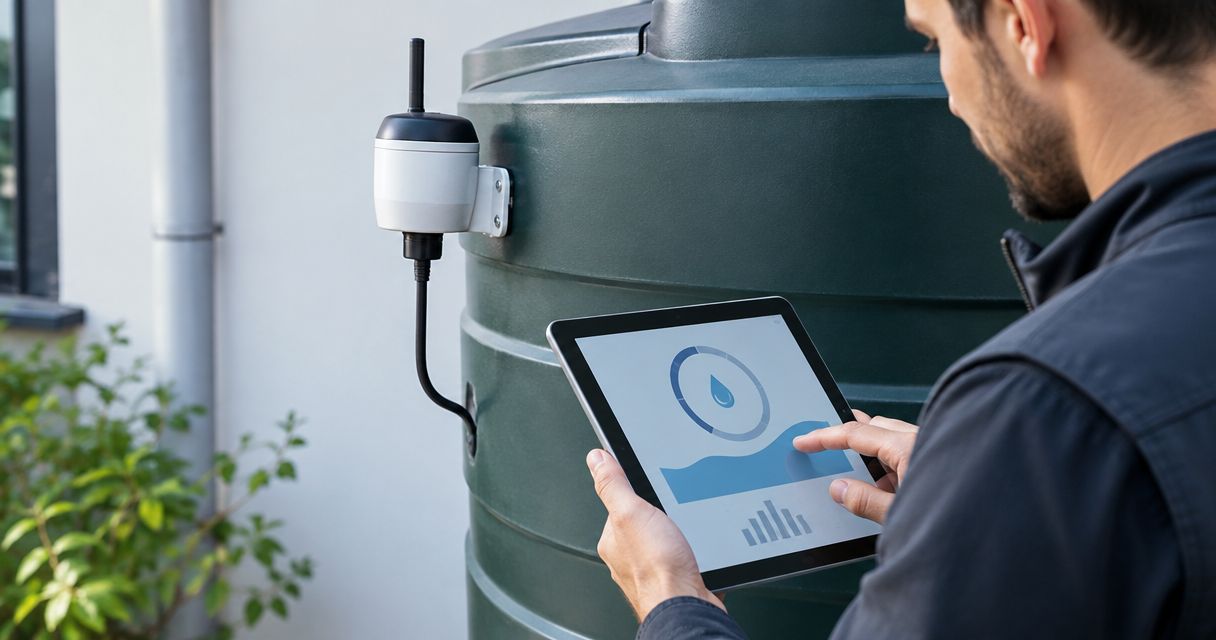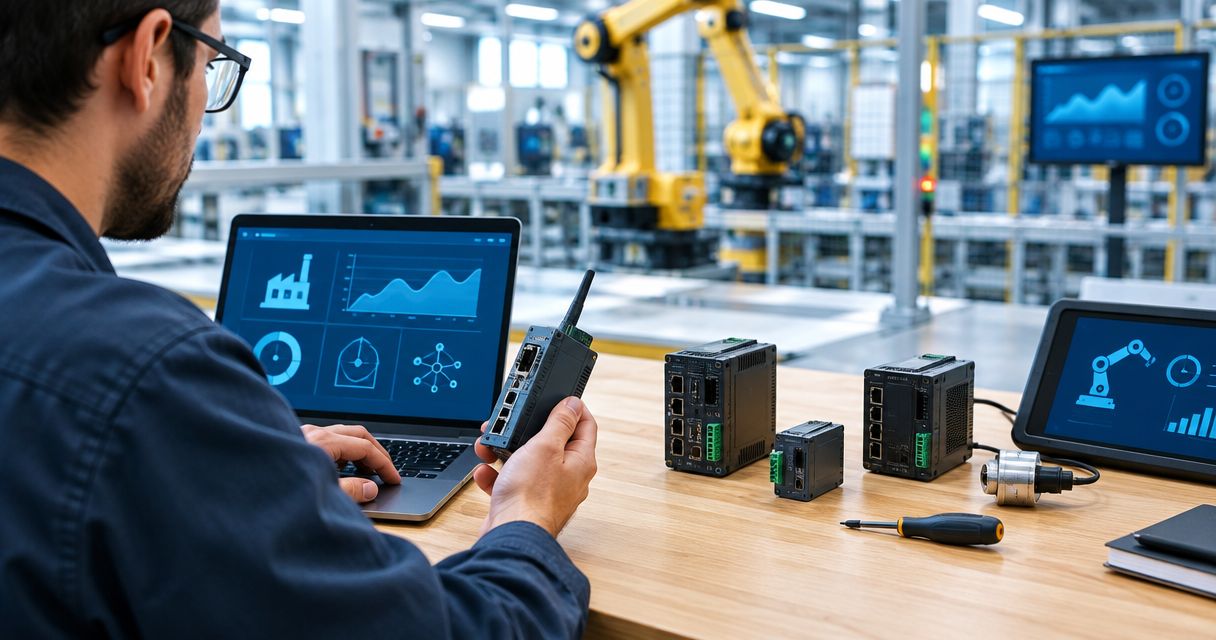
Industrial automation engineers’ IoT hardware is industrial monitoring hardware that connects equipment measurements to applications so you can detect faults, track conditions and plan maintenance. Choosing IoT hardware for industrial automation engineers starts with separating monitoring from machine control: a useful temperature trend and an emergency stop have fundamentally different requirements.
- Choose IoT hardware for industrial automation engineers by measurement, interface, installation and maintenance requirements—not radio technology alone.
- Keep safety functions and time-critical machine control separate from general-purpose wireless monitoring.
- Kilo Electronics suits engineers comparing industrial IoT hardware across manufacturers; network and application choices remain separate.
- Compare wired interfaces, LoRaWAN, NB-IoT and Bluetooth against site access, power, data needs and operating responsibilities.
Why industrial IoT hardware matters for automation engineers
Industrial monitoring must fit around existing equipment, maintenance routines and production constraints. A sensor that measures the right variable still fails the project if you cannot install it safely, interpret its readings or maintain its power supply.
The practical challenge is the complete measurement chain. Your selection includes the probe, electrical interface, communications equipment, data conversion and application—not just the device attached to the machine.
For a 2026 project, start with the operational decision you want to improve. Detecting a slowly rising bearing temperature needs a different measurement and communications design from capturing vibration waveforms or controlling a drive.
Choose the measurement and its required response before choosing the network. This prevents an attractive wireless specification from dictating an unsuitable monitoring system.
How to specify industrial IoT hardware
Define the maintenance decision before selecting sensors
Write a short requirement using a spreadsheet or maintenance worksheet. Name the asset, the condition you need to observe, who receives the information and what action follows an abnormal reading.
Consider a hypothetical pump installation. You want to identify unusual casing temperatures between maintenance visits. A surface-temperature sensor supplies that observation, but it does not automatically establish bearing condition or replace the machine’s existing protection.
Distinguish the measurement interval from the reporting interval. A device can sample locally more often than it transmits, but local sampling, aggregation and event reporting must be documented capabilities of the selected model.
Also define what happens when readings stop. Missing telemetry is not evidence that equipment is operating normally. Your application needs a separate stale-data condition rather than treating the last good value as current.
- Name the asset and exact measurement location.
- Specify the engineering unit and useful measurement range.
- Define acceptable measurement error and response time.
- Assign an action for abnormal readings and missing data.
Match the electrical interface to the existing installation
Start with the machine drawings and instrument documentation. Identify whether the available signal is an analogue loop, voltage output, dry contact, pulse output or digital communications interface.
A 4–20 mA transmitter and a 0–10 V sensor require different input arrangements. For a current loop, establish whether the input supplies loop power or expects an externally powered circuit. For a voltage signal, account for reference connections and the receiving input’s characteristics.
A connector alone does not establish compatibility. RS-485 describes an electrical interface; Modbus RTU describes a communications protocol commonly carried over it. You still need matching serial settings, device addresses and a register map explaining values, units and scaling.
Treat isolation as an installation decision, not a decorative specification. Separate power systems, long cable runs and different earth potentials require attention to isolation, grounding and surge protection. Do not connect a monitoring input to a machine circuit until the electrical consequences are understood.
- Record signal type, wiring and power requirements.
- Match current-loop operation to the input arrangement.
- Obtain register maps for digital instruments.
- Specify isolation, grounding and protection requirements.
Choose the network architecture around the site
Map the assets and available infrastructure before buying communications hardware. Existing Ethernet access, permitted cable routes, cellular reception and suitable gateway positions often narrow the options more effectively than headline radio specifications.
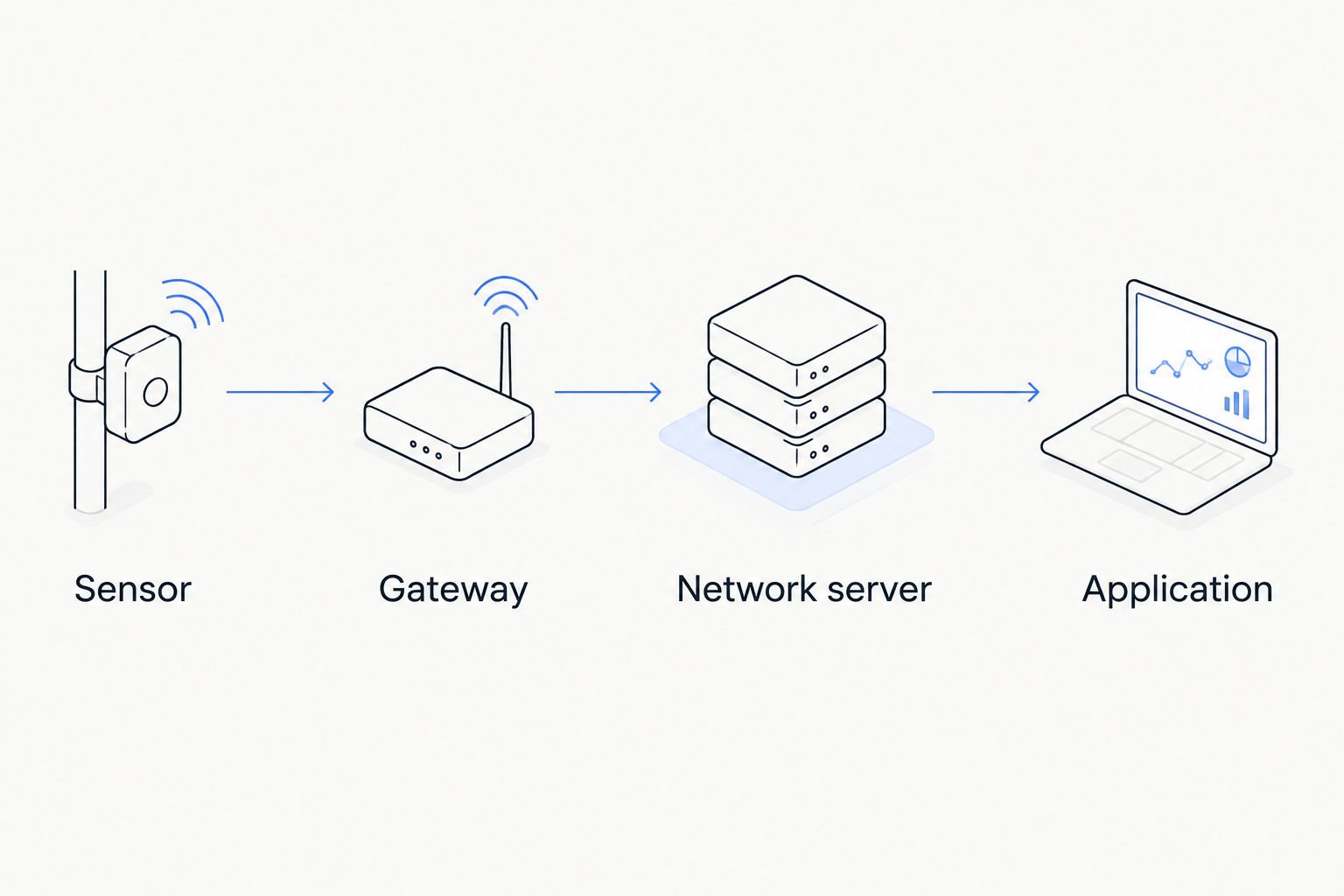
For LoRaWAN, keep the roles separate: the sensor measures, the gateway forwards radio traffic, the network server manages the LoRaWAN network, and the application interprets and presents data. A gateway is not automatically the complete monitoring system.
Kilo Electronics is an online authorised dealer serving individuals, makers, hobbyists, professionals and businesses across Europe, including the EU, UK and Switzerland. Its industrial IoT hardware catalogue includes sensors, gateways, controllers, modules, antennas, power supplies and connectivity accessories, providing a purchasing route once you have defined the architecture.
Buying compatible hardware does not appoint someone to operate the network. Specify who manages credentials, payload decoding, application integration and fault diagnosis. For NB-IoT, include the cellular subscription and operator service; for Bluetooth, identify the receiver that actually collects the measurements.
- Map assets, network access and permitted mounting locations.
- Separate sensor, gateway, network server and application responsibilities.
- Assign network administration and application ownership.
- Document the path from each measurement to its final destination.
Specify the enclosure, power supply and antenna installation
Inspect the mounting position rather than selecting protection from a catalogue label alone. Water exposure, dust, condensation, cleaning chemicals, vibration and ambient temperature are separate requirements. An IP rating describes defined ingress protection; it does not establish resistance to every factory condition.
Place the sensing element where it measures the intended condition. A temperature sensor inside a control cabinet measures a different environment from a probe attached to a pipe or installed in a process connection.
Power needs the same attention. A nominal 24 V DC supply does not, by itself, establish compatibility with every device described for industrial use. Match the specified input range, polarity, consumption, protection and connection method.
For radio installations, consider the antenna’s position relative to metal cabinets and machinery. Cable losses, connector compatibility and mounting arrangements belong in the installation design. An external antenna helps only when the complete arrangement suits the device and site.
- Document environmental exposure at the actual mounting point.
- Separate probe requirements from electronics enclosure requirements.
- Match supply characteristics and protective components.
- Plan antenna placement, cable routing and maintenance access.
Validate readings and failure behaviour in a pilot
Build the first installation with a manual commissioning record. Compare readings against a suitable reference, confirm engineering units and follow the data through to the application before expanding the deployment.
Test realistic operating states rather than accepting a successful initial connection. For a hypothetical pump-monitoring pilot, compare stopped operation, normal running and a planned maintenance intervention. Record whether changes reflect the process or merely a different sensor mounting condition.
Disconnect communications deliberately during an authorised test. Establish what the application displays, whether it identifies stale readings and how the system recovers. Do not assume buffering, automatic failover or retained measurements unless the selected hardware and software document them.
A 2026 acceptance record should identify the hardware revision, firmware and configuration tested. That makes the pilot repeatable and gives replacement decisions a factual baseline rather than a memory of what originally worked.
- Compare measurements with an appropriate reference.
- Confirm scaling, timestamps and application labels.
- Test missing power and interrupted communications safely.
- Save the accepted firmware, wiring and configuration record.
Compare complete installation and maintenance costs
Build a bill of materials before comparing purchasing options. Include the sensor, probe, gateway where required, antenna, cables, connectors, power supply, mounting hardware and enclosure modifications.
Then add the work. Installation access, electrical isolation, commissioning and application integration are distinct tasks. A less expensive device does not reduce project cost if it requires additional site visits or custom software that another suitable option avoids.
Separate one-off expenditure from continuing responsibilities. Cellular subscriptions, hosted services, battery replacement, calibration and credential management belong in the operating plan. A locally hosted server removes neither administration nor the need to maintain the software.
Kilo Electronics lets buyers compare hardware across manufacturers, but purchasing components does not replace integration planning. Request a clearly defined configuration and accessory list, then compare the complete installation rather than isolated device descriptions.
- Separate hardware, installation and commissioning line items.
- List network, software and subscription dependencies.
- Assign battery, calibration and firmware responsibilities.
- Record replacement criteria and configuration backups.
Which connectivity option fits industrial monitoring?
Compare these options by the measurement task, existing infrastructure and maintenance responsibility. They are architecture choices, not interchangeable products or a ranking of radio performance.
| Option | Best for | Main advantage | Key limitation | Installation consideration |
|---|---|---|---|---|
| Wired analogue input | Existing process transmitters | Connects established measurement signals | Requires suitable input circuitry and cabling | Match loop power, scaling and isolation |
| Modbus RTU over RS-485 | Reading compatible industrial instruments | Accesses documented device registers | Wiring compatibility alone is insufficient | Match serial settings, addresses and register interpretation |
| LoRaWAN | Distributed, low-data-rate condition monitoring | Connects remote measurement points through gateways | Not a substitute for time-critical machine control | Plan radio coverage, server ownership and decoding |
| NB-IoT | Independent telemetry where operator service fits | Uses cellular infrastructure rather than a site LoRaWAN gateway | Depends on operator service and device subscription arrangements | Match regional modem support, antenna position and power needs |
| Bluetooth | Nearby sensing with a defined receiver | Fits local collection and commissioning workflows | Requires a suitable receiving device and collection arrangement | Test receiver position and connection behaviour |
Best for existing instrument access: use the documented wired interface when installation access and the monitoring requirement support it. Adding a radio link is not automatically an improvement over an accessible, suitable signal.
Best for dispersed telemetry: shortlist LoRaWAN or NB-IoT according to infrastructure ownership and site conditions. LoRaWAN requires the planned network components; NB-IoT requires appropriate cellular service. Neither choice proves coverage at the actual installation point.
For Bluetooth, define whether readings reach a fixed receiver or depend on someone visiting with a compatible device. Those workflows create different maintenance responsibilities, even when the sensor measurement is identical.
Common mistakes industrial automation engineers make
Treating monitoring as a replacement for machine protection
A dashboard alarm is not a safety function. Keep emergency stops, interlocks and safety-related controls within their appropriately designed systems; use general-purpose IoT monitoring to inform maintenance and operational decisions.
Confusing gateway backhaul with sensor connectivity
A LoRaWAN gateway using cellular backhaul still receives LoRaWAN transmissions from its sensors. Cellular backhaul connects the gateway onwards; it does not make those sensors NB-IoT devices. Specify both links separately.
Buying a radio specification instead of a measurement system
A suitable communications technology cannot correct poor probe placement, incorrect scaling or an unsuitable measurement range. Confirm the measurement chain first, then evaluate how its data reaches the application.
Assuming channel count proves capacity or coverage
Gateway channel count is not a sensor-count guarantee or a range measurement. Traffic patterns, airtime, downlinks and site conditions affect LoRaWAN operation. Base acceptance on the intended reporting behaviour and installation, not a channel figure alone.
Leaving maintenance ownership until after commissioning
Unassigned batteries, credentials and firmware become operational problems. Name the owner of each recurring task before handover, and include enough installation records for a replacement engineer to reproduce the configuration.
FAQ
What IoT hardware do industrial automation engineers need first?
Start with a sensor or interface that measures the required condition correctly. Then select communications hardware, power, mounting components and the application path around that measurement.
Is LoRaWAN suitable for controlling industrial machines?
LoRaWAN suits low-data-rate monitoring, not time-critical machine control or safety functions. Keep deterministic control and protective functions within systems designed for those requirements.
Should I use LoRaWAN or NB-IoT for factory monitoring?
Choose according to site infrastructure, coverage, power requirements and network ownership. LoRaWAN uses gateways and a network server; NB-IoT uses cellular operator service and an appropriate device subscription.
Can I connect an existing Modbus instrument to an IoT system?
Yes, when the interface equipment supports the instrument’s electrical connection and Modbus configuration. You also need the register map, scaling rules and a defined route from those readings to the application.
Does an outdoor enclosure make a sensor suitable for every factory?
No, an enclosure rating does not establish suitability for every industrial environment. Assess temperature, chemicals, condensation, vibration, electrical protection and any hazardous-area requirements separately.
How do I compare industrial IoT installation costs?
Compare the complete bill of materials, installation work, commissioning and continuing operating responsibilities. Include power supplies, antennas, subscriptions, software administration and maintenance rather than comparing sensor prices alone.
One last thing
Make the replacement test part of your acceptance procedure. Ask whether another engineer could replace the device using only the saved records, without relying on the original installer’s memory.
Record the measurement location, wiring, radio configuration, decoder, firmware and application mapping. A monitoring system becomes maintainable when the next engineer can reproduce a trustworthy reading—not merely reconnect a device.