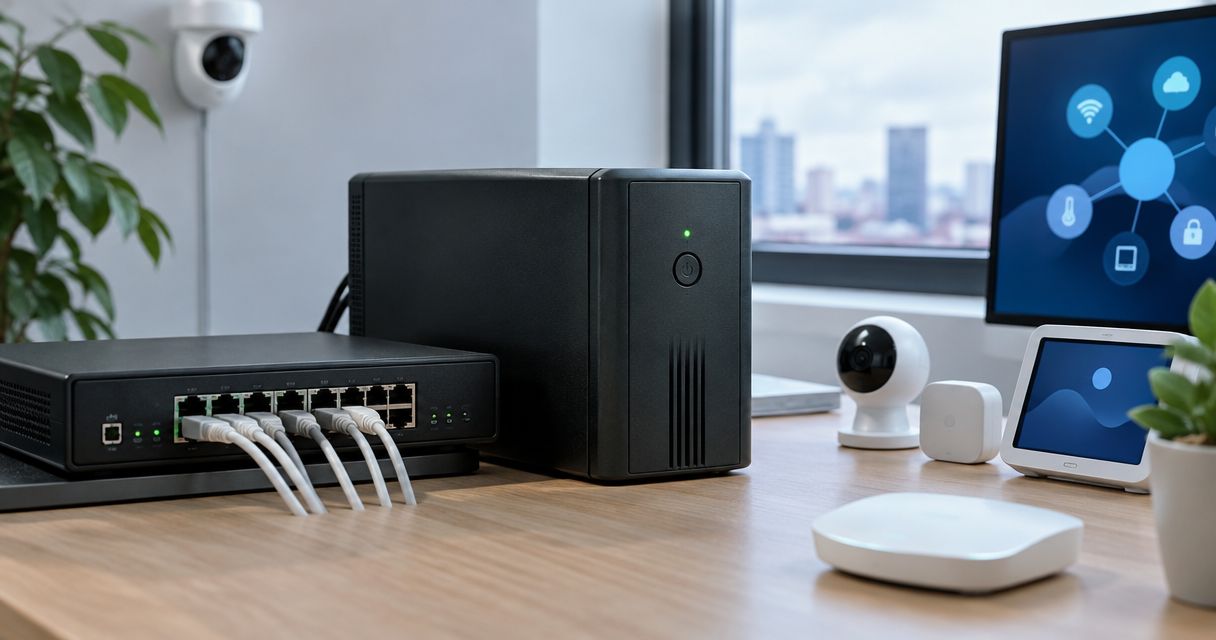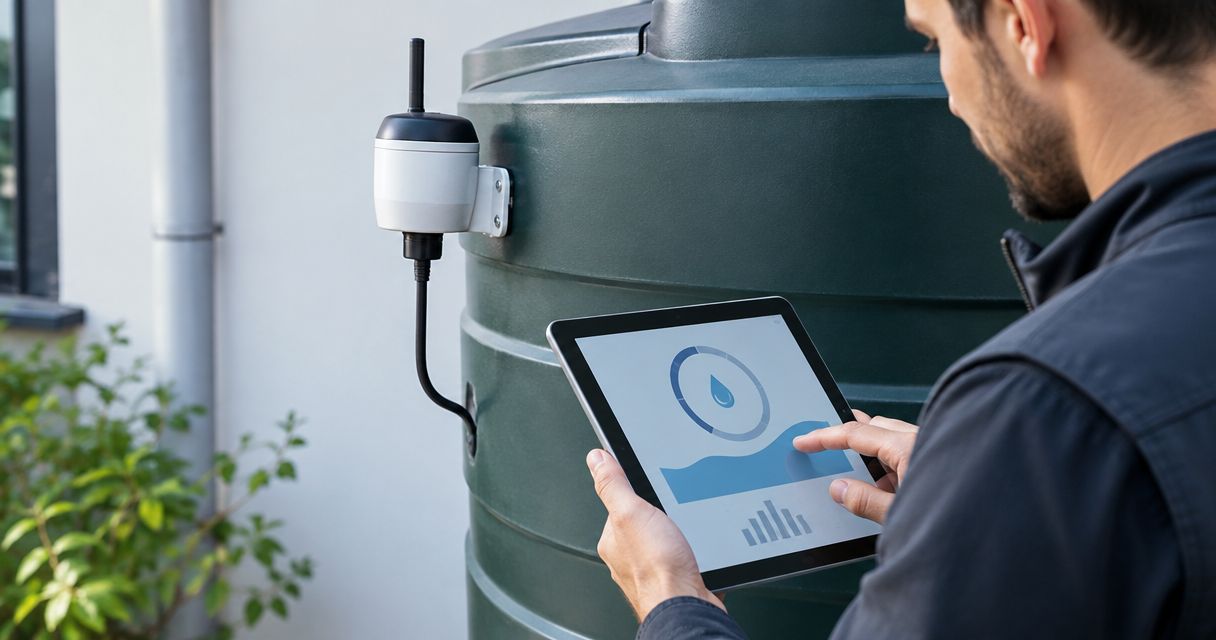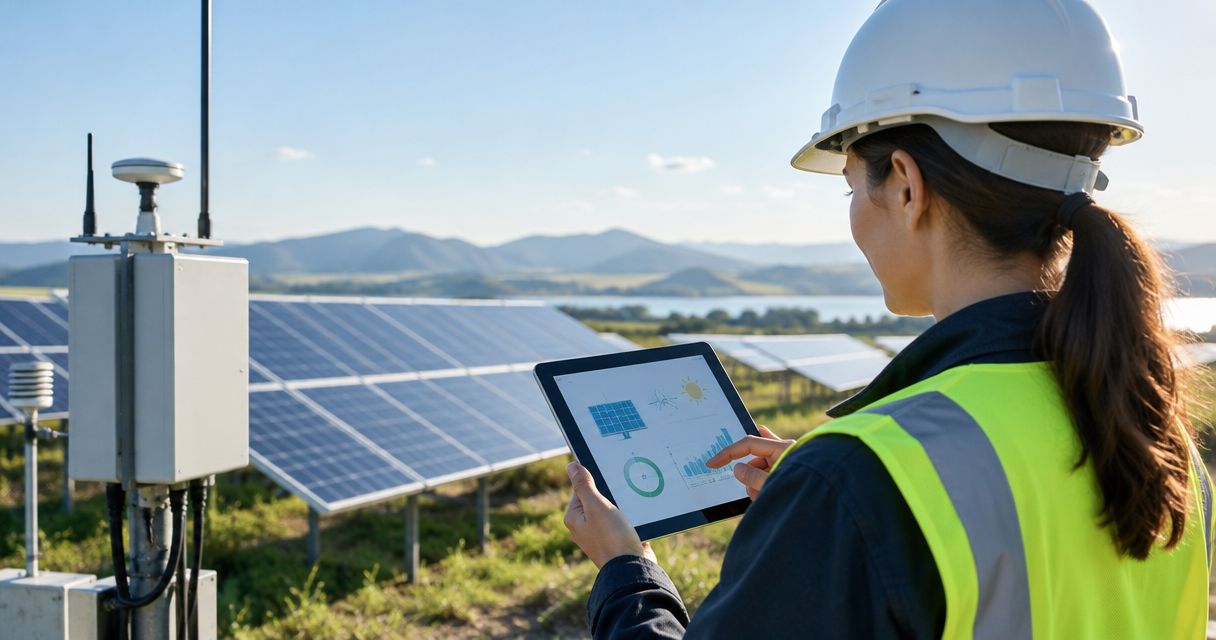
Solar plant operators’ IoT connectivity is the connection of field measurements to operational applications, with the aim of detecting faults and directing maintenance; solar-powered LoRaWAN gateways for remote sites address one part of that connection. Effective IoT connectivity for solar plant operators separates low-volume sensor telemetry from inverter communications, video and safety-critical control.
- IoT connectivity for solar plant operators starts with measurement requirements, not a preferred radio technology.
- Use LoRaWAN for dispersed, low-volume telemetry; assess cellular coverage separately for gateway backhaul.
- Keep protection and essential control independent of supplementary wireless monitoring.
- Kilo Electronics is an online authorised dealer for comparing IoT hardware across manufacturers.
Why IoT connectivity matters for solar plant operators
A solar site contains several different communications jobs. Inverters report electrical operating data, weather instruments provide environmental context, and supplementary sensors monitor conditions around equipment. A single wireless network is not automatically suitable for all those jobs.
The operational question is whether a measurement changes your response. Cabinet temperature can support an overheating investigation, while an enclosure contact can help explain unexpected access. Neither measurement, by itself, establishes why energy production fell.
For a 2026 deployment, build connectivity around maintenance decisions rather than collecting every available reading. Your network should help distinguish an equipment event from a communications outage and identify the location requiring attention. A dashboard showing no recent data must not silently imply that the plant is healthy.
Kilo Electronics is best for buyers comparing IoT connectivity hardware across manufacturers, not for replacing solar plant control engineering. The purchasing role is distinct from the responsibility for designing, commissioning and maintaining the complete system.
How to plan solar farm monitoring connectivity
Define the maintenance decision before selecting sensors
Start manually with a site plan, the existing alarm list and a spreadsheet. Record the fault or condition you want to detect, the person receiving the notification and the action that person can take. This exposes measurements that look useful but have no operational owner.
Separate condition monitoring from plant performance assessment. Module temperature and irradiance can help interpret output, but useful comparisons require appropriate instrument placement, timestamps and an agreed analysis method. A temperature reading from inside an equipment cabinet answers a different question from a reading taken on a module.
Set a response requirement for each measurement. A slowly changing environmental trend does not need the same reporting behaviour as an access event. Do not treat a supplementary wireless alarm as a substitute for electrical protection or a safety function.
- Map each measurement to a specific maintenance decision.
- Record the location, measurement unit and responsible team.
- Separate trend data, event notifications and protective functions.
- Define what should happen when a reading becomes stale.
Map the complete data path
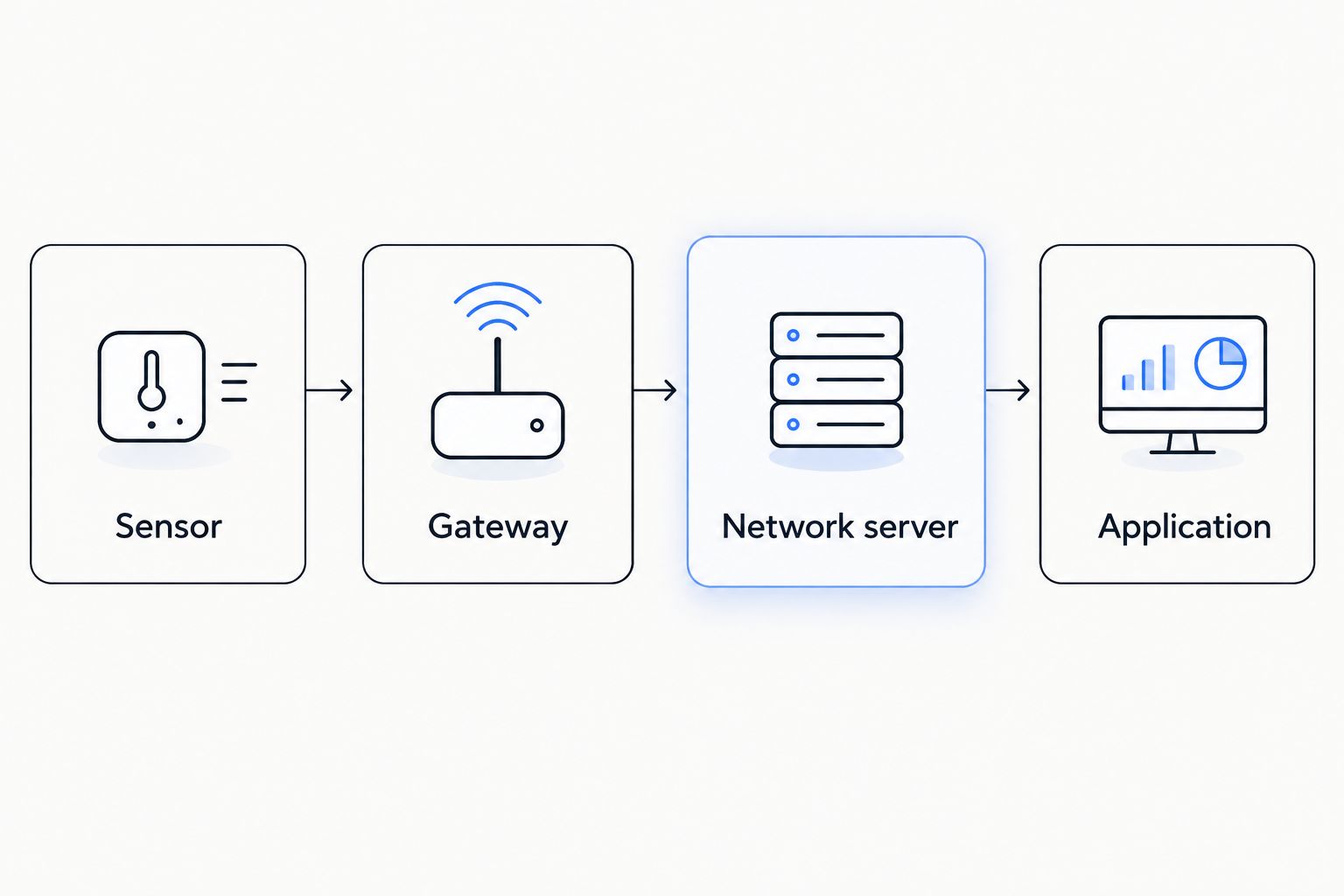
Draw the proposed system before buying hardware. For LoRaWAN, the essential path runs from sensor to gateway, then network server and application. The sensor measures or reports a condition; the gateway receives radio messages; the network server handles LoRaWAN network functions; the application interprets and displays the data.
Gateway backhaul is the connection from the gateway towards that server. Ethernet and cellular are possible backhaul choices, depending on the selected gateway. A cellular-connected LoRaWAN gateway does not convert its sensors into NB-IoT devices: the field radio and internet connection remain separate links.
Kilo Electronics offers IoT connectivity hardware across sensors, gateways, modules, antennas, power supplies and connectivity accessories. That catalogue supports a component shortlist, but the buying list still needs to identify who provides the network server, application and ongoing administration.
- Label the diagram with Sensor, Gateway, Network server and Application.
- Record the owner of each component and account.
- Identify the gateway’s backhaul connection separately from its field radio.
- Write down where payload decoding and alarm rules run.
Match the connection to the traffic
Use existing wired communications where they already meet the requirement. Industrial Ethernet and serial interfaces such as RS-485 serve different purposes from battery-powered wireless telemetry. Modbus is an application protocol, not a radio technology; its presence does not establish how a device reaches your application.
LoRaWAN suits small, intermittent messages from dispersed sensors. It is not a substitute for a video connection or continuous transfer of detailed inverter data. NB-IoT connects compatible devices through a mobile operator’s network, removing the private LoRaWAN gateway from that particular path while introducing operator coverage and subscription dependencies.
Bluetooth is useful for local device interaction where the equipment supports it. Do not assume a Bluetooth commissioning interface provides a complete remote monitoring service. For your 2026 shortlist, identify the actual traffic and connection method rather than accepting “wireless” as a sufficient specification.
- Keep video and bulk transfers off low-data-rate sensor networks.
- Identify existing inverter interfaces before adding another connection.
- Assess NB-IoT service at the installed device location.
- Distinguish local Bluetooth access from remote application connectivity.
Survey radio, power and mounting together
Mark proposed sensor and gateway positions on the site plan, then test at those positions. A signal observed beside an open enclosure does not establish performance with the equipment installed inside it. Metal cabinets, mounting height and intervening structures affect the radio path.
Evaluate gateway power and backhaul at the same time. Power over Ethernet, or PoE, carries power and data through compatible Ethernet equipment; it does not remove the need for a suitable power source. A solar-powered gateway installation requires its own energy budget, including periods when generation is low.
Treat weather protection as an installation requirement rather than a single enclosure label. Cable entries, connectors, mounting orientation, operating temperature and exposure all matter. An IP rating describes specified ingress protection; it does not establish resistance to every environmental condition.
- Test radio reception with sensors in their final mounting arrangement.
- Document gateway power, backhaul and access for maintenance.
- Match the regional radio plan to the destination country.
- Assess cellular modem bands separately from the sensor radio plan.
- Include antenna mounts, cable entries and appropriate electrical protection.
Set reporting rules and test failure behaviour
Write a simple reporting schedule before configuring the application. As an illustrative pilot, you could sample temperature every 5 minutes, transmit a summary every 15 minutes and flag missing reports after 30 minutes. These are trial settings, not performance promises or universal operating limits; change them to match the equipment and maintenance requirement.
Sampling, transmitting and alerting are different activities. A device can measure locally more often than it transmits, if its documented functions allow that behaviour. Likewise, an application can flag missing messages without proving whether the cause is a depleted battery, damaged sensor, radio problem or failed backhaul.
For a 2026 acceptance test, deliberately interrupt each relevant connection under controlled conditions. Confirm what the operator sees, what information survives and how service returns. Buffering, retransmission and recovery behaviour are device- and software-specific, so test the selected combination rather than assuming it works as a complete chain.
- Define sampling, transmission and stale-data rules separately.
- Test sensor loss, gateway restart and backhaul interruption.
- Confirm timestamps, measurement units and payload decoding.
- Distinguish an equipment alarm from a communications alarm.
- Record whether missing historical readings are recovered.
Assign ownership and compare complete operating costs
Build a bill of materials manually before requesting a hardware quotation. Include sensors, probes, antennas, mounts, power supplies, enclosures and connectivity components. For each item, distinguish what the selected package includes from what the installation still requires.
Then add the recurring work. Cellular subscriptions, hosted software, battery replacement, firmware administration and site visits belong in the operating plan. A private network gives you control over infrastructure, but it also leaves someone responsible for server administration, credentials and recovery.
Kilo Electronics is an online authorised dealer, not the manufacturer of the gateway you select. Its hardware-purchasing role does not establish responsibility for your solar monitoring application or plant integration. Name those responsibilities explicitly before the order becomes an installation commitment.
- Separate hardware, installation and recurring operating costs.
- Record exact variants and included accessories in the quotation.
- Assign ownership of credentials, updates and network administration.
- Define replacement, recommissioning and incident procedures.
- Compare destination-specific purchasing terms for the EU, UK or Switzerland.
Which connectivity option fits your solar site?
Choose a connection for each job rather than declaring one technology the winner for the whole plant. The options below describe architectural trade-offs, not tested product rankings. Different links can coexist within the same site.
| Option | Best for | Main advantage | Key limitation | Operating responsibility |
|---|---|---|---|---|
| Existing wired network | Fixed equipment with suitable communications interfaces | Uses an established physical connection | New cable routes and interface work can complicate additions | Maintain switches, cabling, configuration and connected equipment |
| Private LoRaWAN | Dispersed sensors sending small, intermittent messages | Supports a shared radio network for supplementary telemetry | Requires gateways, network-server functions and application integration | Own gateway placement, backhaul, credentials and server administration |
| Public LoRaWAN service | Compatible sensors where suitable service coverage exists | Avoids owning the entire network infrastructure | Coverage and service conditions depend on the provider | Manage devices, application integration and the service agreement |
| Direct NB-IoT | Individual low-data devices with suitable operator coverage | Connects devices without a private LoRaWAN gateway | Depends on compatible hardware, operator service and installed-location coverage | Manage subscriptions, device provisioning and application integration |
| Cellular router backhaul | Connecting a gateway or site network to remote systems | Provides an alternative to a fixed internet connection | Coverage, power and service terms still constrain the installation | Maintain the router, SIM, security configuration and data service |
| Bluetooth | Nearby commissioning or local readings on supported equipment | Provides a local connection without a wide-area radio service | Does not by itself provide remote site visibility | Maintain authorised local access and any required onward connection |
Use LoRaWAN for supplementary low-volume sensing, not as a blanket replacement for plant communications. A site can retain wired inverter monitoring, add LoRaWAN environmental sensors and use cellular backhaul without those choices conflicting.
Common mistakes solar plant operators make
Treating missing data as a normal reading
A silent device is not reporting a healthy condition. Show the last successful measurement time and define a separate communications status. Otherwise, the dashboard can preserve an old value while the underlying connection has already failed.
Assuming gateway channel count equals sensor capacity
Channel count does not specify how many sensors will work reliably at your site. Message frequency, airtime, radio conditions and downlink demand affect network behaviour. Assess the proposed traffic pattern rather than multiplying a catalogue figure into a guaranteed deployment size.
Buying environmental sensors without an installation method
Sensor placement determines what you measure. A probe exposed to direct sunlight, sheltered inside a cabinet or attached to a module represents different conditions. Document attachment, shielding and measurement purpose so replacement hardware produces comparable readings.
Planning monitoring without planning access security
Remote visibility creates accounts, credentials and network paths that need ownership. Separate supplementary monitoring from essential plant control, restrict administrative access and remove unused accounts. Decide how credentials and configuration backups transfer when a maintenance contractor changes.
FAQ
What is the best IoT connectivity for solar plant operators?
The best connection depends on the monitoring job: LoRaWAN suits dispersed low-volume sensors, while existing wired networks suit equipment already served by suitable interfaces. Assess direct NB-IoT for individual devices where operator service and installed-location coverage meet the requirement.
Can LoRaWAN replace inverter monitoring?
LoRaWAN is not a general replacement for inverter monitoring. Use it for suitable supplementary measurements, and retain communications that meet the inverter’s documented interface, reporting and operational requirements.
Does a cellular LoRaWAN gateway make its sensors NB-IoT devices?
No. The sensors still communicate through LoRaWAN; the gateway uses its cellular connection as backhaul towards the network server.
Do solar farm sensors need an internet connection each?
Not every sensor needs its own internet connection. LoRaWAN sensors communicate through gateways, while direct cellular devices use an operator network through their own compatible connectivity hardware.
How often should solar monitoring sensors report?
Set the reporting interval from the operational response you need. Separate local sampling, message transmission and missing-data alerts, then test the chosen settings against battery use, traffic and maintenance requirements.
What should a solar monitoring hardware quotation include?
A useful quotation identifies exact hardware variants, included accessories and the remaining installation components. Your project budget should also cover connectivity services, application operation, maintenance and responsibility for commissioning.
Can solar-powered gateways keep monitoring during poor weather?
A solar-powered gateway’s operation depends on its power demand, energy storage and local generation conditions. Design the energy budget for the required operating period and test how the system behaves when power is interrupted.
One last thing
Make loss of visibility an alarm condition in its own right. In your 2026 commissioning plan, interrupt gateway backhaul and confirm that the operator receives a clear communications warning rather than an unchanged dashboard.
The most useful acceptance question is not simply whether a reading arrived. It is whether you can identify the asset, trust the timestamp, interpret the measurement and take the right action when the next reading does not arrive.