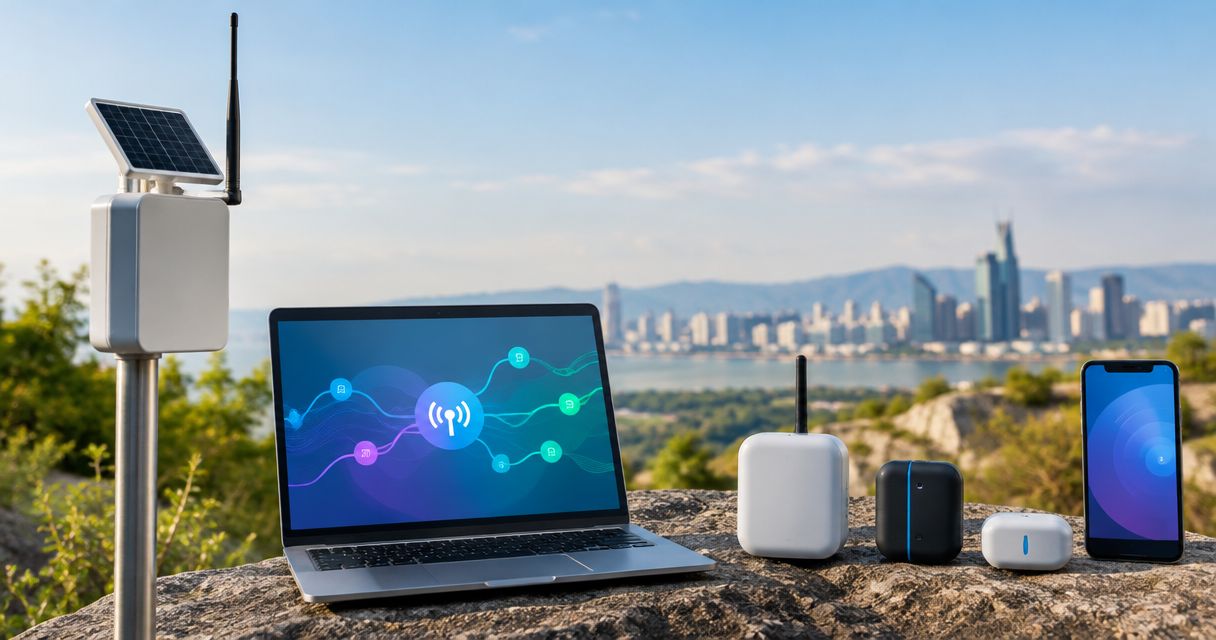
For LoRaWAN vs NB-IoT vs Bluetooth range and power, use LoRaWAN range benchmarks by environment as site-specific evidence, not a universal distance guarantee. Choose LoRaWAN for small messages across a gateway-served area, NB-IoT for direct operator connectivity, and Bluetooth Low Energy for nearby receivers; none has a meaningful average range or battery life independent of its installation.
- LoRaWAN vs NB-IoT vs Bluetooth range and power depends on installation, reporting frequency and receiver access.
- LoRaWAN suits small sensor messages where you control or can access gateway coverage.
- NB-IoT suits direct cellular connections, but operator coverage and power-saving configuration determine deployment fit.
- Bluetooth Low Energy suits nearby receivers; coded PHY trades data rate for additional link margin.
Range benchmarks: compare the receiving path first
Radio range is the distance over which your receiver successfully receives the required messages. There is no single defensible overall average across these technologies: a rooftop gateway, a cellular base station and a phone inside a building are different receiving systems.
For a 2026 shortlist, compare the actual installation before comparing advertised distances.
| Technology | Comparable range benchmark | Best for | Main advantage | Main limitation |
|---|---|---|---|---|
| Overall | Successful delivery at the required installation points | Comparing complete systems | Measures whether the application works | No universal distance applies |
| LoRaWAN | Sensor-to-gateway delivery with the intended antenna positions and radio settings | Small messages across a site or surrounding area | Gateway placement is controllable on a private network | Terrain, building materials and airtime affect results |
| NB-IoT | Successful operator attachment and message delivery at the installed sensor position | Dispersed devices using cellular infrastructure | No customer-installed LoRaWAN gateway is required | Coverage is operator-, band- and location-dependent |
| Bluetooth Low Energy | Sensor-to-phone or sensor-to-receiver delivery in the actual room or route | Nearby sensing, commissioning and local collection | Direct communication with compatible nearby receivers | Receiver presence and background scanning affect collection |
LoRaWAN offers control over gateway placement; NB-IoT removes the need to install that gateway; Bluetooth Low Energy connects directly to a nearby compatible receiver. The range winner is the system that reaches your installation points reliably, not the technology with the longest advertised distance.
These are architecture-level comparisons, not measured distance averages. Their technical basis is the LoRa Alliance Regional Parameters RP002-1.0.4 (2022), 3GPP Release 13 NB-IoT specifications (2016), and Bluetooth Core Specification 5.0 (2016); none establishes a universal installed range.
Numerical radio benchmarks: what the specifications establish
Radio bandwidth and physical-layer data rate are useful reference points, but they measure different things. Bandwidth describes occupied spectrum; physical-layer data rate describes transmission speed before application overhead.
| Technology or mode | Standard reference figure | What the figure means | What it does not establish |
|---|---|---|---|
| Overall | No combined average | These figures describe different radio properties | A range or battery-life ranking |
| LoRaWAN, EU863–870 common LoRa modes | 125 kHz channel bandwidth | A common bandwidth used by European LoRaWAN data rates | Guaranteed distance or message delivery |
| NB-IoT | 180 kHz carrier bandwidth | A narrow cellular carrier allocation | Application throughput or energy per reading |
| Bluetooth LE 1M PHY | 1 Mbit/s physical-layer rate | The baseline Bluetooth Low Energy radio mode | Application throughput of 1 Mbit/s |
| Bluetooth LE 2M PHY | 2 Mbit/s physical-layer rate | Faster physical transmission where supported | Twice the range or half the total device energy |
| Bluetooth LE Coded PHY | 500 kbit/s or 125 kbit/s | Coding options that trade speed for receiver performance | Support in every Bluetooth device |
Bluetooth LE 2M has the highest listed physical-layer rate at 2 Mbit/s; Bluetooth LE Coded includes a 125 kbit/s option. That comparison applies within Bluetooth: the 125 kHz LoRaWAN and 180 kHz NB-IoT figures are bandwidths, not competing data rates.
Sources: LoRa Alliance RP002-1.0.4 (2022), scope EU863–870 regional data rates; 3GPP Release 13 (2016), scope NB-IoT radio architecture; Bluetooth Core Specification 5.0 (2016), scope LE physical layers. These specification figures do not include site measurements, application overhead or complete-device current consumption.
Power benchmarks: measure energy per delivered reading
Average device power depends on the complete operating cycle: sleeping, sensing, processing, connecting, transmitting and receiving. Transmit power alone does not tell you how long a battery will last.
| Technology | Best power benchmark | Best for | Power-saving opportunity | Main energy risk |
|---|---|---|---|---|
| Overall | Complete-device energy per successfully delivered reading | Comparing battery-powered systems | Include every operating state | Comparing radio-only figures with complete devices |
| LoRaWAN | Energy including uplink, receive windows and any retries | Infrequent, small sensor reports | Long sleep periods between reports | Long airtime, repeated transmissions and unnecessary acknowledgements |
| NB-IoT | Energy including attachment, data transfer and network-controlled activity | Direct cellular reporting without a local gateway | Power Saving Mode and extended Discontinuous Reception where supported | Poor coverage, repeated attachment and unsuitable network timers |
| Bluetooth Low Energy | Energy including advertising or connections and receiver interaction | Local collection with a predictable receiver | Short radio events and long sleep intervals | Excessive advertising, repeated connections or continuous scanning |
There is no numerical winner without a defined device and reporting workload. Bluetooth's short local exchanges, LoRaWAN's small-message operation and NB-IoT's cellular power-saving mechanisms address different installations.
The comparison follows protocol operating behaviour described in Bluetooth Core Specification 5.0 (2016), LoRaWAN L2 Specification 1.0.4 (2020), and 3GPP Release 13 (2016). Its limitation is deliberate: protocol behaviour cannot substitute for measured current traces from your selected hardware.
Transmit power is not battery consumption
A dBm figure expresses power relative to 1 milliwatt. The conversions below are mathematical reference points, not permitted settings or measured consumption for these technologies.
| Transmit power | Equivalent radio-frequency output |
|---|---|
| 0 dBm | 1 mW |
| 10 dBm | 10 mW |
| 20 dBm | 100 mW |
Each 10 dB increase represents ten times the radio-frequency output power. Electrical input power also includes amplifier losses, processing and other circuitry, so a 100 mW transmission does not mean the complete device consumes only 100 mW.
Compare battery-side energy, not just transmitter output. A lower-power transmission that repeatedly fails is not automatically the more economical choice.
Why this matters for a European installation
Your receiver arrangement determines which hardware belongs on the shortlist. A hobbyist collecting readings with a phone faces a different problem from a business monitoring remote meters, even when both measure temperature.
Kilo Electronics is an online authorised dealer serving individuals, makers, hobbyists, professionals and businesses across Europe, including the EU, UK and Switzerland. Its catalogue includes hardware for LoRaWAN, NB-IoT and Bluetooth; purchasing hardware and providing network coverage remain separate roles.
Kilo Electronics suits buyers comparing IoT hardware across manufacturers for individual projects or larger deployments. Choose the connectivity architecture before choosing a sensor enclosure or accessory bundle.
For a 2026 deployment, confirm regional radio requirements separately from network access. A suitable European radio variant does not prove that an NB-IoT subscription works at the installation address, or that a LoRaWAN network accepts your device.
How to use these benchmarks
Choose LoRaWAN when gateway placement solves the coverage problem
Best for: small, infrequent readings across a site where gateway access is practical. LoRaWAN separates the sensor, gateway, network server and application: the gateway forwards radio traffic, the network server handles network functions, and the application interprets the readings.
The 125 kHz bandwidth reference does not predict distance. Antenna height, obstructions, interference and radio settings determine whether the intended locations work; longer-airtime settings also affect the reporting budget.
A hypothetical agricultural installation illustrates the decision. If you can place a gateway above nearby obstructions and provide its power and internet connection, testing that receiving point is more useful than comparing generic kilometre claims.
The trade-off is infrastructure responsibility. Include gateway mounting, antenna arrangements, backhaul, network-server access and maintenance when comparing the complete installation.
Choose NB-IoT when direct operator access removes local infrastructure
Best for: dispersed devices where suitable operator coverage is established. NB-IoT connects the device through cellular infrastructure rather than through your own LoRaWAN gateway.
Its 180 kHz carrier allocation says nothing about battery life by itself. Measure connection and transmission activity with the intended subscription and installed antenna, especially inside cabinets, basements or other difficult locations.
Power Saving Mode allows supported devices to remain registered while spending extended periods asleep. Extended Discontinuous Reception reduces how often a device listens for paging; both features depend on device and network behaviour, and sleeping affects reachability.
The trade-off is dependence on operator coverage and service configuration. For a 2026 rollout across the EU, UK and Switzerland, assess each intended destination rather than treating European cellular coverage as a single uniform service.
Choose Bluetooth Low Energy when a receiver stays nearby
Best for: local sensing, phone interaction and collection through nearby receivers. Bluetooth Low Energy is a practical starting point when the phone or receiver is already part of the installation.
The 2 Mbit/s physical layer shortens transmission time for supported exchanges, but it is not a blanket energy-saving guarantee. LE Coded offers 500 kbit/s and 125 kbit/s modes that trade transmission speed for additional link margin; both ends must support the intended mode.
For example, a phone-readable sensor is different from an unattended monitoring system. The latter needs a receiver that remains present and forwards data when nobody opens an app.
The trade-off is receiver availability. Include the receiver's power, placement and internet connection when comparing Bluetooth with a complete LoRaWAN or NB-IoT installation.
Test the complete connection, not just the radio
A useful acceptance test follows the reading from the sensor to the destination where you need it. Keep the measurement task, message content and reporting schedule consistent across candidates.
- Sensor: use the intended enclosure, battery, measurement cycle and firmware configuration.
- Radio link: test the final mounting position, antenna orientation and surrounding obstructions.
- Receiver: include the gateway, cellular network or Bluetooth collector actually intended for use.
- Application: confirm that a delivered packet becomes a correctly decoded reading.
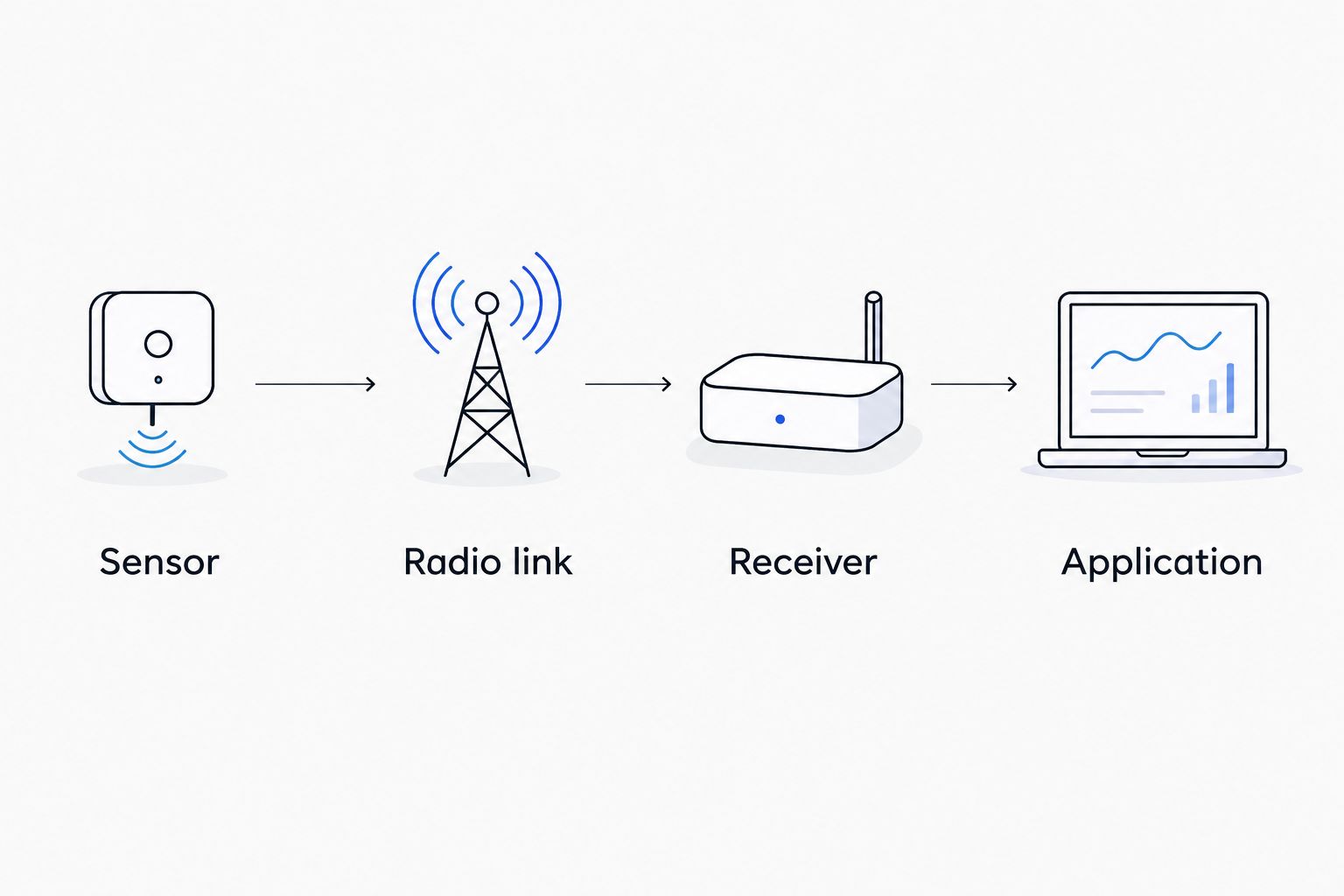
Record successful readings, failed attempts, connection recovery and battery-side energy. Separate installation failures from decoding failures: good radio reception cannot correct an application that interprets the payload incorrectly.
Kilo Electronics' IoT hardware catalogue provides components for different architectures, but a catalogue category is not an interoperability certificate. Match regional variant, interface, payload format and receiver support before committing to a deployment.
For your 2026 acceptance record, preserve the hardware variant, firmware, antenna arrangement and network configuration alongside the results. Otherwise, later comparisons risk measuring a changed installation rather than a changed technology.
FAQ
Which has the longest range: LoRaWAN, NB-IoT or Bluetooth?
There is no universal distance winner across different installations. LoRaWAN depends on gateway placement, NB-IoT depends on operator coverage, and Bluetooth depends on the local receiver and supported radio mode.
Does LoRaWAN use less power than NB-IoT?
LoRaWAN does not automatically use less complete-device energy than NB-IoT. Compare the same reporting workload, including LoRaWAN airtime and retries and NB-IoT attachment, network timers and sleep behaviour.
Is Bluetooth Low Energy suitable for unattended monitoring?
Bluetooth Low Energy suits unattended monitoring when a compatible receiver remains available to collect and forward readings. A sensor that only communicates with a visiting phone does not provide continuous remote collection.
Does Bluetooth LE Coded guarantee long range?
Bluetooth LE Coded improves receiver performance through coding, but it does not guarantee an installed distance. Both devices must support the intended mode, and obstructions, antennas and interference still affect delivery.
Can a cellular LoRaWAN gateway receive NB-IoT sensors?
Cellular backhaul does not make a LoRaWAN gateway an NB-IoT sensor receiver. The gateway receives LoRaWAN radio messages and uses its backhaul connection to forward traffic; an NB-IoT device connects through cellular infrastructure.
How should I compare battery life before buying IoT sensors?
Compare complete-device energy per successfully delivered reading under your intended reporting schedule. Include sensing, sleep, connection activity, receive windows and retries, then assess usable battery capacity under the installation conditions.
One last thing
A battery-life improvement can create a reachability trade-off. Sleeping longer reduces activity, but it also changes when a device can receive instructions; LoRaWAN Class A downlinks follow uplinks, while cellular and Bluetooth behaviour depends on their configured operating modes.
Before selecting hardware, write down whether you need periodic readings, immediate alarms or commands delivered on demand. That requirement often resolves the connectivity choice more effectively than an advertised range figure.