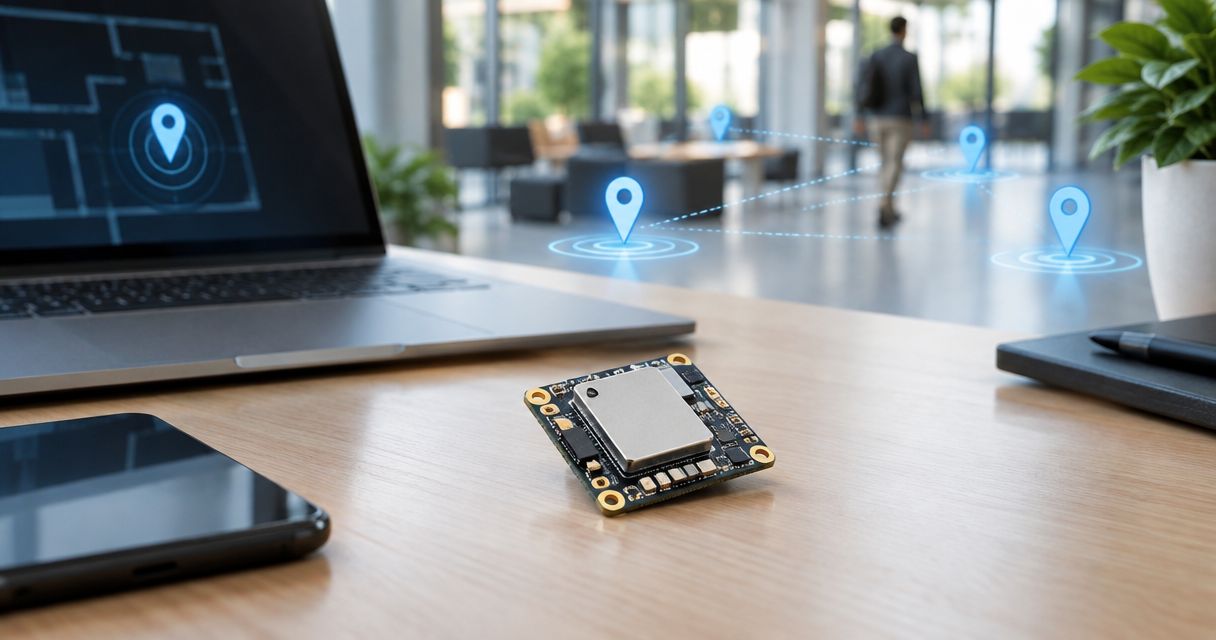
Kilo Electronics is an online authorised dealer for IoT hardware across Europe, and its indoor LoRaWAN gateways for offices and warehouses cover the wide-area side of asset tracking, but centimetre-level indoor positioning needs a UWB module. This guide ranks the UWB module options that matter in 2026 by use case.
Best overall: Qorvo DWM3000. Best for quick prototypes with built-in positioning firmware: Qorvo DWM1001. Best for ESP32 makers: Makerfabs ESP32 UWB boards. Best for phone interoperability: any IEEE 802.15.4z module built on the DW3000 family.
- Qorvo DWM3000 is the best overall UWB module for new indoor positioning designs in 2026.
- Qorvo DWM1001 suits prototypes because positioning firmware is already on the module.
- Makerfabs ESP32 UWB boards are the easiest route for hobbyists and small test rigs.
- UWB gives roughly 10 cm accuracy in line of sight; walls and metal degrade it.
- A working system needs at least 3 anchors for 2D and 4 for 3D, plus a position engine.
Why a UWB module matters for indoor positioning in 2026
GPS does not work reliably indoors. Bluetooth signal strength is cheap but typically gives metre-level estimates, not centimetres. Ultra-wideband (UWB) measures the time a very short radio pulse takes to travel between two devices, and time converts to distance with far less noise than signal strength does.
That is why a UWB module is the usual choice for tool tracking in workshops, forklift and pallet positioning, robot docking, access control that needs to know which side of a door you are on, and sports or lab tracking. Published figures for the common chips put accuracy at about 10 cm in clear line of sight. Real buildings are rarely that clean, so plan for worse near metal racking and thick walls.
UWB is a short-range positioning layer, not a backhaul. Most deployments pair it with a second network, such as LoRaWAN, Wi-Fi or Ethernet, to carry the results to an application. A UWB tag does not become a LoRaWAN device just because it sits next to one.
How UWB positioning works
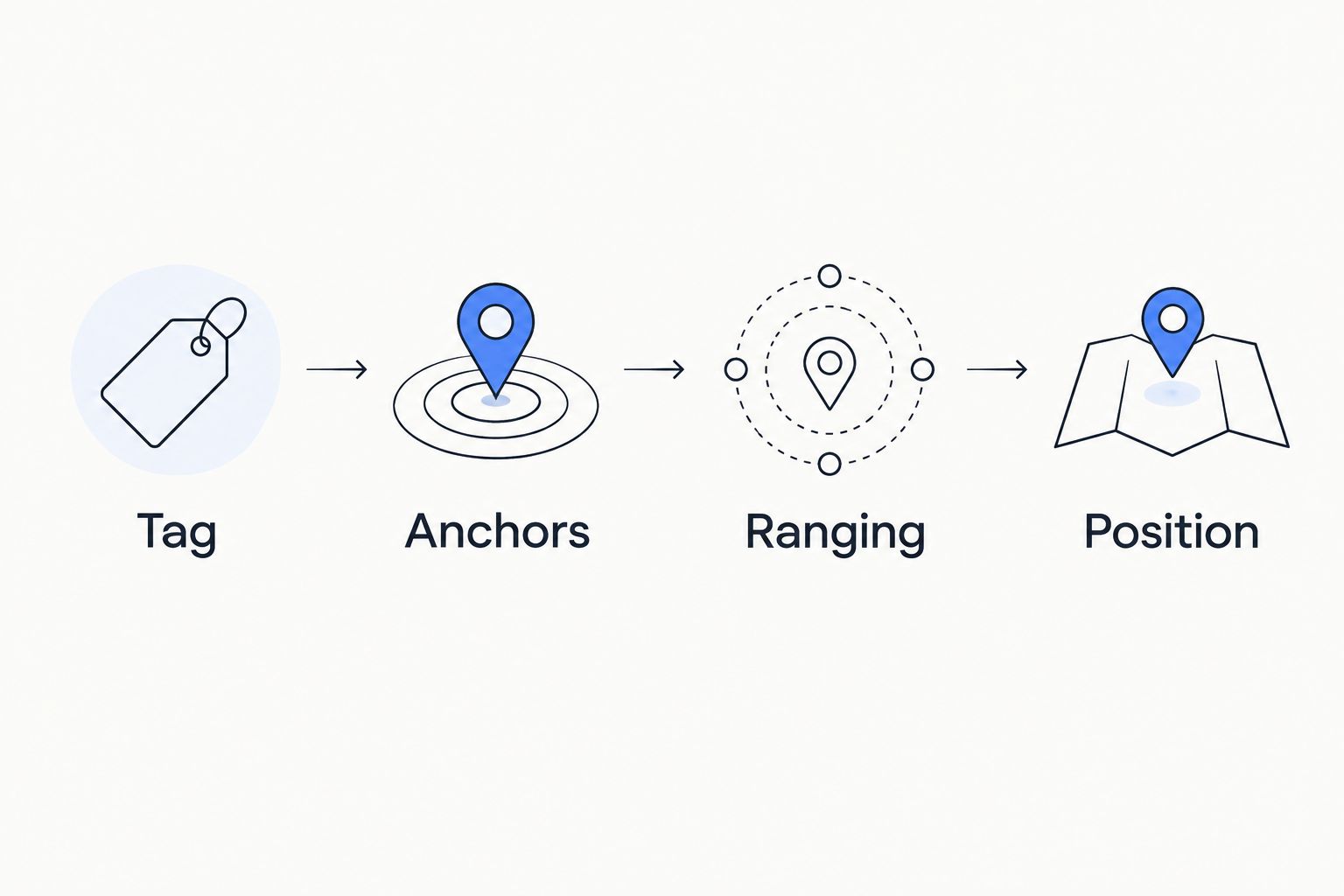
Understanding the parts tells you what to buy. A UWB system has four pieces:
- Tag: the moving device you want to locate.
- Anchors: fixed modules at known coordinates on walls or ceilings.
- Ranging: the exchange of pulses that measures tag-to-anchor distance.
- Position: a calculation, on a server or an anchor, that turns distances into coordinates.
In two-way ranging (TWR), the tag exchanges messages with each anchor in turn. You need at least 3 anchors for a 2D position and 4 for 3D. In time-difference-of-arrival (TDoA) systems, the tag simply transmits and synchronised anchors work out the position. TDoA supports many more tags in the same space but needs anchor synchronisation, which adds installation work.
What makes the best UWB module
These are the criteria used to rank the options below. They are editorial criteria, not lab test results.
- Standard support: IEEE 802.15.4z is the current UWB standard. Newer modules support it; older designs on the DW1000 chip use the earlier 802.15.4-2011 PHY.
- Interoperability: whether the module can range with phones or other vendors' devices, or only with its own ecosystem.
- Integration effort: a bare radio needs your own firmware and host processor. A module with a host MCU and positioning firmware needs far less.
- Radio channels and regional rules: UWB channel 5 is around 6.5 GHz and channel 9 around 8 GHz. Regulation differs between the EU, UK and Switzerland, so confirm your target market's rules before ordering.
- Ecosystem: documentation, reference designs and community support decide how quickly a team gets to a working demo.
- Power: battery tags live or die on sleep current and how often they must range.
UWB modules at a glance
| Module | Best for | Standout feature | Key limitation |
|---|---|---|---|
| Qorvo DWM3000 | New designs, phone interoperability | DW3000-family radio on a ready-made module | You supply the host MCU and firmware |
| Qorvo DWM1001 | Fast prototypes | Radio plus Nordic nRF52832 MCU with positioning firmware | Older DW1000 radio, no 802.15.4z |
| Makerfabs ESP32 UWB | Makers and small test rigs | ESP32 board with UWB chip, Arduino-friendly | Not designed for large production rollouts |
| NXP Trimension-based modules | Designs that follow the FiRa ecosystem | Chip family aimed at secure ranging and access | Module availability varies by vendor |
The table covers manufacturer hardware. It does not mean Kilo Electronics stocks every item. Check the current catalogue for the UWB listings that exist today before you plan a purchase around a specific part.
1. Qorvo DWM3000: best UWB module for new indoor positioning designs
The DWM3000 is a compact module built around Qorvo's DW3000-family radio. It supports IEEE 802.15.4z, which is the standard newer UWB devices target, and the DW3000 family is known for interoperating with phones that carry UWB. If your roadmap includes a phone acting as a tag, this is the safest starting point.
DWM3000 pros:
- Current-generation standard, so a design started in 2026 is not built on a legacy radio.
- Ranging with UWB-equipped phones is possible within the DW3000 ecosystem.
- Large body of community code, reference designs and forum answers.
- Supports channels 5 and 9, which helps when one band is crowded or restricted.
DWM3000 cons:
- It is a radio module, not a positioning system. You write or buy the firmware, the anchor logic and the position solver.
- Needs a host microcontroller with SPI, so the bill of materials grows.
- Antenna placement and the ground plane on your board strongly affect ranging accuracy.
Best for: hardware teams building custom tags and anchors. Verdict: Buy for new designs where you control the firmware.
2. Qorvo DWM1001: best UWB module for fast prototypes
The DWM1001 pairs the older DW1000 radio with a Nordic nRF52832 microcontroller on one module, and ships with positioning firmware. Out of the box, you can set modules as anchors or tags, and a tag will report its position. For a proof of concept in a single room, it is the fastest route in this list.
DWM1001 pros:
- Positioning firmware on board, so a demo can run within hours.
- Bluetooth Low Energy from the same nRF52832, useful for configuration from a phone.
- Works as tag, anchor or gateway-style node depending on configuration.
DWM1001 cons:
- DW1000 radio predates 802.15.4z. It will not range with newer phones.
- Anchor and tag roles fixed by the vendor firmware limit how far you can customise.
- A newer design started today should usually choose a DW3000-family part instead.
Best for: proofs of concept, university labs and pilots under a few dozen tags. Verdict: Hold for new production designs; Buy for prototyping.
3. Makerfabs ESP32 UWB boards: best UWB module for makers and hobbyists
Makerfabs sells ESP32 boards that carry a UWB chip, aimed at hobbyists and developers who want to try ranging without designing a PCB. Because the host is an ESP32, you can program in the Arduino environment and send positions over Wi-Fi to a dashboard or MQTT broker.
Makerfabs ESP32 UWB pros:
- Low barrier to entry for people who already know ESP32.
- Wi-Fi is built in, which solves the backhaul for a lab or home project.
- Good fit for learning how anchors, tags and ranging behave before committing to a custom design.
Makerfabs ESP32 UWB cons:
- Development boards, not certified production modules. You still need to check radio compliance for any product you sell.
- ESP32 power draw makes long battery life on a tag difficult without careful sleep handling.
- Documentation depends on the vendor and community rather than the chip maker.
Best for: makers, students and anyone building a small test rig. Verdict: Buy for learning and demos; Skip for volume products.
4. NXP Trimension-based modules: best for FiRa and secure ranging
NXP's Trimension family targets secure ranging and access-control use cases and follows the FiRa Consortium's interoperability work. Modules from several vendors are built on it. Details differ by module, so confirm the exact part, its firmware and its regional approvals before designing around it.
NXP Trimension-based pros:
- Focus on secure ranging, which matters for door unlocking and vehicle access.
- Backed by an industry group working on cross-vendor interoperability.
NXP Trimension-based cons:
- Development often involves vendor agreements and fewer open examples than the Qorvo parts.
- Less suited to hobby projects.
Best for: teams building access or secure-ranging products. Verdict: Hold until you have confirmed a specific module and its support.
How we ranked
The ranking follows the criteria above, weighted toward current standard support and integration effort. It reflects manufacturer documentation and the public state of each ecosystem, not hands-on testing by Kilo Electronics. Manufacturer accuracy figures are claims made under good conditions; your building will differ.
What a complete UWB installation costs
The module price is a small part of the total. A realistic 2026 project also budgets for:
- Anchors: at least 3 or 4 per room or zone, each with power. Mains or PoE at ceiling height often costs more than the modules.
- Survey: anchor coordinates must be measured accurately. A 10 cm anchor error becomes a 10 cm position error.
- Position engine: a server or edge device running the solver, plus software to display and store positions.
- Backhaul: Ethernet, Wi-Fi or a second radio network to carry data out.
- Tag power: battery size and replacement schedule for each tag.
A hypothetical example: a 300 square metre workshop split into three zones, with 4 anchors per zone, needs 12 anchors before a single tag is counted. Overlapping coverage at zone edges can reduce that number, but plan the layout before you price it.
Common mistakes with UWB modules
- Expecting range figures to hold indoors. Open-air range claims do not survive metal shelving, concrete and people.
- Mounting anchors at the same height. Anchors on one plane give poor vertical accuracy. Vary heights for 3D positioning.
- Ignoring tag orientation. Antenna patterns are not spherical. A tag worn flat on a wrist behaves differently from one hung on a lanyard.
- Mixing generations. A DW1000-based tag will not range with DW3000-based anchors. Keep the whole system on one radio family.
- Skipping regional checks. UWB transmit rules differ across Europe, the UK and Switzerland, so verify the rules for each country you deploy in.
Which UWB module should you choose?
- Building a new product in 2026: pick the Qorvo DWM3000 and budget time for firmware.
- Proving the idea in a week: use the Qorvo DWM1001, then move to a newer radio for production.
- Learning, or running a home or lab project: start with a Makerfabs ESP32 UWB board.
- Designing around secure access: evaluate NXP Trimension-based modules and confirm the exact part first.
If you are unsure, start with the DWM3000: it is on the current standard and has the broadest community knowledge.
FAQ
What is a UWB module?
A UWB module is a small radio board that sends very short pulses across a wide frequency band to measure distance precisely. Paired with other modules at known positions, it lets a system calculate where a tag is.
How accurate is a UWB module indoors?
Published figures for common chips are around 10 cm in clear line of sight. Walls, metal and people reduce accuracy, so real installations vary by site.
How many anchors do I need for UWB positioning?
You need at least 3 anchors for a 2D position and 4 for 3D with two-way ranging. More anchors improve coverage and reliability in larger or cluttered spaces.
What is the best UWB module for beginners in 2026?
A Makerfabs ESP32 UWB board is the easiest start for makers, while the Qorvo DWM1001 is easier if you want positioning firmware already running. Both avoid designing a PCB.
Is UWB better than Bluetooth for indoor positioning?
UWB is more precise because it measures time of flight rather than signal strength. Bluetooth is cheaper and lower power, so it suits room-level presence better than centimetre-level tracking.
Can UWB work with LoRaWAN?
Yes, as separate layers. UWB measures position over short range, and a LoRaWAN device can then carry the result to a network server. LoRaWAN does not perform the positioning itself.
Can a UWB module range with a smartphone?
Only if both sides support a compatible UWB profile. Modules in the DW3000 family are the usual choice for phone interoperability, while DW1000-based modules are not.
One last thing
Most failed UWB pilots come down to the anchors, not the modules. Survey anchor positions carefully, mount them above head height with a clear view of the working area, and test with one tag before you buy fifty.
Kilo Electronics lists the hardware you need around a positioning system, from gateways to power and connectivity accessories, so you can compare the full installed cost for 2026 and 2027 rather than the module alone.