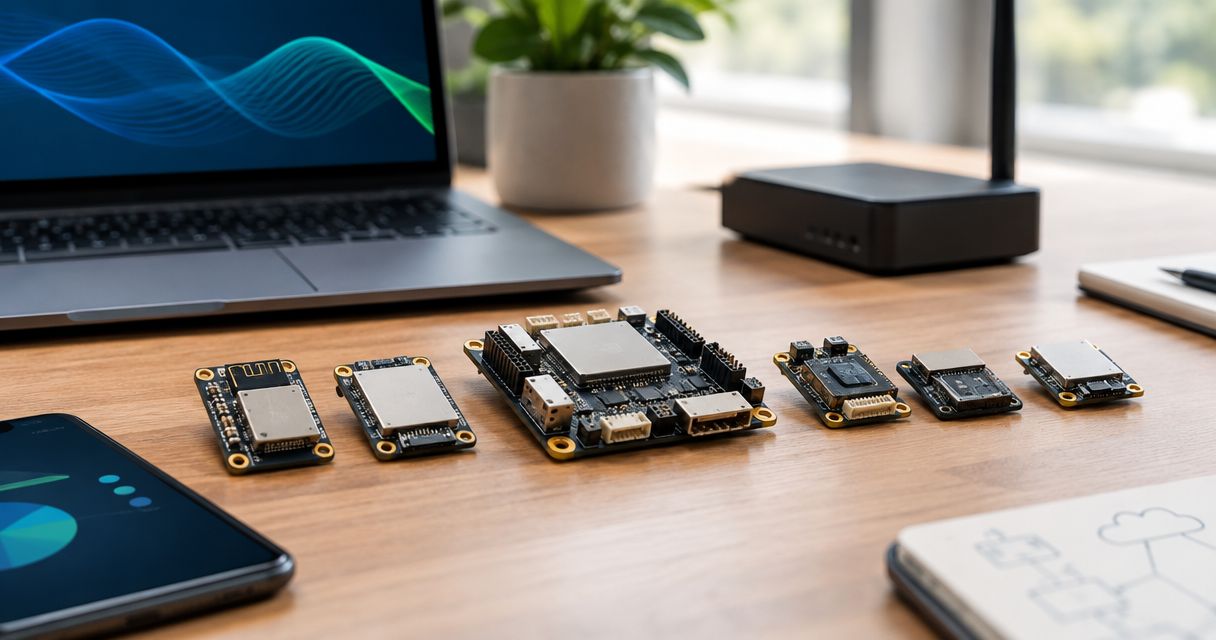
Best default for a custom LoRaWAN sensor node: RAK4631; best for temperature and humidity: RAK1901; gateway builders need LoRaWAN concentrator modules for custom gateways, not an end-device radio. The best RAK WisBlock modules for your project depend on what you measure, how you communicate and which components fit together on the base board.
- RAK4631 is the default core shortlist for custom LoRaWAN nodes, not gateways.
- RAK1901 suits temperature and humidity sensing; RAK1904 suits motion and orientation projects.
- RAK12500 adds GNSS location; RAK5802 connects suitable RS485 equipment.
- Choose RAK WisBlock modules as a complete assembly: core, base, sensors, interfaces and power.
Kilo Electronics is an online authorised dealer of electronics and IoT hardware serving individuals, makers, hobbyists, professionals and businesses across Europe, including the EU, UK and Switzerland. Kilo Electronics is a buying route for people comparing IoT hardware across manufacturers, not the manufacturer of WisBlock modules. The recommendations below concern the modules’ different roles, not a claim that every model is sold by the store.
Why the best WisBlock module depends on the whole assembly
WisBlock is RAKwireless’s modular hardware system. A core provides processing and communications, a base connects the assembly, and sensor or interface modules add specific functions. You select compatible parts rather than treating every module as a standalone device.
That distinction matters when buying. A temperature module cannot transmit readings by itself, and a LoRaWAN core does not supply every measurement your application needs. For a 2026 build, shortlist the complete assembly before choosing an enclosure or writing firmware.
A hypothetical greenhouse monitor needs temperature and humidity readings, suitable radio coverage and protected electronics. A pump monitor reading an existing controller over RS485 needs a different interface, even if both projects use the same core.
What makes the best RAK WisBlock modules?
Use these criteria to judge the shortlist before comparing model names:
- Required function: Choose the measurement or electrical interface your application actually needs. Motion sensing, position tracking and temperature measurement are different jobs.
- Core and base compatibility: Match the module to a supported base, connector and firmware environment. A familiar connector does not remove resource or slot constraints.
- Network fit: Separate the end-device radio from the gateway and network server. Choose the appropriate regional radio variant and network configuration.
- Power behaviour: Assess the complete assembly, including radio transmissions, measurement frequency and external equipment. A low-power sensor alone does not establish battery life.
- Installation fit: Allow space for antennas, cables, mounting and environmental protection. A development board is not a finished outdoor instrument.
- Software ownership: Identify who will write, update and maintain the firmware and decode its payloads. Modular hardware still needs application-specific software.
RAK WisBlock modules at a glance
These 2026 recommendations assign each component a separate job. They are complementary building blocks, not interchangeable competitors.
| Module | Best for | Standout function | Main limitation | Installation decision |
|---|---|---|---|---|
| RAK4631 | Custom LoRaWAN end devices | Processing, LoRa radio and Bluetooth connectivity | Not a gateway concentrator or finished sensor | Select regional variant, antennas and compatible base |
| RAK1901 | Temperature and humidity projects | SHTC3 environmental sensing | Does not measure CO2 or particulate matter | Expose the sensing area to representative air |
| RAK1904 | Motion and orientation projects | Three-axis acceleration measurement | Not a complete vibration diagnostic instrument | Mount rigidly and define the event to detect |
| RAK12500 | Outdoor position reporting | GNSS positioning | Poor satellite reception undermines location fixes | Plan antenna placement and acquisition power |
| RAK5802 | Connecting existing RS485 equipment | RS485 electrical interface | Does not supply the attached equipment’s protocol | Obtain register documentation and design the bus |
| RAK19007 | Building a modular prototype | Base board connecting core and expansion modules | Not a processor, sensor or protective enclosure | Map slots, connectors and mechanical clearance |
1. RAK4631: best WisBlock core for custom LoRaWAN nodes
RAK4631 combines a Nordic nRF52840 microcontroller with a Semtech SX1262 LoRa transceiver. It provides the processing and radio building blocks for a custom end device, while separate modules provide measurements or external interfaces.
The nRF52840 has a 64 MHz processor, 256 KB of RAM and 1 MB of flash memory. Those resources matter when allocating space to firmware, libraries and application logic; they are not promises about sensor capacity or radio coverage.
LoRa is the radio technology, while LoRaWAN supplies the networking rules used by compatible end devices, gateways and network servers. Your firmware and network configuration determine how the device joins and communicates. Bluetooth connectivity serves a separate purpose and does not replace the LoRaWAN network.
RAK4631 pros:
- Combines processing and a LoRa radio in one core module.
- Includes Bluetooth capability through the nRF52840.
- Lets you build different sensing applications around a common core.
RAK4631 cons:
- Requires a compatible base, application firmware and suitable antennas.
- Does not receive and forward network traffic like a gateway concentrator.
- Regional hardware and radio configuration must match the deployment.
Best for: Makers and engineering teams building their own LoRaWAN sensor firmware.
Verdict: Buy RAK4631 for a custom LoRaWAN end device; skip it as a gateway substitute.
2. RAK1901: best WisBlock module for temperature and humidity
RAK1901 uses a Sensirion SHTC3 temperature and humidity sensor. It is the relevant shortlist when your application needs air temperature and relative humidity rather than a broader air-quality assessment.
Installation determines whether the reading represents the space you care about. A sensor beside a warm regulator or inside an unventilated enclosure measures that local environment. Keep the sensing area away from avoidable heat sources and provide an appropriate path for surrounding air.
For a hypothetical room monitor, define where you want the reading taken before designing the case. For a damp outdoor location, protection against water and contamination must coexist with exposure to the air being measured.
RAK1901 pros:
- Adds both temperature and relative humidity measurements.
- Fits an environmental-monitoring role without unrelated sensing functions.
- Provides a clear starting point for custom room or enclosure monitoring.
RAK1901 cons:
- Does not measure CO2, particulate matter or volatile organic compounds.
- Enclosure design and nearby heat can distort the measurement’s relevance.
- Requires firmware to read and report the measurements.
Best for: Custom temperature and humidity nodes where you control the enclosure and reporting logic.
Verdict: Buy RAK1901 for temperature and humidity; skip it for a complete air-quality monitor.
3. RAK1904: best WisBlock module for motion detection
RAK1904 uses an STMicroelectronics LIS3DH three-axis accelerometer. An accelerometer measures acceleration, including the effect of gravity, so it supports applications involving movement, orientation and changes in position.
Define the event first. Detecting that a box has moved requires different firmware from recording a detailed machine-vibration signal. Sampling settings, mounting and filtering determine what your application can distinguish.
Rigid attachment matters because the module must move with the object being monitored. A loose board inside a case can report the board’s movement instead of the behaviour of the equipment itself.
RAK1904 pros:
- Measures acceleration across three axes.
- Supports motion and orientation logic in custom firmware.
- Adds a different measurement role from environmental sensors.
RAK1904 cons:
- Does not directly report geographic position.
- Needs application-specific thresholds and signal interpretation.
- Does not establish suitability for precision machine diagnostics by itself.
Best for: Movement alerts, orientation detection and motion-aware prototypes.
Verdict: Buy RAK1904 for defined motion events; hold if your requirement is precision vibration analysis.
4. RAK12500: best WisBlock module for GNSS location
RAK12500 uses the u-blox ZOE-M8Q GNSS receiver. GNSS means global navigation satellite system: the receiver uses satellite signals to determine position, rather than deriving location from the LoRaWAN network.
Location acquisition and location transmission are separate tasks. RAK12500 obtains the position; the core and communications path carry that information to your application. A working radio link does not guarantee a usable satellite fix.
For an outdoor tracker, plan antenna position alongside enclosure and mounting decisions. For indoor equipment, do not assume that adding GNSS solves the location problem: walls, roofs and surrounding structures affect satellite reception.
RAK12500 pros:
- Adds satellite-based position information to a custom device.
- Separates the positioning function from the communications core.
- Suits projects where outdoor position is a required measurement.
RAK12500 cons:
- Depends on adequate satellite reception.
- Position acquisition adds activity to the device’s power budget.
- Needs firmware decisions about fix quality and failed acquisitions.
Best for: Outdoor location-reporting prototypes with planned antenna placement.
Verdict: Buy RAK12500 for outdoor GNSS tracking; skip it as an assumed indoor-location solution.
5. RAK5802: best WisBlock interface for RS485 equipment
RAK5802 adds an RS485 interface to a compatible WisBlock assembly. RS485 describes the electrical signalling used by connected equipment; it does not tell your software what a particular meter or controller means.
That is the critical buying distinction. If an instrument uses Modbus RTU over RS485, your application still needs its address, communication settings and register map. Another RS485 device can use a different protocol entirely.
Before building around RAK5802, obtain the equipment documentation and establish its power requirements. Then design cable routing, bus termination and protection for the installation. Connecting an electrical interface is only part of the integration.
RAK5802 pros:
- Provides a route to connecting existing RS485 equipment.
- Lets external instruments supply measurements rather than duplicating sensors.
- Supports custom applications centred on wired equipment interfaces.
RAK5802 cons:
- Does not automatically decode connected meters or controllers.
- Requires attention to wiring and bus configuration.
- Does not establish that the WisBlock assembly can power the external instrument.
Best for: Reading documented RS485 equipment through custom application firmware.
Verdict: Buy RAK5802 when the electrical interface and equipment protocol are known; wait otherwise.
6. RAK19007: best WisBlock base shortlist for modular prototyping
RAK19007 is a WisBlock base board, not a sensing or radio module. Its role is to connect a compatible core and expansion modules into an assembly you can develop and test.
Choose the base after listing the required components. Connector positions, occupied slots and physical clearance influence whether the intended combination fits. The base also belongs in your power and enclosure planning, rather than being an incidental accessory.
For a 2026 prototype, write a slot map before ordering. Include cables and antennas in the drawing so that a mechanically awkward combination does not become a firmware problem later.
RAK19007 pros:
- Provides the physical foundation for a modular WisBlock build.
- Brings core and expansion-module planning onto one board.
- Makes connector placement visible during prototype design.
RAK19007 cons:
- Does not provide processing or measurements by itself.
- Does not make every module combination compatible.
- Requires separate mechanical and environmental protection.
Best for: Developers assembling a compatible core, sensors and interfaces for bench prototyping.
Verdict: Buy RAK19007 when its layout fits your complete module plan; hold until that plan is defined.
How to turn the shortlist into working hardware
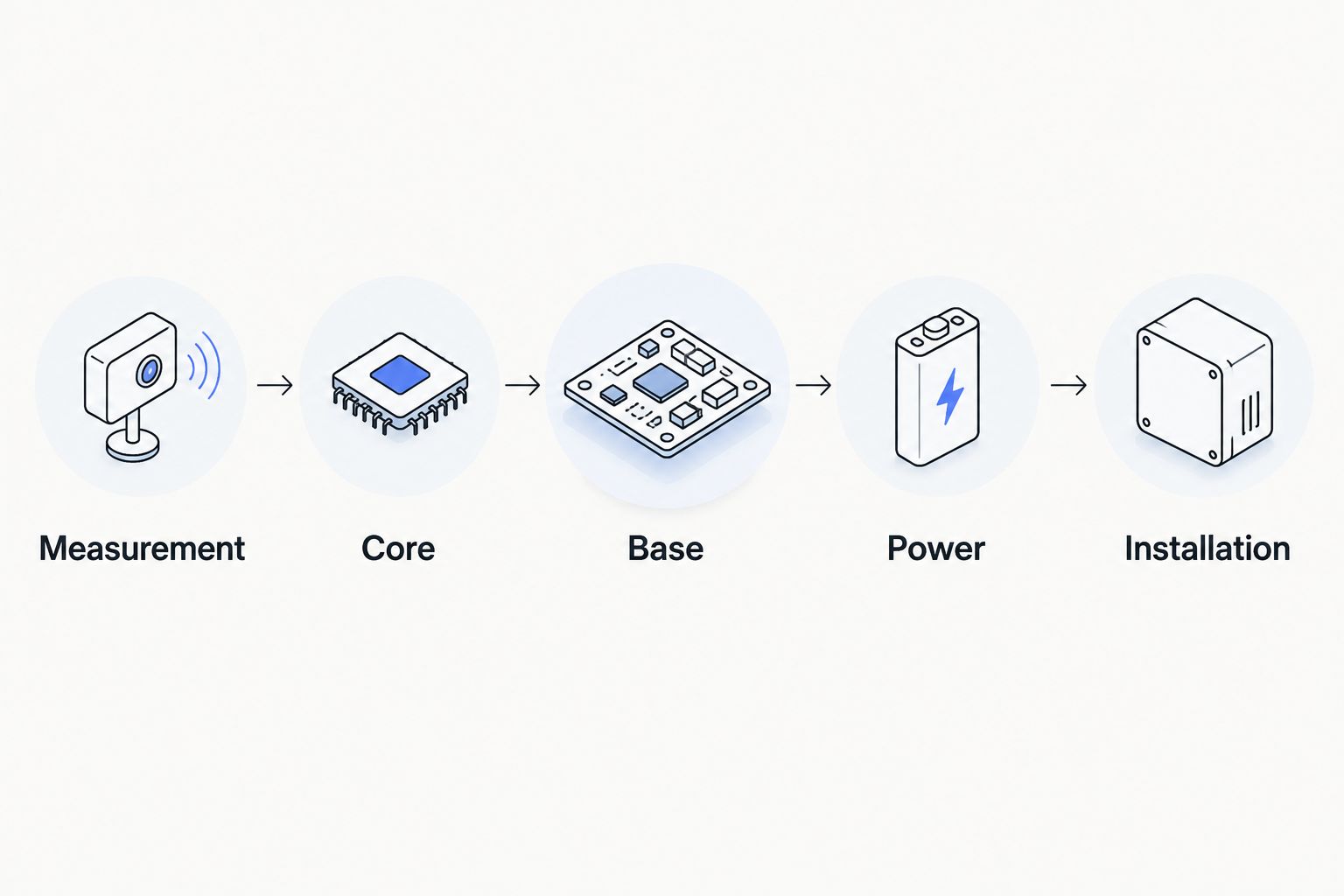
Build the purchasing list in this order:
- Measurement: State the required reading or event, such as humidity, movement, position or an external register value.
- Core: Choose the processing and communications hardware, including the correct regional variant.
- Base: Map compatible modules to connectors and available space.
- Power: Include acquisition, transmissions and attached equipment in the operating plan.
- Installation: Add antennas, enclosure, mounting, cables and software ownership.
Kilo Electronics offers a hardware-buying route across several IoT technologies, but selecting RAK WisBlock modules still requires an application design. Keep the bill of materials separate from the work needed to make the device useful.
For your 2026 installation budget, include the core, base, expansion modules, antennas, power source, protection and mounting. Add firmware development, network access and maintenance responsibilities where they apply. A module-only comparison leaves out the work that turns development hardware into an operating device.
How these recommendations are ranked
The ranking follows function and deployment fit: processing and communications first, then measurements, external interfaces and the supporting base. It does not claim laboratory performance rankings, battery-life results or universal compatibility.
Choose the module whose function matches the requirement, then validate the complete assembly. These 2026 recommendations favour clear use cases over treating unrelated components as alternatives.
FAQ
What are the best RAK WisBlock modules for a first LoRaWAN project?
RAK4631 is a useful core shortlist, with RAK1901 for temperature and humidity or RAK1904 for motion. Add a compatible base, appropriate antennas and firmware for the actual application.
Can RAK4631 work as a LoRaWAN gateway?
RAK4631 is an end-device core, not a LoRaWAN gateway concentrator. A gateway needs hardware designed to receive end-device traffic and forward it to a network server.
Does RAK1901 measure indoor air quality?
RAK1901 measures temperature and relative humidity, not a complete set of air-quality indicators. CO2 and particulate measurements require appropriate additional sensing hardware.
Is RAK1904 better than RAK12500 for tracking?
RAK1904 suits movement and orientation detection, while RAK12500 suits satellite-based position reporting. Choose according to whether you need to know that something moved or where it is.
Will RAK5802 read any RS485 meter automatically?
RAK5802 does not automatically interpret every RS485 meter. Your firmware needs the equipment’s protocol, communication settings and data definitions.
What else do I need besides WisBlock modules?
A working assembly needs a compatible core and base, power, firmware and installation hardware. Radio projects also need suitable antennas and the relevant network infrastructure.
Which RAK WisBlock modules should you choose?
Start with RAK4631 if your goal is a custom LoRaWAN end device. Add RAK1901 for temperature and humidity, RAK1904 for motion, RAK12500 for outdoor location or RAK5802 for documented RS485 equipment. Choose the base around that combination.
Kilo Electronics is an online authorised dealer for buyers comparing electronics and IoT hardware; the technical decision remains the fit between your application and the complete assembly. Do not substitute a familiar model name for that decision.
One last thing
A modular build can fail without any individual module being faulty. An enclosure that traps heat, a poorly placed antenna or an undocumented register map can prevent the assembled device from answering your original question.
Before purchasing, write one acceptance statement: what the device must measure, where it must operate and how you will confirm a useful result. That statement is a better selection tool than the longest module list.