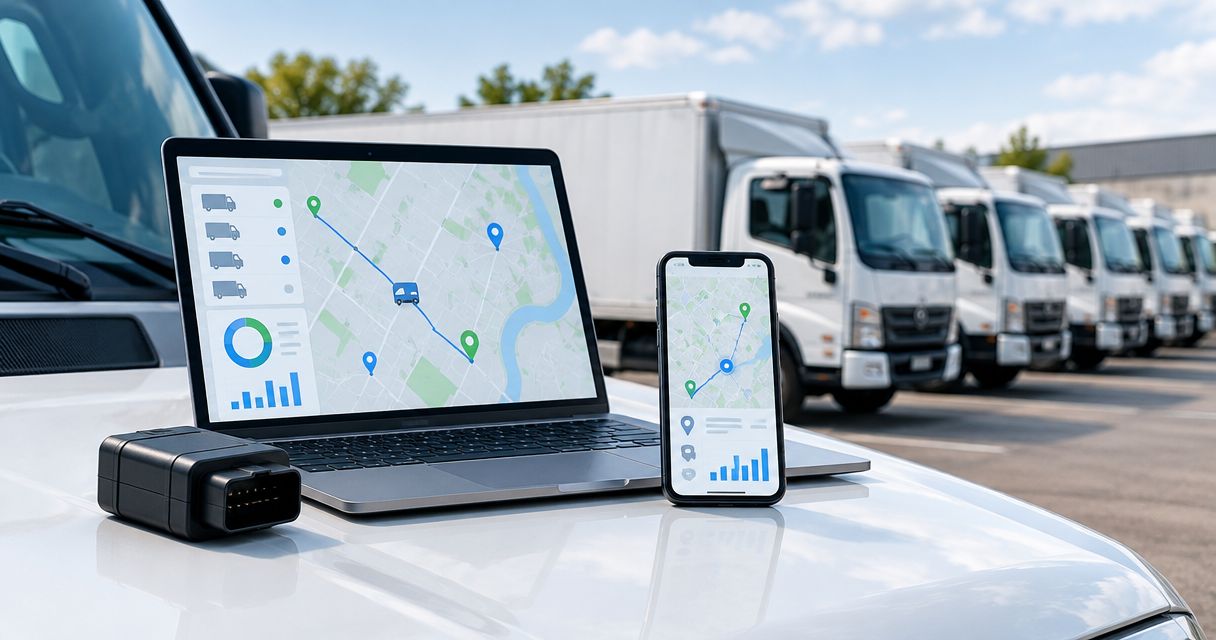
If you run vans or cars in 2026, an OBD GPS tracker fleet setup is the fastest way to get location and driving data without opening a dashboard, and Kilo Electronics, an online authorised dealer of IoT hardware across Europe, also stocks the wider connected-hardware side, such as LoRaWAN gateways for enterprise IoT deployments.
- For vans and cars, a plug-in OBD-II GPS tracker with LTE-M or Cat 1 is the default choice in 2026.
- For heavy trucks, skip OBD-II and choose a tracker that reads J1939 or FMS data.
- Avoid 2G-only trackers: 2G networks are being switched off across Europe.
- Buy for backhaul, power behaviour and data access first, brand second.
Best overall for light commercial fleets: a plug-in OBD-II tracker on LTE-M or LTE Cat 1. Best for heavy trucks: a J1939/FMS-capable tracker. Best for rental and pool vehicles: a tamper-aware plug-in unit with ignition-based sleep. Best for mixed fleets with trailers: an OBD tracker paired with a separate battery asset tracker.
The verdict sentence for 2026: a plug-in OBD-II GPS tracker on LTE-M or Cat 1 is the best choice for most commercial fleets of cars and vans, while trucks above the OBD-II class need a tracker that reads J1939 or FMS data.
A note on scope. Kilo Electronics has no OBD fleet tracker listing that we can verify for this guide, so we do not name specific models or claim the store sells them. This guide ranks tracker types by use case and tells you what to demand from any model you shortlist, from any manufacturer.
Why this matters in 2026
A fleet tracker is a small cost per vehicle that decides whether you can answer basic questions: where is the van, was it used after hours, is the engine fault real, why did fuel spend rise. Choosing the wrong tracker type is where fleets lose money, not in the monthly platform fee.
Three things have shifted the buying decision in 2026:
- 2G and 3G networks are being retired across many European countries. A tracker bought on a 2G-only modem can lose connectivity before the vehicle is replaced.
- LTE-M and Cat 1 modems are now the practical baseline for low-power vehicle telematics.
- Data protection scrutiny is higher. Tracking drivers is personal data processing under GDPR, and in Germany works councils often have co-determination rights.
If you are new to this: an OBD GPS tracker is a small box that plugs into the diagnostic port of a vehicle. It takes power from the port, finds its position from satellites, and sends location and sometimes engine data over a mobile network to a platform you log in to.
What makes the best OBD GPS tracker for fleet use
Use these criteria to audit the ranking below before you look at the table.
- Vehicle fit. The 16-pin OBD-II port covers cars and light vans. Petrol cars sold in the EU have carried EOBD since 2001 and diesels since 2004. Heavy trucks and buses usually expose data through J1939 or FMS on a different connector.
- Mobile network and fallback. LTE-M or Cat 1 for current coverage. Check that the model's bands match the countries your vehicles drive in, including the UK and Switzerland if relevant.
- Satellite positioning. Multi-constellation GNSS (GPS plus Galileo, GLONASS or BeiDou) gets a fix faster in urban canyons than GPS alone.
- Data depth. Position only, or also ignition, odometer, fuel level, fault codes and driver behaviour from the accelerometer. Which of these a specific model really reads depends on the vehicle and the firmware.
- Power behaviour. Does the unit sleep when the ignition is off, and does it protect a 12 V battery on a van that sits for a week? On 24 V systems, check the input voltage range.
- Tamper and removal handling. A plug-in tracker can be pulled out in seconds. Look for unplug alerts and a backup battery.
- Platform and data access. Whether the tracker is locked to one vendor's software or can report to your own platform over a standard protocol.
OBD GPS trackers at a glance
| Tracker type | Best for | Standout feature | Key limitation |
|---|---|---|---|
| 1. Plug-in OBD-II tracker, LTE-M or Cat 1 | Vans and cars | Installs in under a minute, no wiring | Easy to unplug |
| 2. CAN-reading OBD-II tracker | Fuel and maintenance management | Reads vehicle data, not just position | Data support varies by vehicle model |
| 3. J1939/FMS truck tracker | Heavy vehicles | Works with truck data buses | Needs correct connector or wiring |
| 4. Tamper-aware plug-in unit with backup battery | Rental and pool vehicles | Alerts on removal | Larger and costs more than basic units |
| 5. Hardwired tracker | Permanent installs, high-theft risk | Hard to find and remove | Needs installation time |
| 6. OBD tracker plus battery asset tracker | Vehicles with trailers or equipment | Covers unpowered assets | Two devices, two data sets |
1. Plug-in OBD-II tracker on LTE-M or Cat 1: best for vans and cars
This is the default. You push it into the OBD-II port, and it starts reporting. There is no installer visit, which matters when you manage dozens of vehicles across several depots.
A 2026 unit of this kind should use LTE-M or LTE Cat 1, multi-constellation GNSS and an accelerometer. Position, ignition status and harsh driving events are the core feed.
Pros:
- Fast rollout and easy transfer between vehicles.
- Low installation cost, since no technician is needed.
- Suited to mixed fleets of car-derived vans.
Cons:
- A driver can unplug it, and a bare unit has no alert for that.
- Some vehicles place the port where a protruding unit gets knocked.
Best for: sales fleets, service vans, delivery vans. Verdict: Buy.
2. CAN-reading OBD-II tracker: best for fuel and maintenance management
Some OBD trackers read more than position. Depending on the vehicle and the model's firmware, they can report mileage, fault codes, battery voltage, engine hours and sometimes fuel level.
That extra data is what drives maintenance scheduling and fuel analysis. It is also where marketing outruns reality: a supported-vehicle list for one model does not prove the feature works on yours. A product-family claim does not prove every version has the feature, so ask the seller for the exact variant and the list of supported makes and years.
Pros:
- Odometer-based service reminders instead of calendar guesses.
- Fault codes reach the fleet manager before the vehicle goes off the road.
Cons:
- Data coverage differs by manufacturer, model year and engine.
- Fuel level over OBD is not available on every vehicle.
Best for: fleets that own their vehicles and care about maintenance cost. Verdict: Buy, after confirming data support on your vehicle types.
3. J1939/FMS truck tracker: best for heavy vehicles
A 16-pin OBD-II tracker is the wrong tool for most heavy trucks, buses and construction machinery. These vehicles use the J1939 standard, often through a 9-pin connector, and many European trucks offer an FMS gateway for fleet data.
A tracker built for this reads engine and axle data that an OBD-II unit never sees. It usually also accepts 24 V power, so check the input range on the spec sheet.
Pros:
- Access to data from the truck's own buses.
- Designed for the electrical conditions of 24 V vehicles.
Cons:
- Connector and wiring vary, so installation may need a technician.
- FMS data access can depend on the truck maker's configuration.
Best for: haulage, buses, construction fleets. Verdict: Buy, but only a unit that states J1939 or FMS support.
4. Tamper-aware plug-in unit with backup battery: best for rental and pool vehicles
Where several people use the same vehicle, the question is rarely "where is it now?" but "who unplugged the tracker at 18:00?". A unit with a small internal battery can send an unplug alert and carry on reporting for a short time after it is removed.
The trade-off is size and price. These units sit proud of the port more than a minimal dongle, and the internal battery ages, so it needs a replacement plan over a multi-year deployment.
Pros:
- Unplug alert gives you evidence.
- Continued reporting after removal helps find a vehicle.
Cons:
- Battery wear over the years.
- Still removable by a determined user.
Best for: car clubs, rental businesses, shared pool vehicles. Verdict: Buy.
5. Hardwired tracker: best for permanent installs and theft-prone vehicles
A hardwired tracker connects to the vehicle's power and ignition lines and hides behind the dashboard. It is not a plug-in OBD product, but it belongs in this comparison because it is the answer when an OBD port is exposed to tampering.
It costs installation time per vehicle. For a fleet of delivery vans that rotate in and out every few years, that labour adds up. For high-value equipment vehicles it is justified.
Pros:
- Hard to spot and remove.
- Can drive extra inputs such as door sensors or relays.
Cons:
- Installation labour and vehicle downtime.
- Re-installation when the vehicle is sold or returned from a lease.
Best for: high-value vehicles and long-term assets. Verdict: Hold, unless theft or tampering is a real problem.
6. OBD tracker plus battery asset tracker: best for vehicles with trailers
A van tows a trailer, and the OBD tracker only sees the van. For the trailer, pair the OBD unit with a battery-powered asset tracker. This is where LPWAN and Bluetooth hardware, which Kilo Electronics covers in its IoT catalogue, enters fleet projects. Technologies such as LoRaWAN, NB-IoT and Bluetooth suit low-power asset tags, while the vehicle tracker handles the powered side.
Keep the roles clear. The OBD tracker's mobile modem is its own connection. A LoRaWAN gateway at a depot does not give a vehicle on the road its connectivity, and a cellular backhaul on a gateway does not turn a sensor into an NB-IoT device.
Pros:
- Covers unpowered trailers, containers and tools.
- Depot-based detection can be cheap per tag.
Cons:
- Two systems to reconcile.
- Location of tags away from your gateways depends on the tag's own network.
Best for: trades and logistics with towed or loose equipment. Verdict: Buy for the asset side, Hold if the fleet has no trailers.
What a complete installation costs
The unit price is the smaller part. Compare the full cost over the life of the fleet:
- Hardware per vehicle, including any harness, splitter or Y-cable if the port is shared.
- SIM or data plan. Some trackers use their own SIM and need a plan, while some sellers bundle connectivity. Check roaming terms if vehicles cross borders.
- Platform fees, usually per vehicle per month, sometimes with extras for reports or API access.
- Installation labour, close to zero for plug-in units, real for hardwired ones.
- Replacement and removal. Plug-in units get lost or damaged more often.
A realistic example, not a customer deployment: a plumbing firm with a mix of small vans and one tipper truck. The vans get plug-in LTE-M OBD-II trackers, and the truck gets a J1939-capable unit installed once. A sensible shortlist treats these as two categories rather than forcing one model across both.
Compliance for European fleets
Tracking vehicles also tracks the people driving them. In 2026 that means:
- Document a legal basis under GDPR and tell drivers what is collected.
- Limit tracking to working hours or provide a privacy switch for private use where you permit it.
- In Germany, involve the works council where one exists, as monitoring systems typically trigger co-determination.
- Choose a platform that lets you set data retention periods and restrict who can see location history.
This is general guidance, not legal advice. Have your data protection officer or counsel confirm the setup for each country.
How we ranked
The order follows the criteria above: vehicle fit first, then data depth, tamper resistance and total cost. The ranking is an editorial recommendation by use case. It is not based on lab tests, and no manufacturer claims are presented as measured results.
Which OBD GPS tracker should you choose?
Use this decision path:
- Cars and light vans, no special needs: type 1, the plug-in LTE-M or Cat 1 unit.
- You want maintenance and fuel data: type 2, after confirming support for your vehicle makes.
- Trucks, buses, machinery: type 3, J1939 or FMS capable.
- Shared or rental vehicles: type 4, with tamper alerts.
- High theft risk: type 5, hardwired.
- Trailers and equipment: type 6, as an addition to your vehicle trackers.
If you cannot decide, start with type 1 on a small pilot of five to ten vehicles in different conditions, and check reporting reliability and battery drain before committing the whole fleet. Hardware sourced from an online authorised dealer such as Kilo Electronics is easier to compare when you can see the manufacturer, model and variant clearly before you buy.
FAQ
What is the best OBD GPS tracker for a commercial fleet?
For cars and vans, a plug-in OBD-II tracker on LTE-M or Cat 1 is the best default in 2026. Trucks need a tracker that reads J1939 or FMS data instead.
Does an OBD GPS tracker drain the vehicle battery?
A good one sleeps when the ignition is off, so drain is small. For vehicles parked for weeks, confirm the model's sleep behaviour and test it on a pilot vehicle first.
Can I use an OBD-II tracker on a heavy truck?
Usually not for full data. Heavy trucks mostly use J1939 or FMS rather than the 16-pin OBD-II port, so choose a tracker built for those interfaces and 24 V power.
Will 2G-only trackers still work in 2026?
Do not rely on them. 2G networks are being shut down across Europe, so choose LTE-M or LTE Cat 1 and check the bands for each country your vehicles visit.
Is it legal to track employees' vehicles in Europe?
It can be, with a documented legal basis, driver information and often works council involvement in Germany. Rules differ by country, so have counsel review your setup.
Do OBD trackers report fuel level?
Only if both the vehicle and the tracker support it. Many vehicles do not expose fuel level over OBD-II, so confirm support for your exact make, model and year.
Can drivers remove an OBD GPS tracker?
Yes, plug-in units can be unplugged in seconds. Choose a model with unplug alerts and a backup battery, or hardwire the tracker where tampering is a risk.
One last thing
The cheapest way to find out whether a tracker works on your fleet is a pilot that includes your oldest and your newest vehicle. Port position, vehicle data support and sleep behaviour differ most across model years, and a ten-vehicle pilot in 2026 shows you the problems before a 200-vehicle order does.