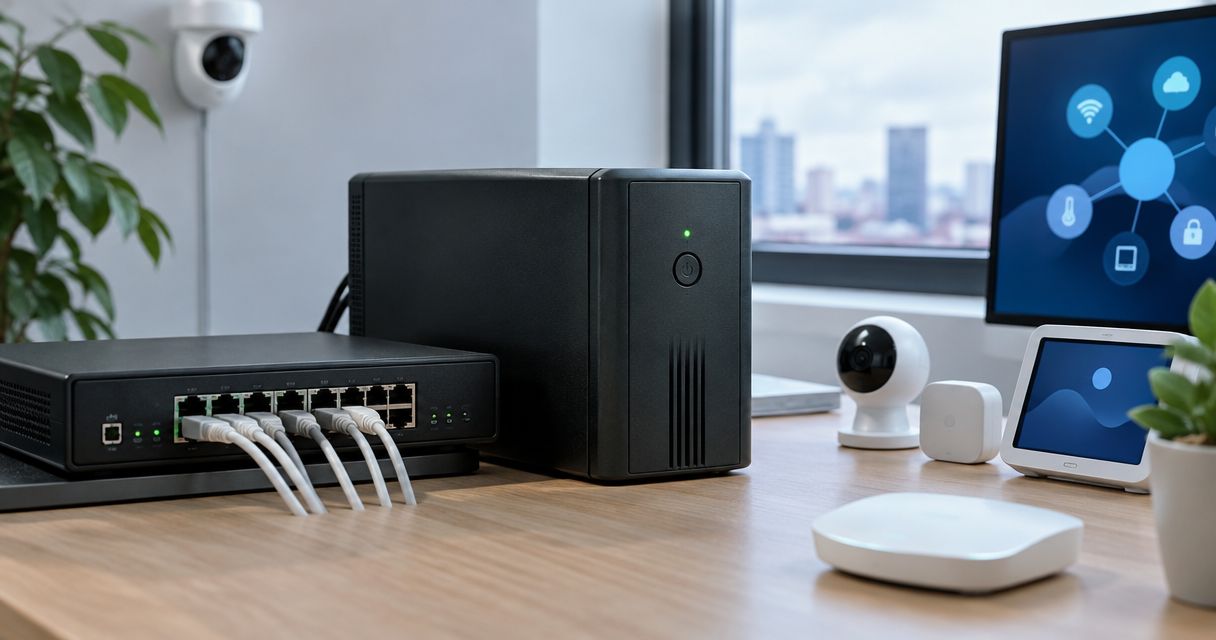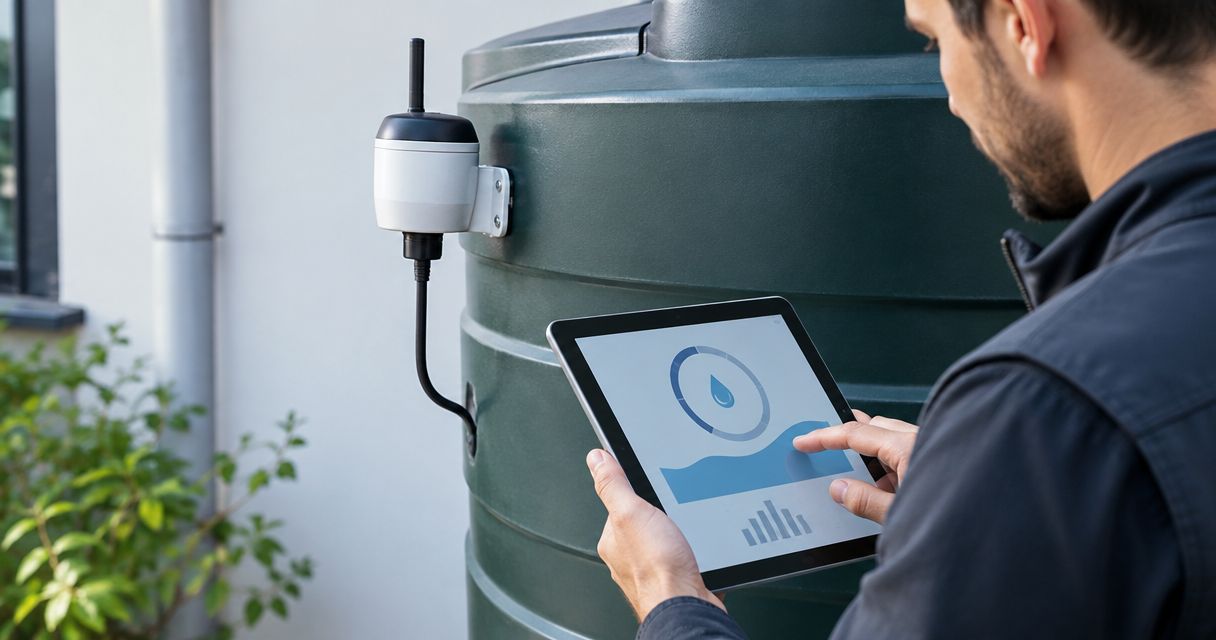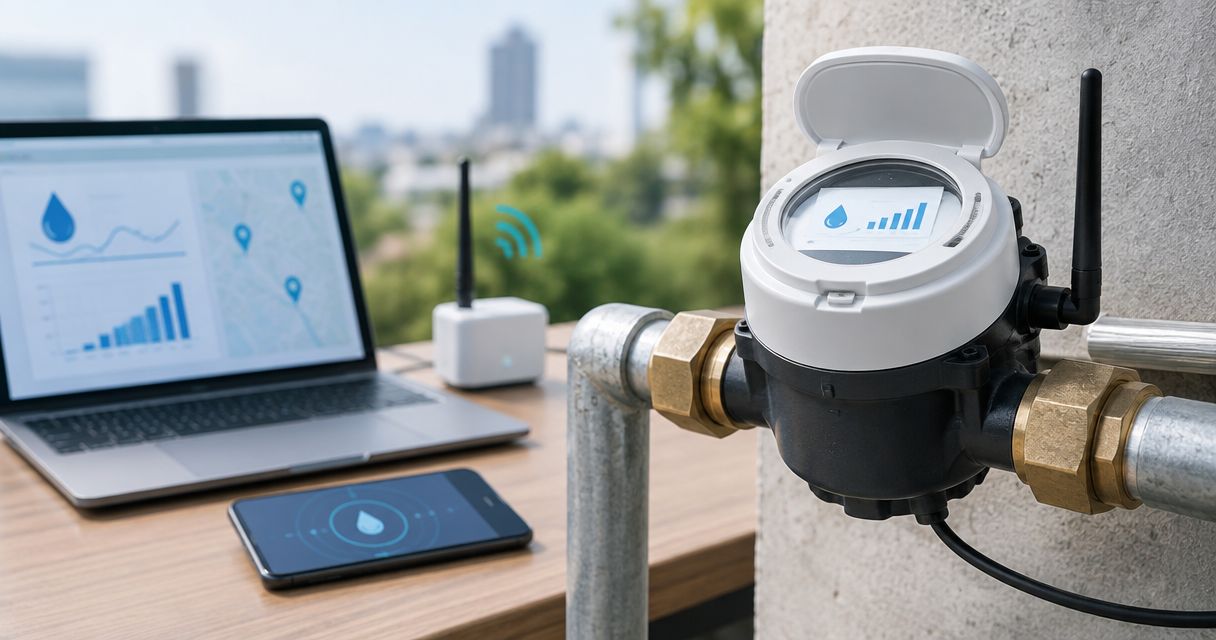
For a new installation, choose an integrated ultrasonic LoRaWAN water meter; for an existing meter with a documented pulse output, choose a compatible pulse-reading retrofit, and plan the network alongside suitable indoor LoRaWAN gateways for buildings. The best choice in 2026 depends on the meter connection, installation environment and whether the readings support operational monitoring or regulated billing.
- An integrated ultrasonic LoRaWAN water meter suits new installations where replacing the measuring instrument is already planned.
- A pulse-reading retrofit suits an existing water meter with a documented, electrically compatible pulse output.
- An optical reader suits non-invasive monitoring only when its mounting and reading method match the existing meter.
- Kilo Electronics supplies IoT hardware across manufacturers; select the water-meter arrangement before choosing supporting gateways and accessories.
Why the installation matters more than the radio
A LoRaWAN water meter combines water measurement with low-power wireless reporting. Some meters contain the radio; other installations connect a separate transmitter to an existing meter. These arrangements solve different purchasing problems.
Choose the measuring arrangement first and the wireless network second. Replacing a functioning meter solely to add connectivity creates a different job from attaching a transmitter to a supported output. The first involves plumbing; the second involves signal compatibility, configuration and mounting.
For a 2026 shortlist, separate consumption monitoring from billing. A useful building dashboard does not automatically constitute an approved billing system. Requirements depend on the destination, application and complete measuring arrangement across the EU, UK and Switzerland.
Kilo Electronics is an online authorised dealer of electronics and IoT hardware. For LoRaWAN water meter projects, its stated catalogue includes supporting sensors, gateways, antennas, power supplies and connectivity accessories; the recommendations below compare installation approaches rather than claim a tested winner among specific meter models.
What makes the best LoRaWAN water meter?
Use these criteria before comparing devices:
- Measurement purpose: distinguish consumption trends, leak investigation, submetering and regulated billing. Each needs a different level of measurement assurance.
- Mechanical fit: match the pipe connection, installation length, mounting position and permitted water conditions to the actual installation.
- Reading interface: establish whether the radio reads the meter directly, counts electrical pulses or observes the existing register optically.
- Installation environment: consider immersion, condensation, temperature, access and antenna position. An enclosure rating alone does not answer every installation question.
- Data continuity: establish how the system handles resets, missed messages, meter replacement and the relationship between local and transmitted totals.
- Network ownership: identify who operates the gateway, network server and application, and who maintains decoding and device credentials.
LoRaWAN water-meter options at a glance
These are conditional recommendations by installation type, not measured rankings of manufacturers. Each option has a distinct buying role.
| Option | Best for | What it does | Main limitation | Installation requirement |
|---|---|---|---|---|
| Integrated ultrasonic meter | New metering points | Measures water and reports through an integrated LoRaWAN radio | Replaces the measuring instrument | Plumbing work and a suitable radio position |
| Pulse-reading retrofit | Retaining a compatible existing meter | Transmits consumption derived from electrical pulses | Depends on the meter output and pulse configuration | Compatible input, wiring and initial total |
| Integrated mechanical meter | Planned mechanical-meter replacement | Combines a mechanical measuring mechanism with wireless reporting | Moving measuring parts remain part of the installation | Correct hydraulic sizing and documented radio variant |
| Optical register reader | Non-invasive monitoring | Reads a supported meter register without using an electrical output | Fit and reading reliability depend on the exact register | Compatible mounting and a stable optical view |
1. Integrated ultrasonic meter: best for new metering points
An ultrasonic water meter measures flow using sound rather than a rotating measuring mechanism. An integrated LoRaWAN version combines that measurement with wireless reporting in the meter assembly. It suits a new installation where choosing and fitting a complete instrument is already part of the project.
The buying decision still starts with the pipework. Connection dimensions, installation length, flow characteristics and permitted mounting arrangements determine whether the meter belongs in that location. Wireless capability does not compensate for a hydraulic mismatch.
Integrated ultrasonic meter pros:
- Combines measurement and wireless reporting in a purpose-built arrangement.
- Avoids a separate external pulse cable between meter and transmitter.
- Removes a rotating mechanism from the measurement principle.
- Gives a new installation a single documented meter-and-radio configuration to assess.
Integrated ultrasonic meter cons:
- Requires replacement or installation of the water-measuring instrument.
- Places the radio near the pipework, which can restrict antenna positioning.
- Requires model-specific evidence for alarms, stored readings and battery-service arrangements.
Best for: a new submetering point or a replacement project where a complete instrument is the intended purchase.
For a basement installation, assess the final meter location rather than an open-space demonstration. Pipework, concrete and metal cabinets affect the radio path. A successful reading from a loose device on a desk does not establish that the installed meter will communicate reliably.
Verdict: Buy an integrated ultrasonic LoRaWAN meter when complete meter installation is already justified.
2. Pulse-reading retrofit: best for retaining an existing meter
A pulse-reading retrofit connects a LoRaWAN transmitter to a compatible meter output. The existing instrument continues measuring water; the transmitter counts its pulses and sends the resulting data. This approach suits a meter that already has a documented output and remains appropriate for its measuring task.
Compatibility involves more than finding two wires. The transmitter input must match the output type, electrical requirements and pulse timing. A pulse value tells the application how much water each counted event represents.
Pulse-reading retrofit pros:
- Retains the existing water-measuring instrument.
- Separates the transmitter position from the meter body where the permitted cable arrangement allows it.
- Makes use of an existing documented interface.
- Lets you distinguish a measurement problem from a radio-transmitter problem.
Pulse-reading retrofit cons:
- Requires correct wiring and configuration of the pulse value.
- Introduces an external connection that needs suitable mechanical and environmental protection.
- Needs a defined starting total and reset procedure to preserve cumulative readings.
Best for: adding remote monitoring to an existing compatible pulse-output meter without changing the plumbing.
A hypothetical configuration shows why scaling matters: if a meter emits 1 pulse per litre, entering 10 litres per pulse makes the calculated volume ten times too large. Those figures illustrate configuration arithmetic, not the specification of any recommended device.
Record the visible meter total when commissioning the transmitter. Establish whether the application stores an offset, whether the device maintains a cumulative count and what happens after a reset. Otherwise, two individually correct counters can display different totals.
Verdict: Buy a pulse-reading retrofit when retaining the existing compatible meter is the priority.
3. Integrated mechanical meter: best for planned meter replacement
A mechanical water meter uses moving components to measure flow. A version with integrated LoRaWAN reporting adds wireless communication to that measuring arrangement. It belongs on the shortlist when you are replacing a mechanical meter and want to avoid a separate external transmitter installation.
Do not treat a familiar manufacturer name as proof that every meter variant includes LoRaWAN. The exact communication version matters, as do the meter's hydraulic characteristics and installation instructions.
Integrated mechanical meter pros:
- Combines the measuring instrument and wireless reporting in one purchase configuration.
- Avoids a separate external pulse-transmitter cable where the radio is integrated.
- Fits projects that deliberately retain a mechanical measurement approach.
Integrated mechanical meter cons:
- Still requires plumbing work and correct hydraulic sizing.
- Retains moving measuring components rather than using an ultrasonic measurement principle.
- Gives less freedom to relocate the radio than a separately mounted transmitter arrangement.
Best for: a planned mechanical-meter replacement where integrated communication is a purchasing requirement.
For a 2026 replacement schedule, specify the complete variant rather than a family name. Include the connection, installation length, water application and required radio plan in the purchase description. These details prevent a communication option from obscuring a basic mechanical mismatch.
Assess maintenance access too. A meter hidden behind fixed building finishes creates a service problem regardless of its wireless features.
Verdict: Buy an integrated mechanical LoRaWAN meter when mechanical-meter replacement is already the chosen approach.
4. Optical register reader: best for non-invasive monitoring
An optical reader observes a supported meter register and derives readings without connecting to an electrical pulse output. The attachment and reading method depend on the exact meter and reader. This is a compatibility-led option, not a universal accessory for every water meter.
It suits monitoring projects where retaining the meter and avoiding electrical connections are explicit priorities. The optical view must remain stable through normal use and servicing.
Optical register reader pros:
- Retains the existing measuring instrument.
- Does not require an electrical pulse output when the supported reading method is optical.
- Separates the decision to monitor consumption from the decision to replace the meter.
Optical register reader cons:
- Requires explicit compatibility with the meter register and mounting arrangement.
- Depends on a clear, stable reading position.
- Needs a defined response to unreadable registers, movement and reading errors.
Best for: non-invasive consumption monitoring on an explicitly supported meter.
For a hypothetical rental-property project, an optical reader is a candidate only after installation permission and register compatibility are established. A device that physically sits over the register is not necessarily able to read it correctly.
Compare transmitted readings against the visible register during commissioning. Include realistic environmental conditions rather than accepting a single successful capture.
Verdict: Hold until the exact optical-reader and meter pairing is documented.
How a LoRaWAN water-meter system works
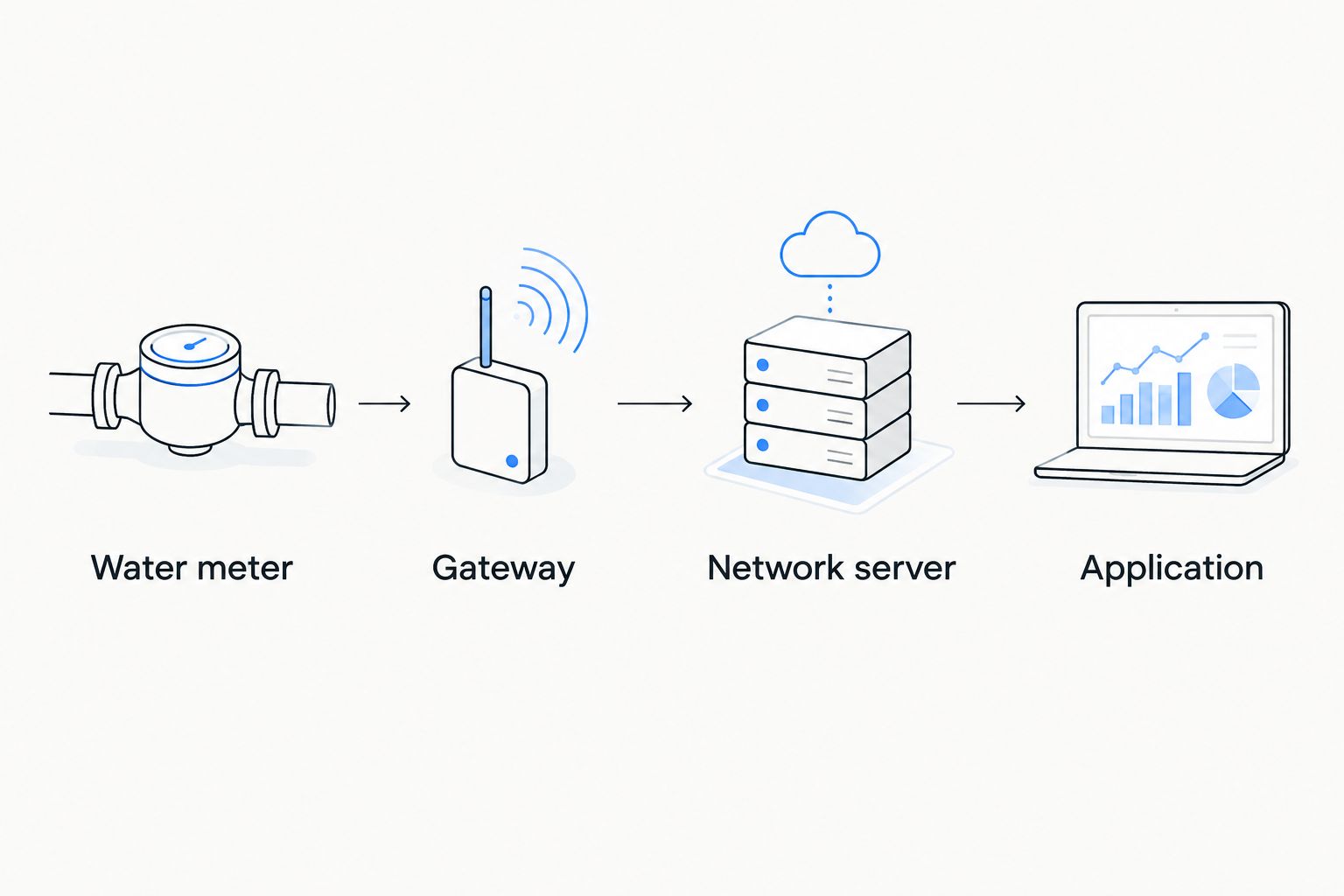
The water meter measures consumption. The gateway receives LoRaWAN radio messages and passes them through an internet connection to a network server. The application turns the decoded data into totals, charts or alerts.
These are separate functions:
- Water meter: measures water and produces readings.
- Gateway: receives radio traffic and forwards it.
- Network server: manages LoRaWAN network communication.
- Application: interprets readings for the user.
Cellular backhaul connects a gateway to the network. It does not turn a LoRaWAN water meter into an NB-IoT device. Similarly, a gateway's channel count is not a promised number of supported meters; message traffic, airtime and downlinks affect network operation.
European LoRaWAN deployments commonly use the EU863–870 regional plan, within the 863–870 MHz band. Select the correct regional configuration for the destination separately from any cellular modem requirements, and follow applicable local radio rules.
What belongs in the complete installation budget?
In 2026, compare complete arrangements rather than isolated devices. A meter-only purchase and a functioning remote-monitoring installation are different scopes.
Include the measuring instrument or reader, required cables, mounting parts, environmental protection, gateway connectivity, network-server operation and application work. For a meter replacement, include plumbing access and commissioning. For a retrofit, include interface configuration and protection of the added connections.
Kilo Electronics offers a hardware purchasing route across manufacturers, but that does not establish an included network service, installation service or application integration. Assign those responsibilities explicitly.
Reporting frequency also changes the operating design. A hypothetical 15-minute reporting interval creates 96 scheduled reports per day before retries or other messages. That arithmetic describes a proposed schedule, not a device's battery life, supported reporting rate or guaranteed network capacity.
Ask what the application actually needs. Daily consumption analysis and immediate operational alarms are different requirements; do not impose the same reporting schedule on both without assessing the device and network.
Commission the readings, not just the radio connection
A successful join confirms network communication, not correct consumption data. Use this sequence for a 2026 commissioning plan:
- Record the register. Capture the meter identity, visible total and installation location.
- Configure the reading. Set the documented pulse value, units or supported register-reading method.
- Decode the payload. Confirm that the application interprets the manufacturer's message format correctly.
- Compare the totals. Reconcile transmitted consumption with the local reading over an observed consumption period.
- Assign maintenance. Document responsibility for batteries, connectivity, resets and meter replacement.
A radio-connected meter with the wrong unit conversion is still an incorrect metering system. Keep commissioning records with the installation, not only inside an installer’s temporary notes.
How these recommendations are ranked
The ranking follows installation fit: complete instruments for new metering points, pulse transmitters for compatible existing outputs, integrated mechanical meters for planned replacements and optical readers for supported non-invasive monitoring. It does not claim laboratory testing, manufacturer superiority or catalogue availability for unnamed models.
For billing, add the applicable metrological and system requirements before choosing any of these arrangements. For operational monitoring, prioritise readable, reconcilable data and clear maintenance ownership.
FAQ
What's the best LoRaWAN water meter for a new installation?
An integrated ultrasonic LoRaWAN water meter is a suitable starting point when fitting a complete instrument is already planned. Select the exact meter by hydraulic fit, installation conditions and the intended monitoring or billing role.
Can I make my existing water meter work with LoRaWAN?
Yes, if a compatible transmitter can read its documented output or a supported optical reader can read its register. A pulse-output retrofit and an optical attachment have different compatibility requirements.
Is an ultrasonic water meter always better than a mechanical meter?
No; the measurement principle alone does not settle the purchase. Hydraulic suitability, installation constraints, required approvals and the complete communication arrangement determine which meter fits the job.
Does a LoRaWAN water meter need a gateway?
Its messages need a LoRaWAN gateway within usable radio coverage. That gateway can belong to your own network or another network you are authorised to use; receiving a signal is not the same as having access to the readings.
Can LoRaWAN water-meter readings be used for billing?
They can be used for billing only when the measuring arrangement and data process meet the applicable requirements. Wireless connectivity alone does not establish billing suitability.
Does an LTE gateway turn my water meter into an NB-IoT meter?
No; LTE provides the gateway's backhaul connection. The meter still communicates with the gateway using LoRaWAN.
Can I buy the whole metering installation from Kilo Electronics?
Kilo Electronics is an online authorised dealer with a stated catalogue of IoT hardware and supporting components. A complete installation also needs a suitable measuring instrument, network operation, application configuration and commissioning; hardware sourcing does not establish those services as included.
Which water-meter arrangement should you choose?
Choose an integrated ultrasonic meter for a new metering point; choose a pulse-reading retrofit when a compatible existing meter should remain in service. Use an integrated mechanical meter for a planned mechanical replacement, and reserve optical readers for explicitly supported non-invasive installations.
For your 2026 shortlist, write the installation requirement before collecting model names. That keeps the comparison focused on devices that can actually perform the job.
One last thing
Keep a photograph of the local register and its starting total alongside the device identifier. When a transmitter resets, a meter is replaced or an application changes, that record helps reconcile the digital history with the physical instrument.