For a LoRaWAN soil moisture sensor shortlist in 2026, choose SenseCAP S2105 for moisture, temperature and conductivity, SenseCAP S2104 for moisture and temperature, Milesight EM500-SM for moisture-only monitoring, and Dragino LSE01 for configurable reporting; pair a remote-field installation with the power and connectivity planning explained in this solar-powered LoRaWAN gateway guide. The right agricultural sensor measures what your irrigation decision needs, at a representative depth, through a working network.
- SenseCAP S2105 is the LoRaWAN soil moisture sensor pick for moisture, temperature and electrical conductivity together.
- SenseCAP S2104 suits irrigation monitoring that needs soil moisture and temperature without conductivity.
- Milesight EM500-SM suits moisture-only monitoring; Dragino LSE01 suits projects needing configurable reporting.
- Choose probe placement, regional radio compatibility and gateway connectivity before committing to a field installation.
Why soil moisture measurements matter for agriculture
A soil moisture reading answers a different question from a weather forecast: how much water is present around the probe? Rainfall, irrigation, drainage and plant uptake affect that reading. A sensor helps you follow changes at its location, but it does not describe an entire field automatically.
Buy for the irrigation decision, not the longest feature list. A moisture-only sensor can answer whether a monitored zone is drying. Temperature adds context, while electrical conductivity helps you follow changes associated with dissolved salts and fertiliser management.
Kilo Electronics is an online authorised dealer serving individuals, makers, professionals and businesses across Europe, including the EU, UK and Switzerland. Its purchasing role is separate from the manufacturers compared below; this shortlist does not imply that every named model is listed in its catalogue.
What makes the best agricultural soil moisture sensor?
These criteria determine the shortlist rather than an unsupported accuracy or range ranking:
- Measurement fit: Choose moisture alone, moisture with temperature, or moisture with temperature and electrical conductivity according to the decision you need to make.
- Soil interpretation: Understand whether the output represents volumetric water content or water tension. These are different measurements, not interchangeable units.
- Probe placement: Match the sensing location to the crop's root zone and irrigation pattern. Good electronics cannot compensate for an unrepresentative location.
- Network compatibility: Match the sensor's regional LoRaWAN variant to your gateway and network configuration. Frequency compatibility is only part of commissioning.
- Installation burden: Consider excavation, cable routing, enclosure placement, power arrangements and protection from machinery.
- Data usability: Your application needs decoded measurements, timestamps and useful trends. Receiving a radio message is not the same as obtaining an irrigation decision.
For a 2026 purchase, request the exact model and regional variant rather than accepting a product-family name alone. Also distinguish included equipment from accessories needed to complete the installation.
LoRaWAN soil moisture sensors at a glance
The order below reflects distinct buying needs. SenseCAP S2105 leads for measurement breadth, not a claimed victory in field accuracy or installed cost.
| Sensor | Best for | Measurement scope | Standout buying reason | Key limitation |
|---|---|---|---|---|
| SenseCAP S2105 | Conductivity-aware agricultural monitoring | Soil moisture, temperature and electrical conductivity | Combines three relevant soil measurements | Conductivity still needs interpretation alongside soil and water conditions |
| SenseCAP S2104 | Moisture and temperature monitoring | Soil moisture and temperature | Covers irrigation trends without adding conductivity | Does not provide electrical conductivity |
| Milesight EM500-SM | Moisture-only monitoring | Soil moisture | Focused measurement scope | Does not replace a temperature or conductivity sensor |
| Dragino LSE01 | Configurable reporting projects | Soil moisture, temperature and electrical conductivity | Configuration controls for reporting behaviour | Requires attention to configuration and payload handling |
1. SenseCAP S2105: best for conductivity-aware monitoring
SenseCAP S2105 measures soil moisture, soil temperature and electrical conductivity. That combination suits a project where irrigation monitoring and salt-related trends belong in the same dataset. It does not measure every aspect of soil fertility.
Electrical conductivity describes how readily the measured medium conducts electricity. It is useful context for dissolved ions, but the reading is not a direct measurement of an individual nutrient or a fertiliser prescription. Moisture and temperature also affect interpretation.
SenseCAP S2105 pros:
- Combines moisture, temperature and conductivity measurements.
- Supports analysis of water conditions alongside conductivity trends.
- Avoids treating temperature as an unrelated measurement when reviewing soil changes.
SenseCAP S2105 cons:
- Adds a measurement stream that needs an agronomic purpose and interpretation.
- Does not directly identify nitrogen, phosphorus or potassium concentrations.
- A single probe location still leaves spatial differences elsewhere unmeasured.
Best for: Growers and project builders who need to follow moisture, temperature and conductivity together, particularly when irrigation water or fertiliser use makes conductivity relevant.
Before selecting SenseCAP S2105, define the action attached to a conductivity change. If nobody will review or use that measurement, its broader measurement scope is not a reason to select it over SenseCAP S2104.
Verdict: Buy SenseCAP S2105 when conductivity has a defined role in your monitoring plan.
2. SenseCAP S2104: best for moisture and temperature monitoring
SenseCAP S2104 measures soil moisture and temperature. It suits irrigation monitoring where you want to follow wetting and drying while retaining temperature context. Unlike SenseCAP S2105, it does not add electrical conductivity.
That narrower scope is useful when your application needs understandable moisture trends rather than a wider soil dataset. It also keeps the decision clear: choose this model because those measurements answer your questions, not because fewer measurements automatically mean less installation work.
SenseCAP S2104 pros:
- Combines moisture and temperature in the same monitoring point.
- Suits projects that do not need conductivity data.
- Provides a clear measurement scope for dashboards and alerts.
SenseCAP S2104 cons:
- Cannot provide conductivity trends for salt-related monitoring.
- Does not replace crop-specific interpretation of moisture thresholds.
- Installation still requires representative probe positioning and reliable connectivity.
Best for: Individuals, farms and technical teams building soil moisture and temperature monitoring without a conductivity requirement.
For a 2026 irrigation pilot, SenseCAP S2104 is a sensible conditional choice when temperature is part of the question but conductivity is not. Establish the intended probe depth and the crop's irrigation response before deciding how the application should display alerts.
Verdict: Buy SenseCAP S2104 for moisture and temperature; skip it if conductivity is essential.
3. Milesight EM500-SM: best for moisture-only monitoring
Milesight EM500-SM measures soil moisture through its probe. Its focused measurement scope suits a system that needs wetting and drying trends without combining soil temperature or conductivity in this model.
Do not confuse EM500-SM with other Milesight soil-monitoring model names. A similar-looking device or a shared product family does not establish identical measurements. Put the full model name on your purchase specification.
Milesight EM500-SM pros:
- Focuses on the soil moisture measurement.
- Suits an application with a defined moisture-only requirement.
- Makes the distinction between moisture monitoring and wider soil analysis explicit.
Milesight EM500-SM cons:
- Does not supply the temperature and conductivity measurements compared above.
- Requires additional sensing if your application later needs those variables.
- Moisture-only data cannot explain every cause of a changing soil condition.
Best for: Projects where moisture is the required measurement and other environmental data is unnecessary or collected separately.
Consider a hypothetical irrigated bed with an existing temperature sensor. Adding a moisture-only monitoring point can answer the missing question without duplicating temperature sensing. That is a system-design choice, not evidence that the model is universally better.
Verdict: Buy Milesight EM500-SM for a defined moisture-only requirement.
4. Dragino LSE01: best for configurable reporting projects
Dragino LSE01 measures soil moisture, soil temperature and electrical conductivity. Its configuration options make it relevant when the person building the system needs control over reporting behaviour and is comfortable managing the device setup.
Configuration matters because the reporting interval affects how clearly you see irrigation events and how much radio traffic the device generates. More frequent reporting is not automatically better. Choose the interval around the event you need to observe and the constraints of the network.
Dragino LSE01 pros:
- Combines moisture, temperature and conductivity measurements.
- Provides reporting configuration options for technical projects.
- Suits a builder who wants to manage device settings deliberately.
Dragino LSE01 cons:
- Configuration adds commissioning work and requires documentation.
- Payload decoding must match the device's documented data format.
- Conductivity data needs the same careful interpretation as other combined probes.
Best for: Makers, professionals and agricultural project teams that want configurable reporting and can maintain the device configuration.
Choose Dragino LSE01 because its configuration approach fits your project. Do not assume that adjustable reporting establishes a particular battery life, guaranteed coverage or compatibility with an application without the required decoder.
Verdict: Buy Dragino LSE01 when configurable reporting is part of your requirements.
How to interpret soil moisture readings
Volumetric water content describes the volume of water relative to the volume of soil. By definition, 0.20 m³/m³ equals 20% volumetric water content. A reading of 0.30 m³/m³ equals 30%; neither value is a universal instruction to irrigate.
For illustration, in a hypothetical uniform soil layer 100 mm deep, an increase from 20% to 30% volumetric water content represents 10 mm of additional stored water. That is a storage calculation, not an irrigation dose: infiltration, drainage, evaporation and uneven wetting affect how applied water changes the root zone.
Water tension describes how tightly soil holds water and is commonly expressed in kilopascals. A volumetric sensor does not directly become a tension sensor by changing the dashboard's unit label. Relate the actual measurement to your soil and crop.
Start with trends around irrigation and rainfall. Then set thresholds using suitable soil and agronomic guidance rather than copying an unexplained percentage from another farm.
Build the complete LoRaWAN monitoring system
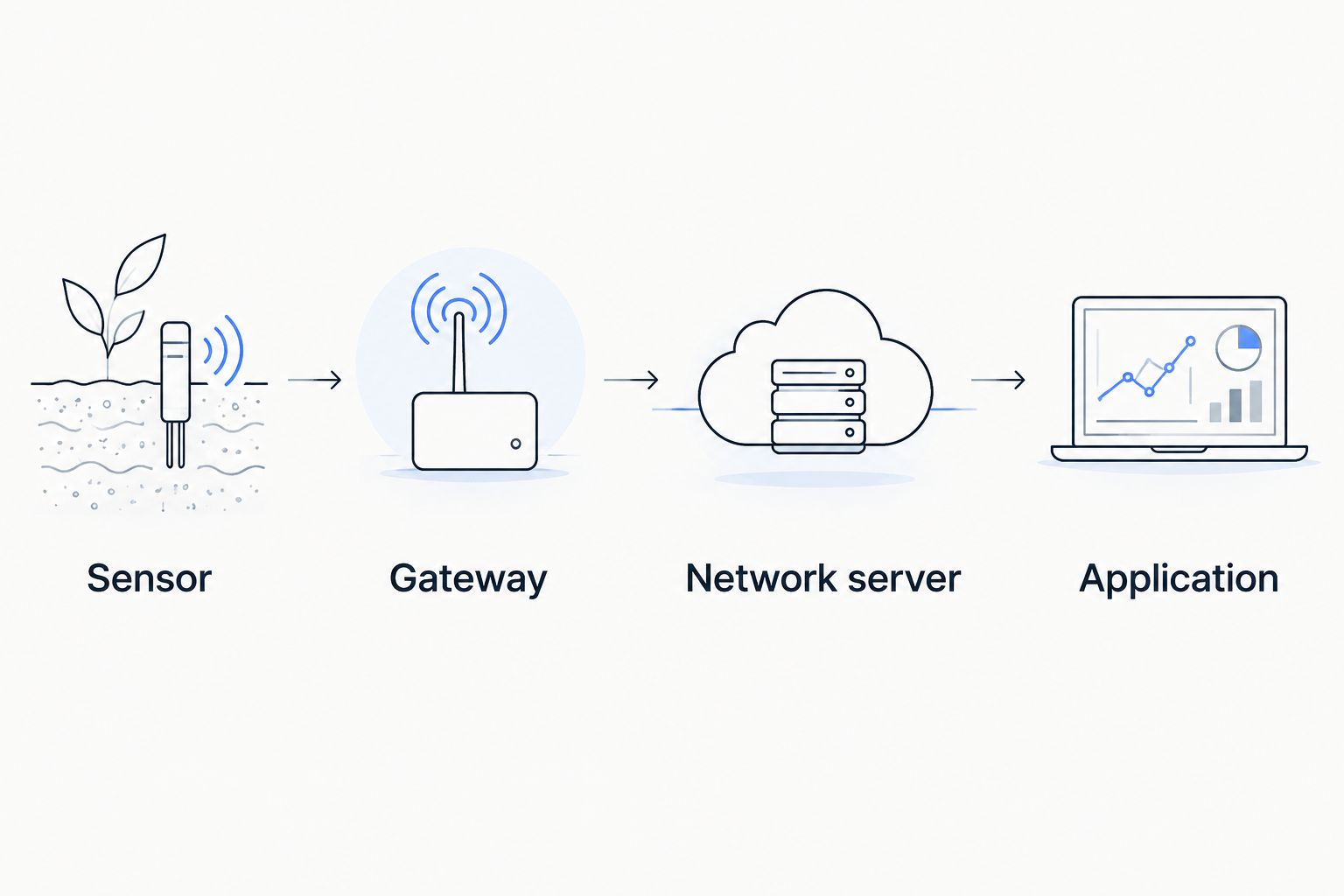
A LoRaWAN soil moisture sensor is one part of the system. The following components have separate jobs:
- Sensor: Measures soil conditions and sends LoRaWAN messages.
- Gateway: Receives radio messages and forwards them over an internet connection.
- Network server: Handles LoRaWAN network functions and routes device data.
- Application: Decodes measurements, stores history and presents charts or alerts.
Cellular backhaul connects a gateway to the internet. It does not turn a LoRaWAN soil sensor into an NB-IoT device. Regional sensor radio compatibility and the gateway's cellular compatibility are separate purchasing checks.
For a 2026 installation, assign responsibility for the network server, decoder and application before ordering. Kilo Electronics supplies electronics and IoT hardware; a hardware purchase does not establish that a complete agricultural application or integration service is included.
Installation choices that change the result
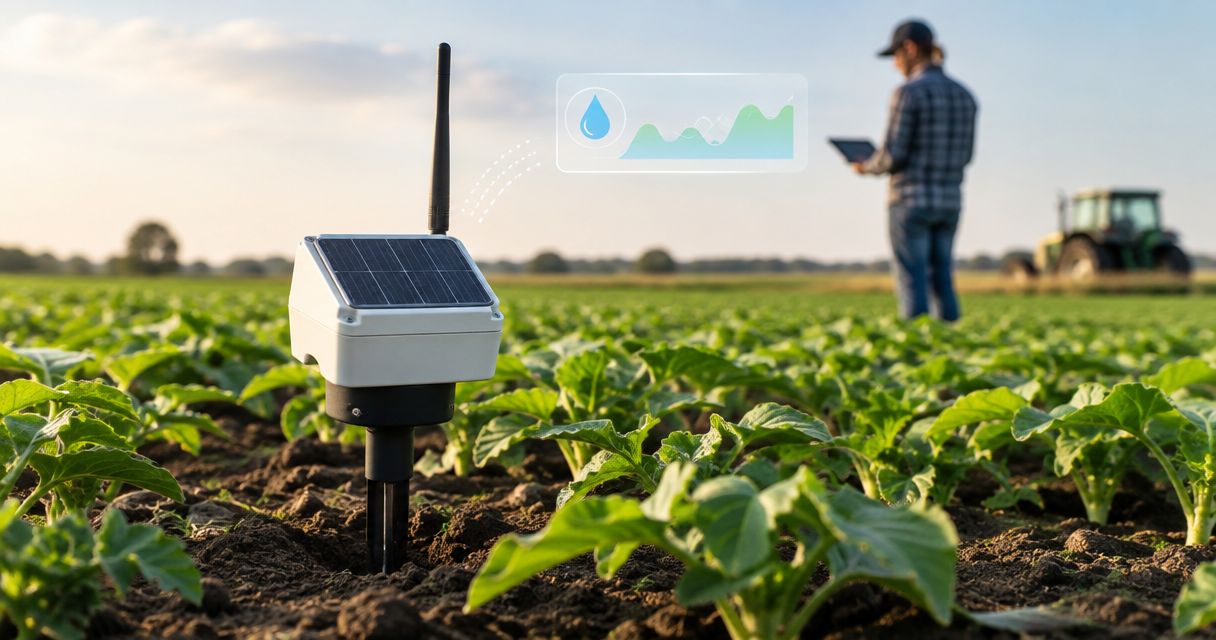
Place the probe where its readings represent the decision you want to make. Under drip irrigation, a location near an emitter follows a different wetting pattern from soil between emitters. Neither location represents the whole field by default.
Maintain good contact between the sensing surfaces and soil. Air gaps and disturbed soil can change the measurement environment, so follow the selected probe's installation instructions. Protect cables and above-ground equipment from cultivation, animals and maintenance work.
Separate radio placement from measurement placement. The probe belongs at the intended soil depth; the radio enclosure and antenna need an installation that supports communication. Do not bury equipment merely because its probe is designed for soil contact.
Before expanding, confirm that irrigation events appear in decoded data and that the monitoring location answers a useful question. Additional sensors should represent meaningful differences in soil, crop or irrigation zone, not simply repeat an arbitrary spacing rule.
Compare the complete installation, not just the sensor
A useful purchasing comparison includes the probe, radio device, required accessories, gateway, gateway power, internet connection and application arrangements. Installation labour and later maintenance belong in the same decision.
Ask for an itemised specification covering:
- Exact sensor model, regional variant and included probe.
- Mounting hardware, cable protection and power requirements.
- Gateway, backhaul and network-server responsibilities.
- Payload decoder and application configuration.
- Battery replacement or other documented maintenance tasks.
Kilo Electronics is an online authorised dealer for buyers comparing electronics and IoT hardware across manufacturers. Match any proposed equipment to the complete specification; the dealer's role and the sensor's technical suitability are separate questions.
How this shortlist is ranked
This 2026 shortlist compares the measurement scope described in Seeed Studio's SenseCAP S2104 and S2105 documentation, Milesight's EM500-SM documentation and Dragino's LSE01 documentation. The recommendations separate conductivity-aware monitoring, moisture with temperature, moisture-only monitoring and configurable reporting.
The order is not a field-tested accuracy ranking. No universal winner follows from a manufacturer's measurement list: soil conditions, installation and the intended decision still determine suitability.
Which soil moisture sensor should you choose?
Choose SenseCAP S2104 if you need moisture and temperature but have no conductivity requirement. Choose SenseCAP S2105 when conductivity belongs in the same dataset, Milesight EM500-SM for moisture alone, or Dragino LSE01 when configurable reporting is a priority.
Write down the required measurements, intended installation and application responsibilities before buying. That short specification gives you a stronger shortlist than a feature count.
FAQ
What's the best LoRaWAN soil moisture sensor for agriculture?
The best choice depends on the measurements you need. SenseCAP S2104 suits moisture and temperature, SenseCAP S2105 adds conductivity, Milesight EM500-SM focuses on moisture, and Dragino LSE01 suits configurable reporting projects.
Is SenseCAP S2105 better than SenseCAP S2104?
SenseCAP S2105 is the better fit when you need electrical conductivity alongside soil moisture and temperature. SenseCAP S2104 suits a project that does not need conductivity; the additional measurement does not establish better moisture accuracy.
Do LoRaWAN soil moisture sensors need a gateway?
LoRaWAN soil moisture sensors need compatible gateway coverage to deliver messages to a network. The gateway can belong to your own installation or an accessible network; you also need network-server and application arrangements.
Can one soil sensor tell me when to irrigate an entire field?
One soil sensor measures conditions at its sensing location, not across an entire field. Differences in soil, roots and irrigation patterns determine whether that location represents the area you want to manage.
Does electrical conductivity measure fertiliser nutrients?
Electrical conductivity does not directly measure individual fertiliser nutrients. It reflects electrical conduction associated with dissolved ions and needs interpretation alongside moisture, temperature and soil conditions.
Can a LoRaWAN soil sensor switch irrigation on automatically?
A LoRaWAN soil sensor does not constitute a complete automatic irrigation system. Automatic control also needs suitable decision logic, a controller or actuator, and safeguards for missing or misleading data.
Does cellular gateway connectivity make the soil sensor NB-IoT?
Cellular gateway connectivity does not make a LoRaWAN soil sensor an NB-IoT device. The sensor communicates with the gateway using LoRaWAN; cellular backhaul connects the gateway to the internet.
One last thing
A detailed soil moisture chart can still describe the wrong location. Before adding more hardware, ask whether the existing probe sits where roots and irrigation make its reading useful. For agricultural monitoring in 2026, representative placement is part of the specification, not an afterthought.