Choosing an antenna is the cheapest way to change what your LoRaWAN gateways for enterprise IoT deployments can reach in 2026. Best overall: the outdoor fibreglass omnidirectional antenna (3 to 8 dBi). Best for one-direction links and remote sites: the Yagi. Best for indoor gateways: the low-gain dipole (2 to 3 dBi).
- For lorawan antenna gain range, an outdoor fibreglass omni at 3 to 8 dBi is the safest default for a gateway.
- Every 6 dB of extra gain doubles free-space range, but real sites give far less than that.
- A Yagi (8 to 15 dBi) wins for one-direction links and loses everywhere else.
- Cable loss and EU868 ERP limits decide how much gain you can actually use.
Why antenna choice matters more than gateway choice
A LoRaWAN link has four parts: the sensor, the gateway, the network server and the application. Range is decided by the first two and the air between them. The gateway radio is usually fixed. The antenna is the part you can change for the price of a small accessory.
Kilo Electronics is an online authorised dealer, and its catalogue lists antennas alongside gateways, sensors and modules. That makes it practical to plan the whole radio path in one order. The ranking below sorts antenna types, not individual models, because gain, pattern and mounting style decide the result far more than brand.
One point trips up first-time buyers: higher gain does not mean more signal. An antenna cannot create power. It reshapes the same power into a tighter beam. You gain distance in the direction of the beam and lose it above and below.
What makes the best LoRaWAN antenna
Five criteria drive this ranking, and you can use them to audit any antenna you are considering:
- Gain in dBi. The headline number. It measures focus, not extra power.
- Radiation pattern. Omnidirectional covers 360 degrees; directional covers a cone. This decides whether gain helps or hurts at your site.
- Frequency match. The antenna must be tuned for your regional band, such as EU868 (863 to 870 MHz) in Europe, the UK and Switzerland. A 2.4 GHz or cellular-only antenna on a LoRa port performs badly.
- Mounting and protection. Outdoor use needs a weatherproof body and a mast or wall fixing. Indoor use does not.
- Installed cost. The antenna, the cable, the connectors, any lightning protection and the mast hardware together make the real price.
Best LoRaWAN antennas at a glance
| Rank | Antenna type | Typical gain | Best for | Key limitation |
|---|---|---|---|---|
| 1 | Outdoor fibreglass omni | 3 to 8 dBi | Rooftop or mast gateway covering all directions | Narrow vertical beam at higher gain |
| 2 | Yagi | 8 to 15 dBi | One remote site or a single long link | Must be aimed; useless off-axis |
| 3 | Panel or sector | 8 to 14 dBi | Covering one arc from a wall or mast edge | Needs the right mounting angle |
| 4 | Indoor dipole | 2 to 3 dBi | Indoor gateways in offices and warehouses | Short reach outdoors |
| 5 | Stubby or flexible device antenna | 0 to 2 dBi | Compact sensors and trackers | Lowest range of the five |
The gain figures are the ranges commonly published for 868 MHz antennas of each type. Check the datasheet of any specific model, since individual products vary.
1. Outdoor fibreglass omni: best LoRaWAN antenna for most gateways
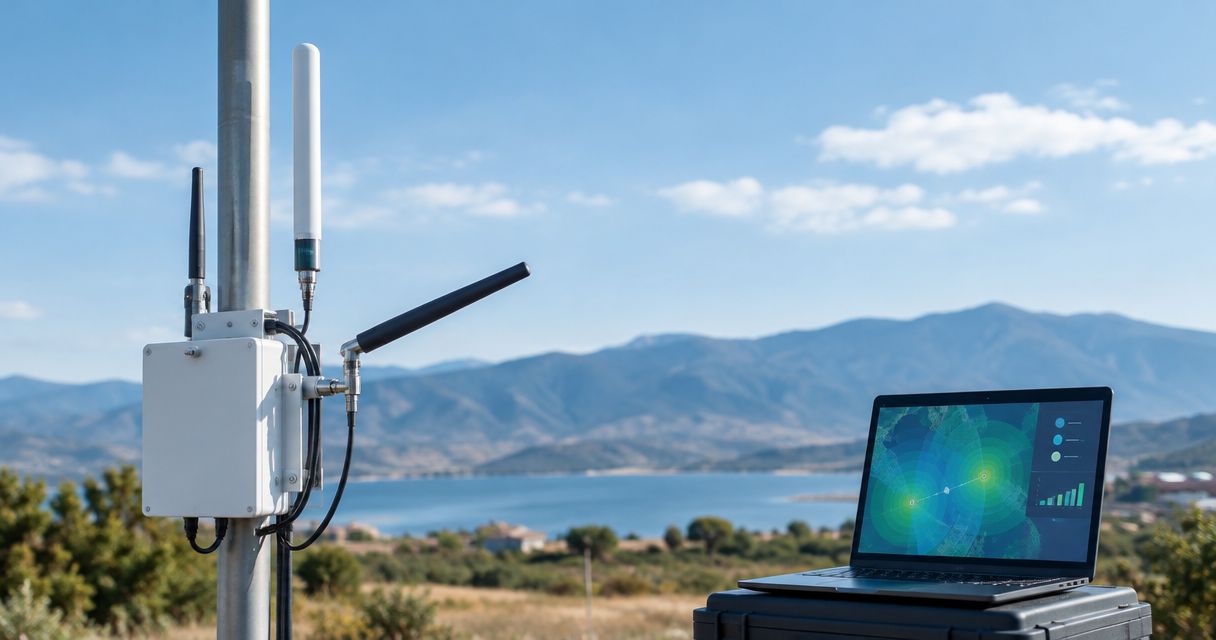
The fibreglass collinear omnidirectional is the default for a reason. It sits on a mast or roof bracket, radiates in a full circle and survives weather. Sold gains typically run from 3 to 8 dBi.
The trade-off is the vertical beam. A collinear antenna reaches higher gain by squeezing its pattern into a flatter disc. At 8 dBi, a sensor in a basement or on a high floor close to the mast can sit outside the strongest part of that disc. A mid-gain model of 3 to 5 dBi is more forgiving for dense urban sites with mixed heights.
Omni pros:
- Covers every direction without aiming
- Weatherproof construction is standard
- Works for most gateway placements
- Wide choice of gains and lengths
Omni cons:
- Higher gain narrows the vertical coverage
- Long 8 dBi models are physically tall and catch wind
- Needs a good cable run to the gateway
Best for: a gateway on a roof or mast that serves sensors on all sides. Verdict: Buy.
2. Yagi: best LoRaWAN antenna for long one-direction links
A Yagi concentrates power into a narrow beam, with typical gains from 8 to 15 dBi. When you know exactly where the sensors are, such as a pump house on a ridge, this is the antenna that reaches them.
The cost is flexibility. Point it a few tens of degrees off and the advantage drops away. Behind the antenna there is almost nothing. It also demands careful mounting, because a mast that sways in wind changes the aim.
Yagi pros:
- Highest gain of the five types
- Rejects interference from behind and the sides
- Good for a single remote sensor cluster
Yagi cons:
- Needs aiming and a rigid mount
- Serves almost nobody outside the beam
- Wasted on a gateway that covers a whole site
Best for: a fixed, known direction, or a gateway linked to one distant sensor group. Verdict: Buy for point-to-point links, Skip for general coverage.
3. Panel or sector antenna: best for covering one side of a site
Panel antennas sit between the omni and the Yagi. They cover a wide arc rather than a narrow cone, with gains commonly between 8 and 14 dBi. Mounted on the side of a building, a panel covers the field in front of it and ignores the building behind.
That suits a gateway on a wall or at the edge of a roof. An omni mounted flush against a wall wastes half its pattern on brickwork. A panel puts that energy where the sensors are.
Panel pros:
- Suits wall and facade mounting
- Wider coverage than a Yagi
- Higher gain than an omni at the same site
Panel cons:
- Only covers the arc it faces
- Two or three panels are needed for full coverage
- Mounting angle affects results
Best for: wall-mounted gateways and sites where sensors are all on one side. Verdict: Buy when the gateway sits against a wall; Hold otherwise.
4. Indoor dipole: best for gateways inside offices and warehouses
Indoors, extra gain rarely helps. Floors, ceilings and shelving scatter the signal, and an antenna that squeezes the beam flat can miss sensors on other levels. A 2 to 3 dBi dipole keeps a rounder pattern, which suits multi-floor buildings.
Most indoor gateways ship with a basic antenna of this kind. Upgrading usually means moving to a version with an extension cable so the antenna can sit higher on a wall, which matters more than the gain number.
Dipole pros:
- Rounder pattern covers several floors
- Small, cheap and easy to fit
- No aiming needed
Dipole cons:
- Short reach outdoors
- Placement near metal shelving hurts it badly
Best for: indoor LoRaWAN gateways. Verdict: Buy as a baseline; Hold on upgrades until you have tried repositioning.
5. Stubby and flexible device antennas: best on the sensor itself
Sensors and trackers are small, so their antennas are small. Stubby or flexible models of 0 to 2 dBi are the norm, and they trade range for size and robustness. You rarely choose these. They come with the device.
The point for buyers is where range is lost. A sensor with a weak antenna talks to the gateway at the limit of what the link allows, so the gateway antenna must compensate. This is the main reason a tall, well-placed gateway antenna beats a high-gain one placed badly.
Stubby pros:
- Compact and durable
- No extra hardware on the device
Stubby cons:
- Lowest gain and shortest reach
- Performance shifts with the sensor's mounting surface
Best for: compact sensors that cannot carry an external antenna. Verdict: Skip as an upgrade target; improve the gateway side instead.
How we ranked
The ranking weighs the five criteria above against how often each antenna type fits a typical deployment. Omni antennas rank first because they work for the widest set of sites. Directional types rank lower because they serve fewer. No range figures here come from field tests; they follow standard radio relationships and published antenna ranges.
How gain turns into range
The rule that matters: in free space, every 6 dB of added gain doubles the distance. Three dB doubles the power. A move from a 3 dBi omni to a 9 dBi directional antenna is 6 dB, so in an open field the reach roughly doubles.
Real sites give less. Trees, buildings and terrain absorb signal, and obstructions change the maths. Treat the 6 dB rule as an upper bound, not a promise. Gateway height and clear line of sight typically add more range than any gain upgrade.
Also note that gain applies at both ends of the link. A high-gain gateway antenna improves reception from sensors, but the sensor's own transmission still leaves through its 0 to 2 dBi antenna. That asymmetry is why uplink range can exceed downlink range on busy sites.
EU868 limits: how much gain you can use
In Europe, the UK and Switzerland, EU868 limits are set as effective radiated power (ERP), not conducted power. The formula: ERP equals radio output power plus antenna gain in dBi, minus 2.15 dB, minus cable and connector losses.
The default 868 MHz channels carry a 14 dBm ERP limit, which is 25 mW. If your gateway radio already outputs near that level, adding a 8 dBi antenna can push you over it unless the cable loss absorbs the difference. Some sub-bands allow higher power, and rules vary by country and by band. Confirm the limits for your destination country before fitting a high-gain antenna on a transmitting gateway.
Devices that only listen are less constrained, which is part of why gateway reception gains are easier to take than transmit gains.
Cable loss and mounting: where range quietly disappears
A good antenna on a poor cable wastes the money. Thin coaxial cable such as RG58 loses more than 0.5 dB per metre at 868 MHz, so a 10 metre run can swallow 5 dB or more, which erases the benefit of a mid-gain antenna. Thicker low-loss cable in the LMR-400 class loses around 0.2 dB per metre and is the usual choice for long runs.
Two practical rules follow:
- Put the antenna as high as you can and keep the cable short. Moving the gateway close to the antenna and using PoE for power often beats a long coaxial run.
- Every connector and adaptor adds loss. Keep the chain short: gateway, one jumper, antenna.
Mounting also matters for lightning protection. An outdoor mast antenna needs earthing and a surge protector on the cable. This is part of installed cost, not an optional extra.
Total installed cost: what to budget for
Compare complete setups, not antenna prices. A typical outdoor installation includes:
- the antenna itself
- a low-loss cable of the right length
- connectors that match the gateway port
- mounting hardware for a mast or wall
- surge protection and earthing
A hypothetical example: a gateway on a warehouse roof with a 5 dBi omni and a short low-loss cable will often outperform the same gateway with an 8 dBi omni on a long thin cable. The cheaper-looking antenna wins once cable loss is counted.
If your plans centre on larger sites, compare gateway options as well. Check the connector on your gateway first. Many gateways use N-type or SMA, and an adaptor adds loss.
Which LoRaWAN antenna should you choose?
If you are unsure, start with the omni. A 3 to 5 dBi outdoor fibreglass omni on a mast, with a short low-loss cable, is the safest buy for 2026 and 2027 projects. Move up to 6 to 8 dBi only if your sensors sit at roughly the same height as the antenna on flat ground.
Choose a Yagi when the destination is a single known point. Choose a panel when the gateway is against a wall. Stay with the supplied dipole indoors, and fix placement before you spend on gain.
A final point on buying: if you cannot find a model that matches your band, connector and mounting needs, it is better to say so than to compromise. Look through the antennas listed at Kilo Electronics and match them to your gateway before ordering, and confirm destination-specific radio rules for your country.
FAQ
What is the best LoRaWAN antenna gain for a gateway?
For most gateways, 3 to 5 dBi on an outdoor omni is the best balance. Higher gain narrows the vertical beam and can leave nearby or elevated sensors with weaker signal.
Does a higher gain antenna always increase LoRaWAN range?
No. Gain focuses the same power into a tighter beam, so range grows in one direction and shrinks in others. In free space, 6 dB more gain doubles distance, but obstacles reduce the effect.
Is a Yagi better than an omni antenna for LoRaWAN?
A Yagi is better only for a single known direction. It reaches further along its beam but serves almost nothing outside it. An omni is better for general site coverage.
Which frequency should a LoRaWAN antenna support in Europe?
Europe, the UK and Switzerland use EU868, which spans 863 to 870 MHz. Pick an antenna tuned for that band rather than a general cellular or 2.4 GHz model.
How much does cable length affect LoRaWAN range?
A lot. Thin cable like RG58 loses more than 0.5 dB per metre at 868 MHz, so a 10 metre run can cost 5 dB or more. Low-loss cable and a short run protect your gain.
Can I fit a high-gain antenna on any LoRaWAN gateway?
Not always. EU868 limits are set as ERP, so antenna gain adds to transmit power. Check the gateway's output setting and the limit for your country before fitting a high-gain antenna.
Do LoRaWAN sensors need a better antenna or does the gateway?
Usually the gateway. Sensors carry small antennas of 0 to 2 dBi and cannot take much more. Raising the gateway antenna and shortening its cable gives the biggest improvement.
One last thing
Before buying any high-gain antenna, try raising the one you have. Height changes the link more than most gain upgrades, and it costs only a mast section. If you do buy, record the gateway's RSSI and SNR from your network server before and after the change, so you know what the upgrade really delivered at your site.